
Last Updated: November 9, 2026
Quick Summary
A custom wine cellar is a purpose-built storage and display space engineered around bottle volume, bottle format, and how often each bottle gets pulled. Start by counting current bottles plus three years of expected growth, then settle layout, climate control, and finishes in that order.
- Plan a walkway wide enough to pull a bottle and step back without turning sideways.
- Zone by drinking status, not region, with everyday bottles near the entrance.
- Label-forward metal racking holds more bottles per linear foot than traditional bin storage.
- Warm-white lighting in the 2700K-3000K range flatters labels and metal finishes.
- Build the insulation and vapor barrier envelope first, then size the cooling unit to the room's heat load.
Table of Contents
- Custom Wine Cellar Design Ideas That Start With the Collection
- Wine Room Layout Planning: Circulation, Zones, and Sight Lines
- Modern Wine Storage Solutions: Label-Forward Racking and Lighting
- Modular Wine Rack Systems: Scaling From 270 to 360 Bottles
- Climate Control, Insulation, and Vapor Barriers in a Custom Wine Cellar
- Wine Cellar Design Ideas for Awkward Spaces and Under-Stair Corners
- Energy Efficiency, Resale Value, and Budget Tiers for a Custom Wine Cellar
- Plan Your Custom Wine Cellar Layout With Winerack Solutions
- Frequently Asked Questions
Custom Wine Cellar Design Ideas That Start With the Collection
The best custom wine cellar design ideas begin with a bottle count, not a mood board. A custom wine cellar is a purpose-built storage and display space engineered around three variables: bottle volume, bottle format, and how often each bottle gets pulled.
Below are seven design ideas that hold up in practice, from layout planning to climate control, plus the budget and resale questions most guides skip.
Count bottles and bottle types before anything else
Start with a hard number: current bottles plus three years of expected growth. Separate standard bottles from magnums, which need deeper, taller racking.
Decide between a closed cellar and an open display wall
A closed cellar prioritizes preservation: controlled temperature, light, and humidity. An open display wall prioritizes architectural presence and daily access. Many homes run both, with a conditioned cellar for aging and a label-forward wall for bottles in rotation. The choice changes insulation, cooling load, and lighting, so settle it early.
Wine Room Layout Planning: Circulation, Zones, and Sight Lines
Wine room layout planning comes down to three things: how people move through the room, where each category of bottle lives, and what the eye lands on when the door opens. Get circulation wrong and every future decision gets harder.
Plan a walkway wide enough to pull a bottle and step back without turning sideways. Zone by drinking status, not region: everyday bottles near the entrance, aging bottles deeper in, magnums on dedicated deeper racking.
If you are working through this stage for the first time, our guide on how to plan wine cellar layout walks through the full step-by-step process before you commit to a design.
Modern Wine Storage Solutions: Label-Forward Racking and Lighting
Modern wine storage solutions have shifted decisively toward label-forward display, and the reason is practical rather than cosmetic: a bottle you can read is a bottle you actually open. Neck-forward storage hides the label, turning a collection into inventory you have to pull bottles out to identify. Label-forward metal racking turns the same bottles into architecture and changes how the room is planned, lit, and used.
Why label-forward changes the layout math
When labels face out, the wall becomes the primary viewing surface, so racking density and sight lines must be designed together. High-density metal systems hold more bottles per linear foot than traditional bin storage because bottles sit in cradles rather than deep shelves, freeing floor area. Plan the wall as a single composition, since a continuous floor-to-ceiling run reads as a deliberate feature.
Lighting that makes labels legible without cooking the wine
Lighting does the heavy lifting in a label-forward room, and the goal is legibility at distance without adding heat or UV load at the bottle. Three principles hold up in practice:
- Grazing angle over direct wash. A source close to the wall and angled down grazes bottle faces, creating depth and readable labels from across the room. A direct wash flattens the wall and glares on glass.
- Warm color temperature. Warm-white output in the 2700K-3000K range flatters labels and metal finishes; cooler temperatures read clinical.
- Low UV and low heat output. LED produces far less UV and radiant heat than incandescent, which matters because light degrades wine. Keep light on the wall face, not aimed into the bottle, and use dimming or occupancy control.
Watch out: treating lighting as a finish-stage decision is the most common planning error in label-forward rooms. If the circuit, dimming, and fixture positions are not set before the racking goes up, retrofitting means removing rack elements and patching the wall.
Finish and material choices that hold up in person
Finish selection is where photographs and reality can diverge. Matte black and bronze are popular because they recede visually and let labels carry the color, but coating quality matters as much as color.
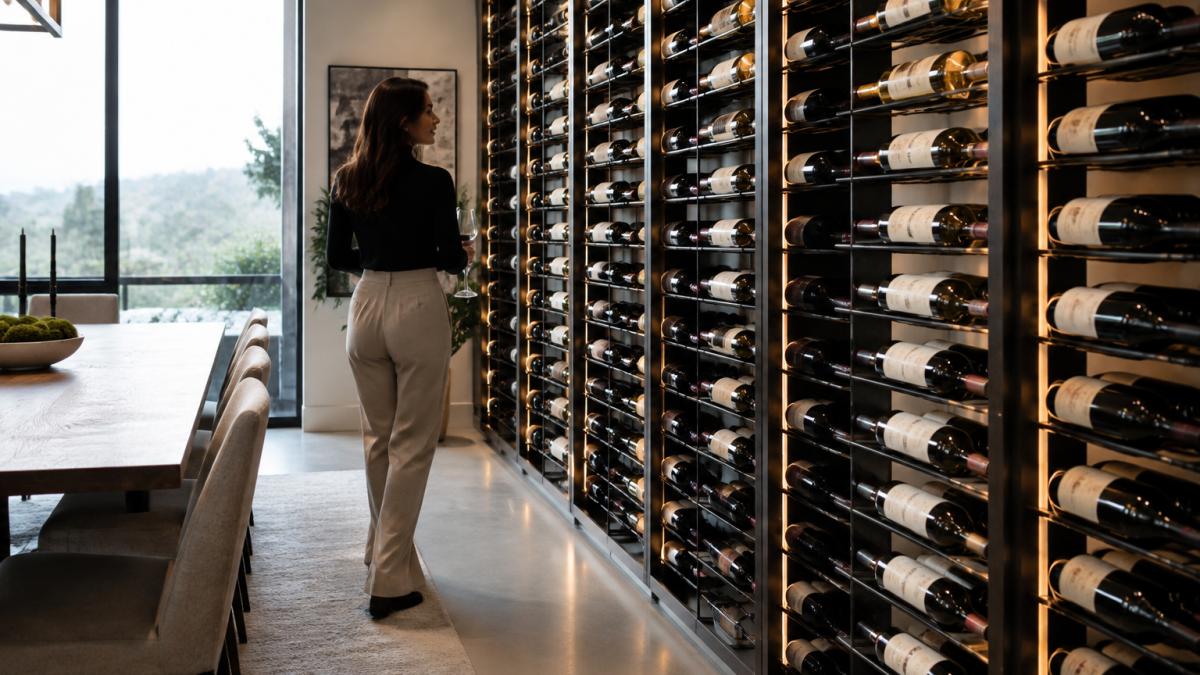 Collector admiring a floor-to-ceiling matte black wine wall with label-forward racking and warm accent lighting.
Pair matte black with a pale wall and the racking reads as a design feature rather than furniture.
Where label-forward display fits and where it does not
Label-forward walls are strongest in dining areas, kitchens, wine rooms, restaurants, and hospitality spaces where the collection is meant to be seen and accessed. They are weaker as long-term aging storage, because light and daily temperature variation are hard on bottles meant to sit for years.
Our matte black modular wine wall is built for exactly this treatment: high-density, label-forward, and finished to look as premium in person as it does in photographs.
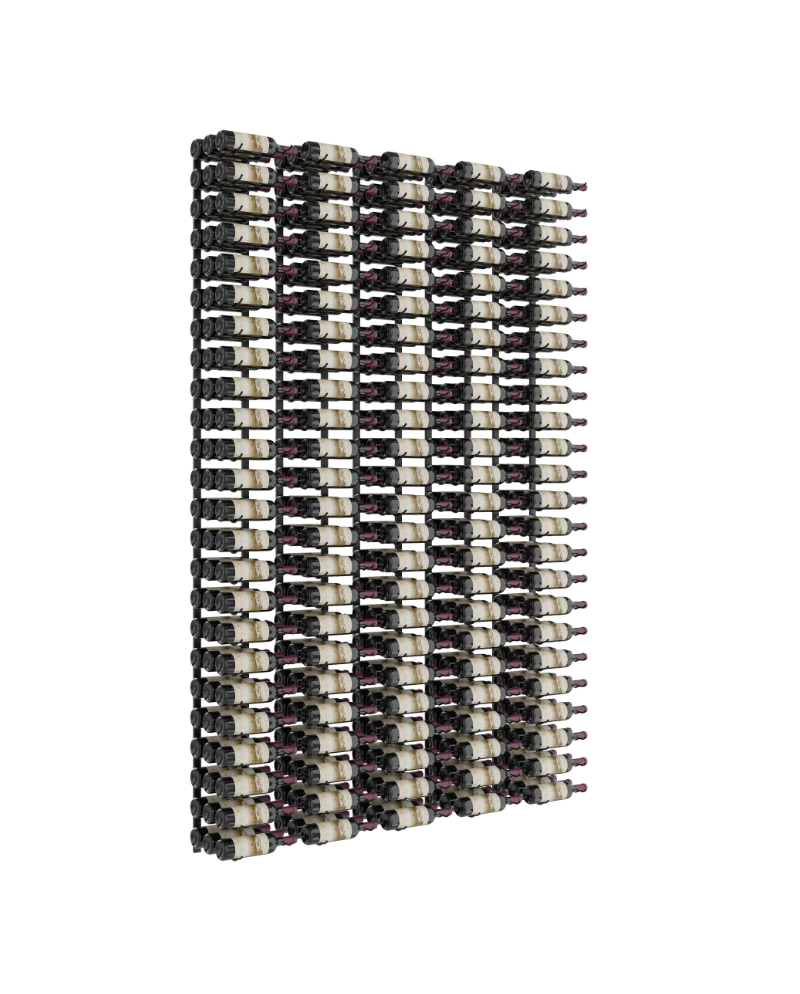 Matte Black Modular Wine Wall - WS7
Modular Wine Rack Systems: Scaling From 270 to 360 Bottles
Modular wine rack systems solve the problem that kills fixed racking: collections grow. A modular system is a set of compatible rack elements that can be added to, reconfigured, or extended along a wall as the collection changes, instead of being replaced wholesale.
The capacity math matters before you buy. A 270-bottle configuration suits a collector building a first dedicated wall. A 315-bottle setup covers a mid-size collection. A 360-bottle wall suits serious collectors and commercial venues.
| Configuration | Bottle Capacity | Best For | Growth Path |
|---|---|---|---|
| 270-bottle wall | 270 standard bottles | Collectors building a first dedicated wall | Add rack elements along the same run |
| 315-bottle wall | 315 standard bottles | Mid-size collections with mixed formats | Extend vertically or into an adjacent wall |
| 360-bottle wall | 360 standard bottles | Serious collectors and hospitality venues | Combine with a conditioned cellar for aging stock |
| Deluxe display kit | 288 standard plus 32 magnum | Collections with oversized formats | Add magnum racking as allocations grow |
A modular system is built to be extended as the collection grows.
Bottle capacity of modular wine rack configurations
Climate Control, Insulation, and Vapor Barriers in a Custom Wine Cellar
Climate control is where custom wine cellars succeed or fail, and it is the part most homeowners underestimate.
Three components work together:
- Thermal insulation: keeps exterior heat from loading the cooling unit beyond its capacity.
- Vapor barrier: stops moisture migrating through the building envelope, which is what causes mold, label damage, and condensation on bottles.
- Wine cellar ventilation: gives the cooling unit somewhere to exhaust heat, especially in enclosed interior rooms.
Skip any one and the cooling unit runs constantly, energy costs climb, and temperature swings shorten the drinking window of everything you own. Build the envelope first, then size the cooling unit to the room's actual heat load.
Installing a cooling unit into an uninsulated or unsealed room is a costly mistake in cellar construction.
Wine Cellar Design Ideas for Awkward Spaces and Under-Stair Corners
Awkward spaces are the most underused storage in most homes. The triangular void under a staircase, a narrow return wall beside a kitchen, a slice of basement with a sloped ceiling: all of these can hold a serious collection with the right modular approach.
For a deeper look at fitting storage into odd dimensions, read our guide to modular wine storage for awkward spaces. If your project is specifically an under-stair corner, our dedicated walkthrough on building an under stair wine rack covers the geometry and planning in detail.
Energy Efficiency, Resale Value, and Budget Tiers for a Custom Wine Cellar
Three questions decide most projects: what it costs, what it returns, and how much energy it burns. This section treats each as a planning input rather than an afterthought.
Budget tiers: what actually changes between them
Choose the tier by how the collection will be used, not by how it will photograph. A collector who drinks from the collection weekly gets more value from a display wall plus a small conditioned cabinet than from a full room that sits unopened.
Energy efficiency: where the savings actually come from
Energy performance in a wine cellar is an envelope problem before it is an equipment problem. A well-insulated, sealed room with a correctly sized cooling unit generally runs more efficiently than a poorly sealed one.
- Insulation continuity. Gaps and thermal bridges around doors, penetrations, and ceiling junctions force the cooling unit to run longer. Continuous insulation with sealed joints lets a smaller unit do the job.
- Air sealing and vapor barrier. Moisture migrating through the envelope causes mold, label damage, and condensation. A continuous vapor barrier on the warm side keeps the room dry and reduces the cooling load.
- Correctly sized cooling unit. An oversized unit short-cycles, producing temperature swings and humidity spikes; an undersized unit runs continuously and fails early. Size to the room's actual heat load after the envelope is built.
Resale value: how appraisers and buyers actually see a cellar
A well-executed wine room functions as a genuine architectural feature in high-end homes, particularly where buyers already collect. The appraisal logic is not a line-item return on the racking; a finished, purpose-built room reads as considered design rather than a converted closet, and adds usable square footage with a clear function. Two factors move the needle most: whether the room is properly conditioned and sealed (a cellar that runs warm or damp is a liability), and whether the layout is flexible enough for a future owner's collection size.
Wine collection management: designing for how you drink
Collection management belongs in the budget conversation because it determines which tier you need. Zone by drinking status rather than region: bottles in rotation near the entrance and at eye level, aging stock deeper in and in lower light, oversized formats on dedicated deeper racking. If you track inventory in software or a spreadsheet, plan a small surface or slot for a tablet or printed inventory near the entrance so the system stays current.
Plan Your Custom Wine Cellar Layout With Winerack Solutions
The difference between a cellar that works and one that disappoints usually comes down to planning order: count first, layout second, climate third, finishes last.
At Winerack Solutions, we supply premium modular wine racking from VintageView, built to scale from a compact wall display to a full wine room.
If you are ready to move from ideas to a plan, our custom wine cellar design guide takes you through the full process.
Frequently Asked Questions
How much does a custom wine cellar cost?
Cost depends on three things: how many bottles you store, whether the space is climate-controlled, and the racking you choose. Racking is the most predictable line item. A 270-bottle matte black modular wine wall kit is 1585, a 315-bottle kit is 1760, and a 360-bottle kit is 1930. A 15-piece display kit holding 288 standard bottles plus 32 magnums is 2420.
How do I choose the right wine storage system for my home?
Start with a bottle count and allow room for growth. Measure the wall height and width available, since kit heights run from 184 cm to 244 cm. If your space is irregular, choose modular wine rack systems that combine individual racks rather than a single fixed unit. Label-forward display suits collectors who want the collection visible; a closed cellar suits those prioritizing capacity and quiet.
Do wine cellars add value to your home?
A well-built wine cellar can be a strong selling point for buyers who collect wine, particularly in high-value homes where a dedicated storage room reads as a finished amenity rather than a converted closet. The value comes from the room being complete: insulated, cooled, lit, and fitted with racking that suits the space. A half-finished cellar or a display wall with no climate control is less persuasive to a buyer.
What are the essential components of a modern wine cellar?
Four components do most of the work: thermal insulation with a vapor barrier, a dedicated wine cooling unit sized to the room, lighting that does not add heat, and racking that fits the bottle count and the wall. Ventilation and a sealed wine cellar door complete the envelope. Racking gets the most attention because it is visible, but the insulation and cooling decide whether the collection ages properly.
