
Table of Contents
- Custom Wine Cellar Design for Homes: Where to Start
- Wine Cellar Layout Ideas for Every Home
- Wine Cellar Size Guide: Capacity, Depth and Clearance
- Wine Cellar Temperature and Humidity: What Your Collection Needs
- Racking Systems, Materials and Finishes That Hold Up
- Wine Cellar Lighting Ideas That Protect the Wine
- Making the Cellar a Focal Point, Not Just Storage
- Conclusion: Designing a Cellar That Grows With You
- Frequently Asked Questions
Last Updated: October 7, 2026
Custom Wine Cellar Design for Homes: Where to Start
Custom wine cellar design for homes starts with one decision: how you actually live with your collection. A cellar built around a fantasy of entertaining every weekend will frustrate you if your real routine is a quiet glass on Tuesday. This guide covers layout, capacity, climate, racking and lighting.
Match the Cellar to How You Actually Live
The biggest mistake in wine cellar design is planning for an imaginary lifestyle. Ask four questions first:
- How often do you open a bottle? A nightly drinker needs fast access to a rotating 40-60 bottles. A collector who opens wine twice a month needs display and long-term storage more than convenience.
- Do you entertain at home? If yes, the cellar or wine wall should sit on the route between kitchen and dining room, not in a distant basement corner.
- Are you buying to drink or buying to hold? Drinking collections reward accessible racking. Long-term collections reward stable conditions and deeper storage.
Answer honestly and the rest gets easier. A wine room is a working space first, a showpiece second.
 Matte Black Modular Wine Wall - WS8
Wine Cellar Layout Ideas for Every Home
Wine cellar layout ideas fall into four categories: dedicated rooms, converted basements, under-stair and closet spaces, and open-plan wine walls. Each suits a different footprint, capacity target and level of climate control. Before you pick one, work through the planning sequence below.
The Planning Sequence
- Measure the usable wall length, not the room. Racking only goes where there is a wall, and doors, windows and services interrupt it. A 4m room with two doorways may only offer 2.4m of rackable wall.
- Check depth. Standard 750ml bottles need roughly 30cm of depth for label-forward display and about 10cm of width per bottle in single-depth racking. Magnums need dedicated wider slots, measure your tallest bottle first.
- Reserve circulation space. Aisle clearance should be at least 90cm where two people might pass, and 60cm minimum for a single-user cellar. A room packed wall-to-wall looks impressive in photos and is miserable to use.
- Calculate capacity, then add headroom. Divide usable wall length by rack width, multiply by rows, then add 20-30% above your current collection. Nearly every collector outgrows a rack within two years.
- Decide the climate strategy. A dedicated room or basement can be conditioned as a true cellar. An open-plan wine wall in a living space displays wine but does not age it, so long-term holdings need a separate conditioned space.
Basement Wine Cellar Conversions
A basement wine cellar conversion is usually the most cost-effective route to real capacity, because the space already exists and sits below ground where temperatures fluctuate less. The trade-off is moisture and access. Basements need a vapour barrier and insulation before any racking goes in, and the cooling system should be sized to the room's volume rather than its floor area.
Under-Stair and Closet Wine Rooms
Under-stair and closet wine rooms suit homes without a spare room. These spaces are rarely rectangular, which is why modular racking works better than fixed joinery. A stepped under-stair kit follows the slope of the staircase and keeps the display flush, so it never obstructs the walkway.
A shallow closet can hold a surprising number of bottles when you rack it floor to ceiling. The constraint is depth, not width.
Open-Plan Wine Walls
An open-plan wine wall works when the collection is for drinking and display rather than long-term aging. It sits between kitchen and dining room, becomes a genuine architectural feature, and needs no separate room. The trade-offs are sunlight exposure, temperature swings, and the fact that it will not hold cellar conditions. Plan the wall for the bottles you want seen, and keep anything you intend to age in a conditioned space.
| Space Type | Typical Capacity | Best For | Watch Out For |
|---|---|---|---|
| Under-stair nook | 30-60 bottles | Compact homes, feature displays | Sloped ceilings limit height |
| Closet conversion | 80-150 bottles | City apartments | Needs ventilation planning |
| Basement room | 300-1,000+ bottles | Serious collectors | Vapour barrier essential |
| Open-plan wine wall | 60-360 bottles | Kitchens, dining rooms | Direct sunlight exposure |
Wine Cellar Size Guide: Capacity, Depth and Clearance
A wine cellar size guide comes down to three numbers: bottles, depth and clearance. Standard 750ml bottles need roughly 30cm of depth for label-forward display and about 10cm of width per bottle in single-depth racking. Aisle clearance should be at least 90cm where two people might pass. Capacity is arithmetic: usable wall length divided by rack width, multiplied by rows, plus 20-30% headroom.
| Space Type | Typical Capacity | Best For | Watch Out For |
|---|---|---|---|
| Under-stair nook | 30-60 bottles | Compact homes, feature displays | Sloped ceilings limit height |
| Closet conversion | 80-150 bottles | City apartments | Needs ventilation planning |
| Basement room | 300-1,000+ bottles | Serious collectors | Vapour barrier essential |
| Open-plan wine wall | 60-360 bottles | Kitchens, dining rooms | Direct sunlight exposure |
Measure your tallest bottle before you finalise any layout. Magnums and unusual bottle shapes need dedicated rack widths, and discovering this after installation means rebuilding a section.
Wine Cellar Temperature and Humidity: What Your Collection Needs
Wine cellar temperature and humidity control is the difference between a display and a cellar. The accepted target range for long-term storage is 12-14°C with humidity between 50% and 70%. Stability matters more than the exact figure: a steady 14°C beats one swinging between 10°C and 20°C.
Achieving those numbers comes down to four decisions: insulation, vapour barrier, cooling-system type, and sizing.
Insulation and Vapour Barrier
A cellar is a thermal envelope, not a room with a fridge in it. Walls, ceiling and floor all need insulation, and the vapour barrier goes on the warm side of the insulation so moisture never reaches the cold surface where it would condense.
Spray foam and rigid board are the two common approaches. Rigid board is cheaper and easier to detail at corners; spray foam seals gaps and irregular framing better.
Cooling-System Types
There are three practical options for a residential cellar:
- Self-contained (through-wall) units, the compressor sits inside the cellar and exhausts into an adjacent space. Simplest to install, but they dump heat and noise into whatever room is on the other side, and they need a vent path.
- Split systems, the evaporator is inside the cellar and the condenser sits remotely (outdoors, garage, utility room). Quieter inside, more flexible for tight footprints, but require a refrigerant line run and a licensed installer.
- Ducted systems, best for larger rooms or where the condenser must be far from the cellar. Highest cost and complexity, but the most discreet.
A domestic air conditioner is not a substitute. It cools air but does not hold humidity, cycles too aggressively, and will fail early under continuous duty.
Sizing the Unit
Cooling capacity is sized to the room's volume, not its floor area, a tall narrow cellar holds more air than a wide shallow one with the same footprint. The load calculation also accounts for insulation R-value, glazing area, door type, and how often the door opens.
An open-plan wine wall in a temperature-controlled living space is a different proposition: it displays wine beautifully but does not age it, so keep long-term holdings in a properly conditioned room.
Matte Black Modular Wine Wall - WS8 →
Racking Systems, Materials and Finishes That Hold Up
Racking is where most projects are won or lost. Modular metal systems hold more bottles per square metre, arrive with predictable load ratings, and can be extended when the collection grows.
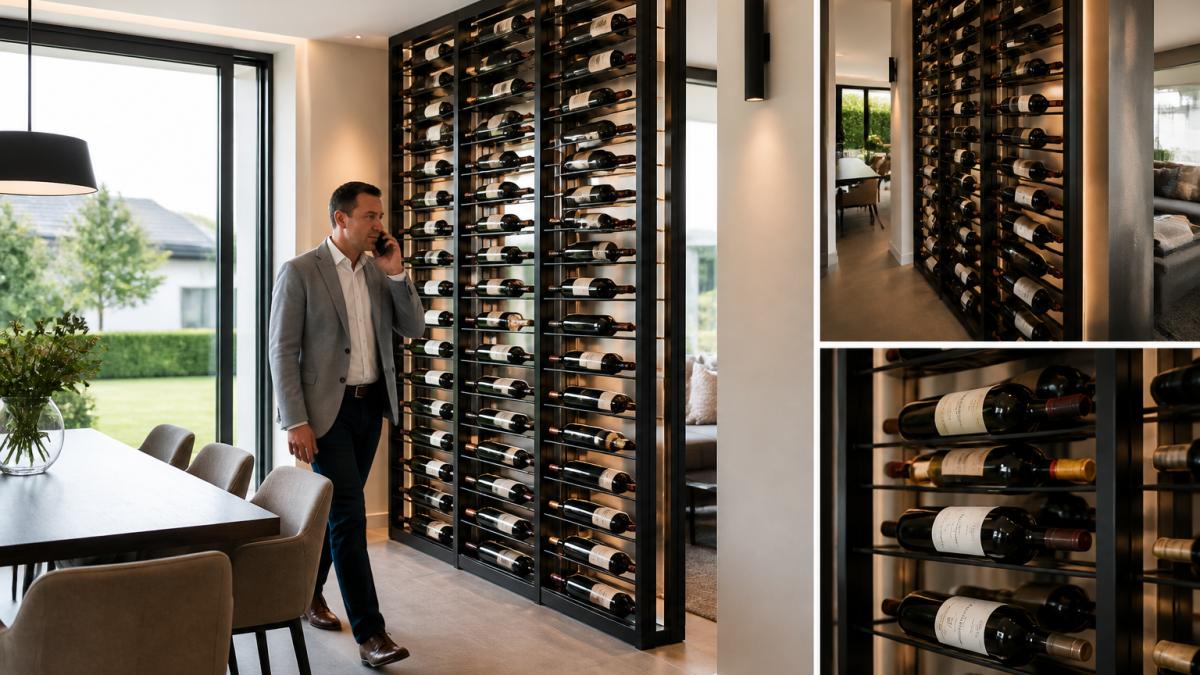 Matte black modular wine rack acting as a room divider in a modern home with label-forward bottle storage
Finish quality is the most common complaint in this category. Matte black and bronze finishes should be powder-coated rather than painted, because paint chips where bottles slide in and out.
Our own Matte Black Modular Wine Wall - WS8 holds 360 bottles in a 244cm-high configuration, and the Matte Black Modular Floor-to-Ceiling Wine Rack Kit creates a 63-bottle column that needs no wall mounting at all, which makes it useful as a room divider.
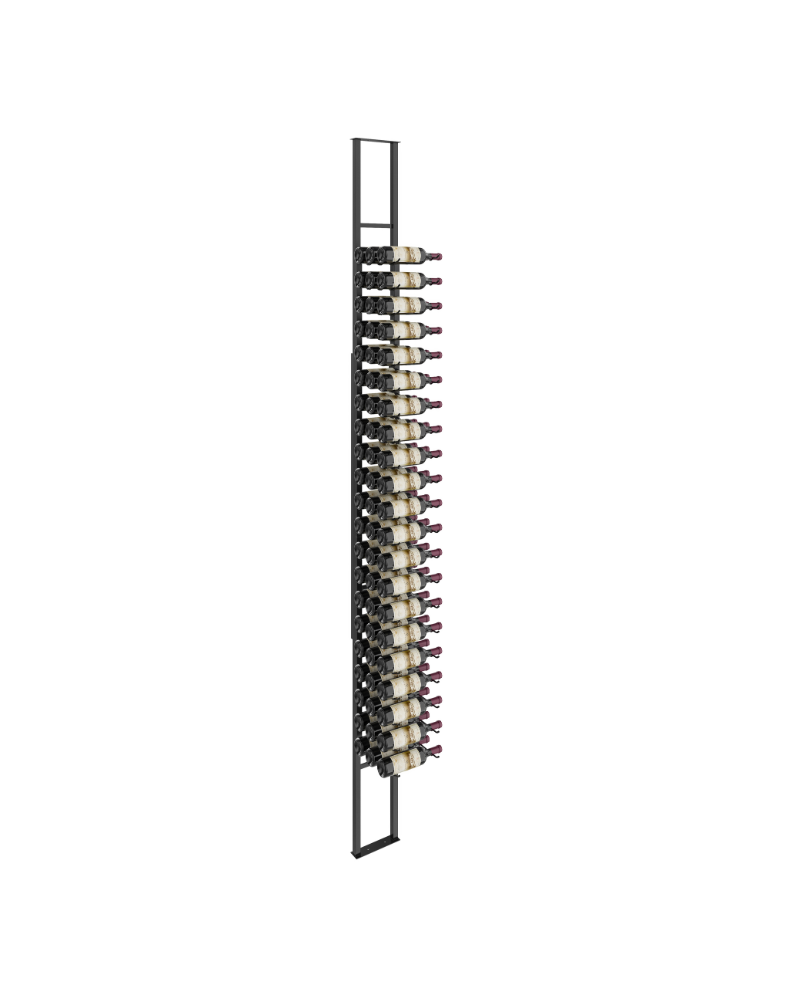 Matte Black Modular Floor-to-Ceiling Wine Rack Kit
Buy racking rated for more weight than you currently need, and buy a system you can extend. Capacity is the one specification almost every collector underestimates.
Wine Cellar Lighting Ideas That Protect the Wine
Wine cellar lighting ideas should serve two purposes: make the collection readable, and keep ultraviolet light away from it.
Label-forward display depends on light hitting the labels, so fixtures should wash across the bottles rather than shine down the aisle. Warm colour temperatures in the 2700-3000K range flatter both the wine and the room, and pair well with darker racking finishes.
Making the Cellar a Focal Point, Not Just Storage
A cellar becomes a focal point when the racking is treated as architecture rather than furniture. Floor-to-ceiling columns, glass panels that reveal the collection without exposing it to the room's air, and a consistent finish across racking, cabinetry and stone all push the space toward something you would show guests.
Form should never beat function, though. A cellar that looks spectacular but forces you to move three cases to reach your everyday bottles will annoy you daily. Plan the display section for the bottles you want seen, and dense storage for everything else.
Conclusion: Designing a Cellar That Grows With You
The hardest part of custom wine cellar design for homes is not the finishes or the cooling unit. It is predicting how your collection will change. Almost every collector needs more capacity within two years, and the projects that age well are built on modular racking that can be extended rather than replaced. VintageView builds premium modular wine storage systems designed to scale with your collection, from a compact 30-bottle under-stair display to a 360-bottle architectural wine wall, all in a consistent matte black finish.
Frequently Asked Questions
How much does it cost to build a home wine cellar?
Cost depends on three things: how much climate control you need, how many bottles you're storing, and how custom the finish is. A converted closet with a small cooling unit costs far less than a fully insulated basement room with stone walls and glass panels. Modular racking keeps costs predictable because you can start with one wall or a single floor-to-ceiling post and add matching racks later. Get quotes for insulation, cooling, and racking separately so you can see where the money actually goes.
What is the ideal size for a wine cellar?
There is no universal ideal, but a workable rule is to plan for your current collection plus roughly 30 percent growth. A 100-bottle collection needs far less footprint than 1,000 bottles, and label-forward display racks take more wall space than high-density storage. Measure your available wall height and depth first, then calculate capacity from those real numbers rather than guessing. A wine cellar size guide based on your own bottle count beats any generic square-metre recommendation.
What temperature and humidity should a home wine cellar maintain?
Most collectors aim for a steady 12 to 14 degrees Celsius with humidity between 55 and 75 percent. Stability matters more than hitting one exact number, because repeated swings stress corks and accelerate ageing. A proper vapour barrier and insulation keep a cooling unit from running constantly, which saves energy. Avoid placing the cellar next to boilers, ovens, or south-facing glass that pushes temperatures up during the day.
How can I make a wine cellar a focal point in my home?
Treat the racking as architecture rather than furniture. A floor-to-ceiling modular post can divide an open-plan room, and a matte black wine wall turns a blank dining room wall into a display. Backlighting or warm wall lighting behind the bottles creates depth without exposing wine to UV. Glass panels let a converted closet or under-stair nook stay visible from the living area, so the collection reads as part of the interior instead of hidden storage.
How do I choose a location for a wine cellar at home?
Look for a space with no direct sun, stable ground temperature, and enough depth for the racks you want. Basements and interior closets usually win because they stay cool year-round. Under-stair nooks work well for 30-bottle displays in a shallow, one-bottle-deep configuration. Avoid garages and rooms above kitchens, where heat rises and temperature swings are hardest to control. Measure ceiling height before committing, since floor-to-ceiling systems need clearance.
Does a wine cellar add value to a house?
A well-built cellar adds appeal for buyers who collect wine, and it can set a home apart in a competitive market. The value comes from the room reading as finished and functional, not from bottle count alone. Climate control, clean lighting, and racking that looks built-in all contribute. A cellar that is damp, poorly lit, or obviously improvised tends to read as a project rather than an asset, which is why planning the technical side first matters.
How can I plan wine storage for a growing collection?
Choose a modular racking system so you can extend it without replacing what you already own. Start with a kit sized for your current bottles plus spare capacity, then add matching racks along the same wall or a second floor-to-ceiling post as the collection grows. Keep the layout consistent in finish and spacing so additions look intentional. Planning the wall height and depth for future capacity now avoids a second renovation in two years.
What lighting works best in a home wine cellar?
LED lighting produces almost no heat and no UV, which makes it the safe choice for any wine storage area. Use warm, dimmable fixtures and aim light at the labels or the wall behind the bottles rather than directly at the wine. Motion sensors keep lights off when nobody is in the room. If you want a glass-front cellar to glow at night, low-output LED strips behind the racking give that effect without raising the room temperature.