
Table of Contents
- Why Wine Storage Under Stairs Works
- Measuring Your Staircase Space and Angles
- Modern Wine Cellar Design Ideas for Under-Stair Spaces
- Best Practices for Residential Wine Storage Installation
- Modular Wine Rack Installation Tips for Angled Spaces
- Under Stair Wine Cellar Climate Control Essentials
- Lighting and Display Finishing Touches
- Frequently Asked Questions
Last Updated: September 22, 2026
Why Wine Storage Under Stairs Works
The space under your staircase is one of the most underutilized areas in a home. It's awkward, angled, and easy to ignore. But it's also perfect for wine storage.
This area offers several real advantages. The temperature tends to stay stable because it's enclosed and insulated by the surrounding structure. The space is naturally dark, which protects wine from light damage. And unlike a dedicated wine room, you don't need to build anything new, the architecture is already there.
Modern wine storage under stairs transforms wasted square footage into a sophisticated display. Instead of hiding bottles in a closet, you create a focal point that showcases your collection. This approach works whether you're storing 30 bottles or 100.
Our modular systems are designed specifically for these challenging spaces. The sloped angles and confined dimensions that make under-stair areas difficult also make them distinctive. When done right, wine storage under stairs becomes a design statement.
 Matte Black Modular Wine Display Under The Stairs 1-deep
Measuring Your Staircase Space and Angles
Before you design anything, you need accurate measurements. Guessing here leads to systems that don't fit, bottles that don't align, and wasted money.
Start with the basics. Measure the width of the staircase opening at the top and bottom, these are rarely the same. Measure the height from floor to the lowest point of the stairs. Take the depth from the front edge of the stairs to the back wall. Write everything down.
The tricky part is the slope. Stairs create an angled ceiling that gets lower as you move back. This angle determines how your wine storage will be positioned.
Using the Pythagorean Theorem for Sloped Spaces
The slope of your stairs follows a predictable geometry. Understanding it helps you calculate exactly how much space you have at different depths.
To find the angle, you need two measurements: the vertical rise and the horizontal run. The rise is how much the stairs climb. The run is how far they extend forward.
Use the Pythagorean theorem to find the slope length: rise² + run² = slope². This tells you the actual distance along the stair edge.
Once you have this number, you can determine how deep your wine storage can be at any height. A 45-degree angle (equal rise and run) gives you the most usable space. Steeper stairs (more rise than run) create a tighter fit.
Many wine storage designs use stepped layouts that follow the stair angle. Each shelf sits slightly higher and further back than the one below it. This mirrors the slope naturally and maximizes bottle visibility.
Accounting for Walkway Clearance
Don't fill every inch of under-stair space. You need clearance for people to walk past safely.
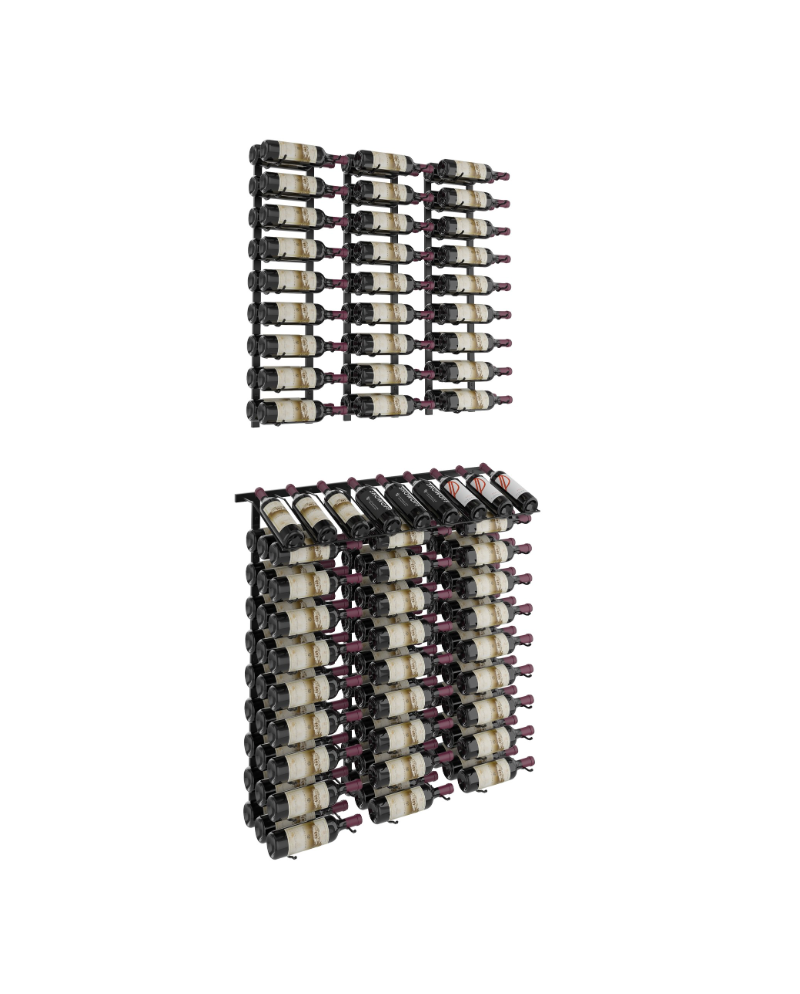 Matte Black Modular Wine Rack Display Kit (7-Piece Set)
Building codes typically require at least 6 feet 8 inches of headroom along a walkway. If your stairs are in a main traffic area, you'll want even more, 7 feet is more comfortable.
Measure the headroom at the front edge of the staircase. This is your maximum height limit for wine storage. Anything taller blocks sightlines and creates a cramped feeling.
Leave at least 12 inches of clear floor space in front of the display. This lets people walk without bumping into bottles or the system itself. If the stairs are near a doorway, factor in swing clearance for the door.
The goal is wine storage that enhances your space, not dominates it. Proper clearance keeps the area feeling open and functional.
Modern Wine Cellar Design Ideas for Under-Stair Spaces
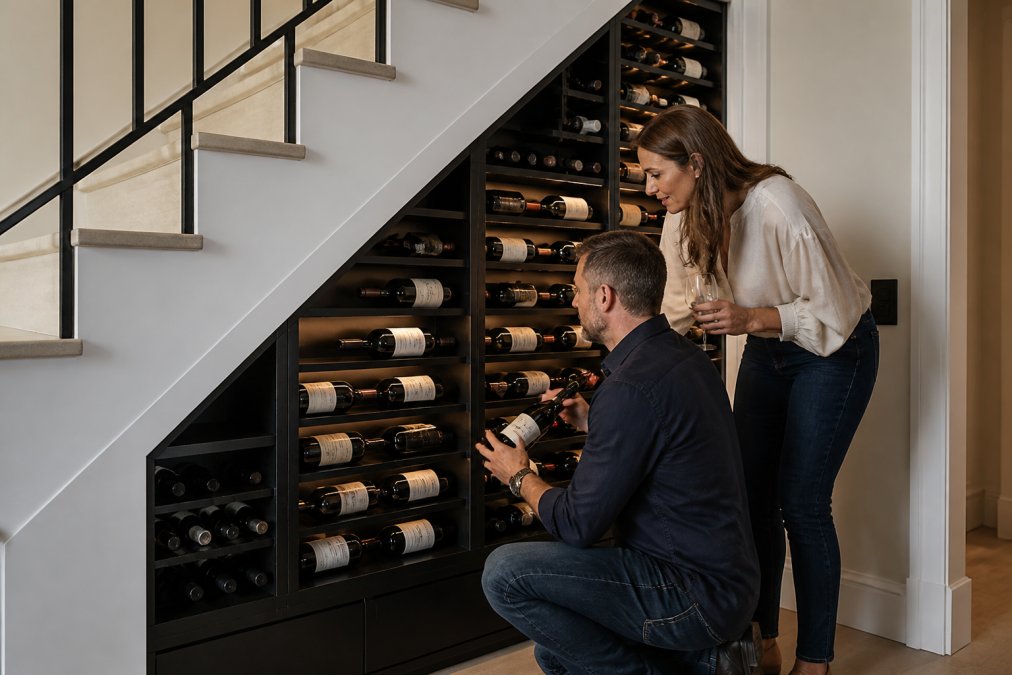 Premium matte black modular wine display installed under a residential staircase, bottles arranged in stepped pattern following stair slope, clean lines and modern interior design aesthetic in contemporary home
Under-stair wine cellar design comes down to how you arrange bottles and materials. The best designs balance capacity with visual appeal.
Stepped Display Layouts
A stepped layout follows the natural angle of your stairs. Each row of bottles sits slightly higher than the one below, creating a cascading effect.
This approach has real advantages:
- Bottles are visible from multiple angles
- The design feels intentional, not cramped
- It's easy to add or remove bottles without rearranging everything
- The stepped pattern complements modern interior design
Stepped layouts work best with modular systems. You start with a base unit at floor level, then stack compatible units above it. Each unit is independent, so you can adjust the configuration as your collection grows.
The matte black modular systems work particularly well here. The dark finish recedes visually, letting the bottles become the focal point. The clean lines of the metal frame complement contemporary interiors.
Integrated Glass Enclosures
Some under-stair spaces benefit from a glass front. This protects bottles from dust and accidental damage while keeping them visible.
A glass enclosure also controls the microclimate. It helps maintain consistent temperature and humidity around your collection. This is especially useful if the under-stair area is near a heating vent or exterior wall.
Glass enclosures add sophistication to the design. They signal that your collection matters. The glass reflects light and creates depth, making the display feel larger than it actually is.
Matte Black Modular Wine Display Under →
The downside is cost and maintenance. Glass needs to be kept clean. It also requires structural support to handle the weight safely.
For most home collections, an open stepped layout provides enough protection while keeping the design clean and accessible.
Best Practices for Residential Wine Storage Installation
Installing wine storage under stairs requires attention to detail. Small mistakes compound into bigger problems later.
Structural Integrity and Load Capacity
Wine is heavy. A single bottle weighs about 1.5 pounds. A full 60-bottle system weighs roughly 90 pounds, plus the frame itself.
Before you install anything, confirm that your walls can handle the load. Drywall alone isn't enough. You need to anchor into studs or use heavy-duty fasteners rated for your wall type.
Check your staircase structure too. If the stairs are cantilevered (hanging without support underneath), the area beneath them is still part of the structural system. Adding weight changes how forces distribute through the stairs.
When in doubt, consult a contractor. A brief structural review costs far less than fixing damage later.
Modern modular wine racks are engineered for residential walls. They distribute weight across multiple anchor points. This is why quality systems matter, they're designed to be safe, not just pretty.
Material Selection and Finishes
The material you choose affects both durability and aesthetics.
Metal systems dominate modern wine storage. Steel frames are strong, don't warp, and work with any interior style. Matte black finishes are versatile and hide dust better than shiny finishes.
Metal also resists humidity better than other materials. Wine storage areas tend to be slightly damp because of the bottles themselves. Metal doesn't absorb moisture or swell.
The finish matters more than you'd think.
Modular Wine Rack Installation Tips for Angled Spaces
Modular systems shine in under-stair spaces because they adapt to irregular angles. But installation requires care.
Leveling and Alignment on Sloped Surfaces
The biggest challenge is keeping your system level when the floor isn't. Under stairs, the floor often slopes slightly to match the stair angle.
Securing Bottles and Preventing Shifts
Bottles need to stay put. Even slight movement creates noise and risk of breakage.
Under Stair Wine Cellar Climate Control Essentials
Wine storage under stairs presents climate challenges. The space is enclosed, which is good for temperature stability. But it can trap humidity and limit airflow.
Temperature and Humidity Monitoring
Ideal wine storage stays between 45 and 65 degrees Fahrenheit. Humidity should be between 50 and 80 percent. These ranges protect corks and labels while preventing mold.
Ventilation and Airflow Management
Stagnant air creates problems. It traps humidity, allows mold to grow, and concentrates odors.
Lighting and Display Finishing Touches
Lighting transforms wine storage from functional to stunning.
LED lighting is ideal. It produces minimal heat (important for wine) and uses very little power. Warm white LEDs (around 3000K color temperature) make wine labels look inviting.
Frequently Asked Questions
Is it a good idea to store wine under stairs?
Yes, wine storage under stairs is an excellent use of otherwise wasted space. The area beneath stairs naturally provides some insulation and protection from light. However, you must address temperature stability, humidity control, and structural support. Sloped ceilings and limited headroom require careful measurement, but modular systems designed for angled spaces solve these challenges effectively. The result is a sophisticated display that transforms an awkward architectural feature into a luxury focal point.
Can modular wine racks be used for under-stair storage?
Yes, modular wine racks are ideal for under-stair storage because they adapt to sloped and irregular spaces. Modular systems allow you to customize bottle capacity, depth, and configuration to fit the exact dimensions of your staircase void. They install flush against walls without obstructing walkways, and you can expand or reconfigure them as your collection grows. Look for systems specifically engineered for angled installations with adjustable leveling features.
What temperature and humidity should I maintain for wine stored under stairs?
Maintain temperatures between 45-65°F (7-18°C), ideally around 55°F (13°C), with humidity levels between 50-80%. Under-stair spaces can experience temperature fluctuations from adjacent rooms and external walls. Install a small wine cooler or active climate control unit if your staircase is exposed to direct sunlight or heating vents. Monitor conditions with a hygrometer and thermometer, and ensure proper ventilation to prevent moisture buildup that can damage labels and create mold.
How do I know a wine storage system will hold the weight of my collection?
Check the weight capacity specifications of your chosen system, premium modular racks are engineered to support 100+ bottles safely. Verify that mounting hardware is rated for your wall type (drywall, plaster, concrete, or brick). A standard wine bottle weighs 1.5-2 kg; calculate your total collection weight and confirm the system exceeds that load by at least 25%. Always use the recommended anchors and fasteners, and have a professional inspect wall integrity if you're mounting near structural elements like staircase supports.