
Table of Contents
- Measure Your Room Dimensions and Usable Wall Space
- Understand Standard Wine Bottle Dimensions and Storage Depth
- Calculate Bottle Capacity by Square Footage
- Account for Bottle Orientation and Mixed-Format Storage
- Wine Cellar Rack Layout Design for Maximum Density
- Plan for Future Collection Growth and Cooling Requirements
- Wine Cellar Space Planning Guide: From Measurement to Implementation
- Frequently Asked Questions
Last Updated: September 20, 2026
Measure Your Room Dimensions and Usable Wall Space
The first step in calculating wine cellar storage capacity is getting accurate measurements of your space. You need to know the total wall space available, but also account for practical constraints that reduce usable area.
Start by measuring the height and width of each wall where you plan to install racks. Use a tape measure and write down dimensions in both feet and inches. Then identify obstacles that eat into your space: doorways, windows, light switches, thermostats, and structural elements like support posts.
Aisle width matters more than most people realize. A narrow walkway feels cramped and makes accessing bottles difficult. Plan for at least 24 to 30 inches of clear aisle space between facing racks. This keeps your cellar functional and prevents you from squeezing past your own collection.
Account for aisle width and accessibility
The usable wall space is what remains after you subtract doorways, windows, and required aisle clearance. If you have a 12-foot wall with a 3-foot doorway, your actual usable wall space is 9 feet.
For accessibility, consider how you'll move through the space:
- Main aisles: 30 inches minimum for comfortable movement
- Secondary aisles: 24 inches acceptable if traffic is light
- Reach zones: Keep bottles within arm's reach (typically 18 to 72 inches from floor)
- Clearance at ends: Leave 12 inches at wall edges to avoid corner dead zones
A common mistake is maximizing density at the expense of usability. You'll regret a cellar where you can't comfortably pull a bottle without disturbing neighbors. Plan the layout first, then calculate capacity based on what actually fits.
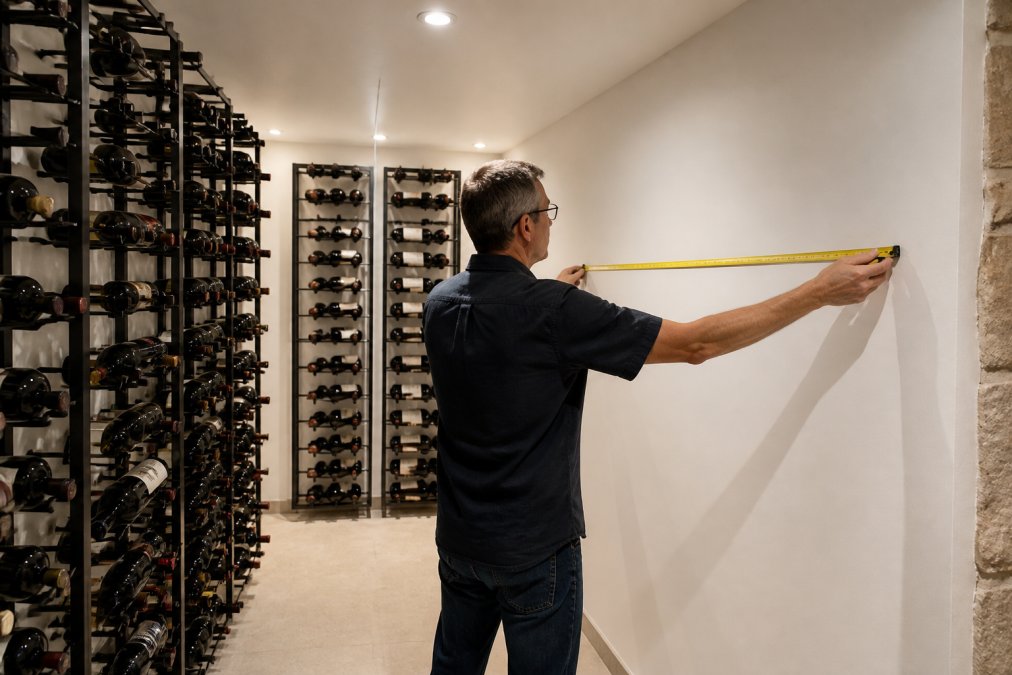 Professional wine collector measuring wall dimensions in a residential wine cellar with modular black racks, using tape measure against clean white walls with natural light from overhead fixtures
Understand Standard Wine Bottle Dimensions and Storage Depth
Standard wine bottles have consistent dimensions that determine how much depth your racking needs. A typical Bordeaux bottle (the most common format) measures about 3 inches in diameter and requires roughly 3.5 to 4 inches of storage depth when laid horizontally.
This depth measurement is critical because it affects how far your racks project from the wall. Shallow racking systems take up less floor space but hold fewer bottles per unit. Deeper systems maximize capacity but can make aisles feel narrower.
Bottle orientation also changes the math. Horizontal storage (bottles lying flat) uses the most space per bottle but is ideal for long-term aging because the cork stays moist. Vertical storage (bottles standing upright) uses less floor space and works well for wines you'll drink within a few years. Mixed formats require flexible racking that accommodates both orientations.
Standard bottle dimensions to know:
- Bordeaux bottle: 3 inches diameter, 11.5 inches tall
- Burgundy bottle: 2.75 inches diameter, 11.5 inches tall
- Storage depth (horizontal): 3.5 to 4 inches
- Storage depth (vertical): 4 to 5 inches
- Spacing between bottles: 0.5 to 1 inch for air circulation
Calculate Bottle Capacity by Square Footage
The relationship between square footage and bottle capacity depends on your racking configuration. A basic rule of thumb: one square foot of wall space, when fully racked horizontally, holds roughly 8 to 12 bottles. But this varies significantly based on racking depth and density.
Here's how to calculate more precisely:
- Measure usable wall space in square feet. Multiply height by width, then subtract doorways and obstacles.
- Determine racking depth. Standard modular systems range from 3.5 to 5 inches deep.
- Calculate bottles per linear foot. Divide 12 inches by your racking depth, then multiply by the number of rows you plan vertically.
- Multiply by total linear feet. This gives your total bottle capacity.
Using the density formula for your racking configuration
The storage density formula works like this:
Capacity = (Usable Wall Length in inches ÷ Bottle Diameter) × (Wall Height in inches ÷ Vertical Spacing) × Number of Racking Rows
Let's work through an example. Say you have a 10-foot wall (120 inches) and 8-foot ceiling height (96 inches). Your bottles are 3 inches in diameter, and you plan 0.5-inch spacing between bottles. You're installing two rows of racking.
- Horizontal capacity per row: (120 ÷ 3.5) × 2 = 68 bottles per row
- Two rows stacked vertically: 68 × 2 = 136 bottles
This assumes you're using standard horizontal racking. Modular systems like those offered by VintageView allow you to adjust configuration, so you can test different layouts before committing to a final design.
The key variable is racking depth. Shallow systems (3.5 inches) maximize usable floor space. Deep systems (5 inches) hold more bottles but reduce aisle width. Choose based on whether you prioritize density or accessibility.
Account for Bottle Orientation and Mixed-Format Storage
Not all wines fit the same storage model. A serious collector often mixes horizontal storage for premium bottles with vertical storage for everyday wines. This flexibility requires racking that adapts to both.
Matte Black Modular Wine Wall - WS8 →
Horizontal storage works best for fine wines you're aging. The cork stays in contact with wine, preventing it from drying out. This orientation uses more linear wall space per bottle but is essential for long-term preservation.
Vertical storage saves space and works fine for wines you'll drink within a few years. Bottles stand upright, using only floor footprint without extending into your aisle space. This is practical for high-volume storage or casual collections.
Mixed-format planning requires flexibility:
- Reserve horizontal racking for premium bottles (Burgundy, aged Bordeaux, collectibles)
- Use vertical racking for everyday wines and bulk storage
- Include case storage if you buy wine by the case
- Plan 20-30% of capacity as flexible space for format changes
Wine Cellar Rack Layout Design for Maximum Density
Strategic layout design determines whether your cellar feels crowded or well-organized. The goal is maximizing bottle capacity while keeping the space functional and visually appealing.
A few layout principles improve both capacity and usability:
- Work from corners outward. Corners often have wasted space; strategic racking fills them efficiently.
- Stack vertically where possible. Two rows of racking on a tall wall doubles capacity without eating floor space.
- Leave main traffic areas open. The path from entrance to cellar door should stay clear.
- Group by format. Keep horizontal storage together, vertical storage together, it simplifies inventory management.
- Plan for visibility. Position premium bottles at eye level where they're visible and accessible.
Plan for Future Collection Growth and Cooling Requirements
To calculate cubic footage:
Cubic Feet = Room Length (feet) × Room Width (feet) × Ceiling Height (feet)
Wine Cellar Space Planning Guide: From Measurement to Implementation
This step-by-step planning worksheet helps you move from theory to actual installation. Work through each step methodically, mistakes caught here prevent costly racking errors later.
Step-by-step planning worksheet and common mistakes to avoid
Step 1: Measure Your Space (Time: 15 minutes)
- Measure each wall's length and height in feet and inches
- Identify doorways, windows, and obstacles
- Note ceiling height and any structural elements
- Sketch your space to scale on graph paper
Step 2: Calculate Usable Wall Space (Time: 10 minutes)
- Subtract doorway widths from total wall length
- Subtract window widths from total wall length
- Account for 24-30 inches of aisle width
- Identify which walls are realistic for racking
Step 3: Determine Your Racking Configuration (Time: 20 minutes)
- Decide on racking depth (3.5 to 5 inches)
- Choose between horizontal, vertical, or mixed storage
- Sketch your racking layout on your scale drawing
- Calculate bottles per wall using the density formula
Step 4: Plan for Growth and Cooling (Time: 10 minutes)
- Add 15-20% buffer capacity to your current collection size
Step 5: Review and Finalize (Time: 15 minutes)
- Check that aisles feel adequate (24-30 inches minimum)
- Verify that premium bottles are at accessible heights
- Confirm that your layout matches your actual space
- Get a second opinion if possible
Common mistakes to avoid:
- Maximizing density at the expense of accessibility. A cellar you can't navigate comfortably is a cellar you won't enjoy.
- Ignoring future growth. Plan for expansion now rather than rebuilding in two years.
- Forgetting about cooling airflow. Racking that blocks vents reduces cooling efficiency and can damage wine.
- Underestimating aisle width. 20 inches feels tight when you're carrying a bottle or reaching into deep racks.
- Mixing bottle formats without flexible racking. Rigid systems designed for only horizontal or vertical storage create frustration when your needs change.
Frequently Asked Questions
How do I calculate wine cellar storage capacity if I have an oddly-shaped space?
Divide irregular spaces into rectangular sections and calculate capacity for each separately. Measure the length and width of each section, then apply the density formula (square footage × bottles per square foot based on your racking depth). Modular racking systems adapt to non-standard shapes, you can configure individual units to fit triangular, sloped, or narrow areas. Add up the capacity of each section for your total.
What is the standard wine bottle dimension I should use for storage calculations?
A standard Bordeaux wine bottle measures approximately 75 mm in diameter and 300 mm in height. When calculating storage capacity, account for racking depth: horizontal racking typically requires 90-100 mm of depth per bottle, while vertical storage needs less horizontal space but more floor footprint. Mixed-format storage, combining standard bottles with larger formats, reduces overall capacity, so plan accordingly if your collection includes magnums or other sizes.
How many bottles can I fit in a 100 square foot wine cellar?
A 100 square foot cellar with standard modular racking typically holds 200-400 bottles, depending on racking configuration. Single-depth wall racking yields approximately 2-3 bottles per square foot. Double-depth or floor-to-ceiling systems increase density to 4-5 bottles per square foot. Subtract space for aisles (typically 24-36 inches wide for accessibility), which reduces usable wall space by 10-20%. Calculate your specific capacity using room dimensions and your chosen racking depth.
Does bottle orientation affect how many bottles I can store?
Yes. Horizontal racking (bottles lying flat) requires more depth but optimizes wall height. Vertical storage takes less depth but uses more floor space. Horizontal orientation is standard for long-term wine preservation, as it keeps the cork moist. If you mix orientations, storing some bottles vertically and others horizontally, your overall capacity decreases because you must design the layout to accommodate both. Plan your bottle orientation before finalizing your racking layout.