
Table of Contents
- Why Modular Wine Storage Works for Awkward Spaces
- Measuring Your Space: The Foundation of Successful Planning
- Wine Rack Dimensions and Capacity: Matching Your Collection
- Narrow Space Wine Storage Solutions
- Wine Storage Ideas for Small Spaces
- Expandable Wine Storage: Building for Future Growth
- Installation, Safety, and Long-Term Performance
- Frequently Asked Questions
Last Updated: October 13, 2026
Why Modular Wine Storage Works for Awkward Spaces
Modular wine storage for awkward spaces transforms areas that seem impossible to use into functional, beautiful displays.
 Matte Black Modular Wine Display Under The Stairs 1-deep
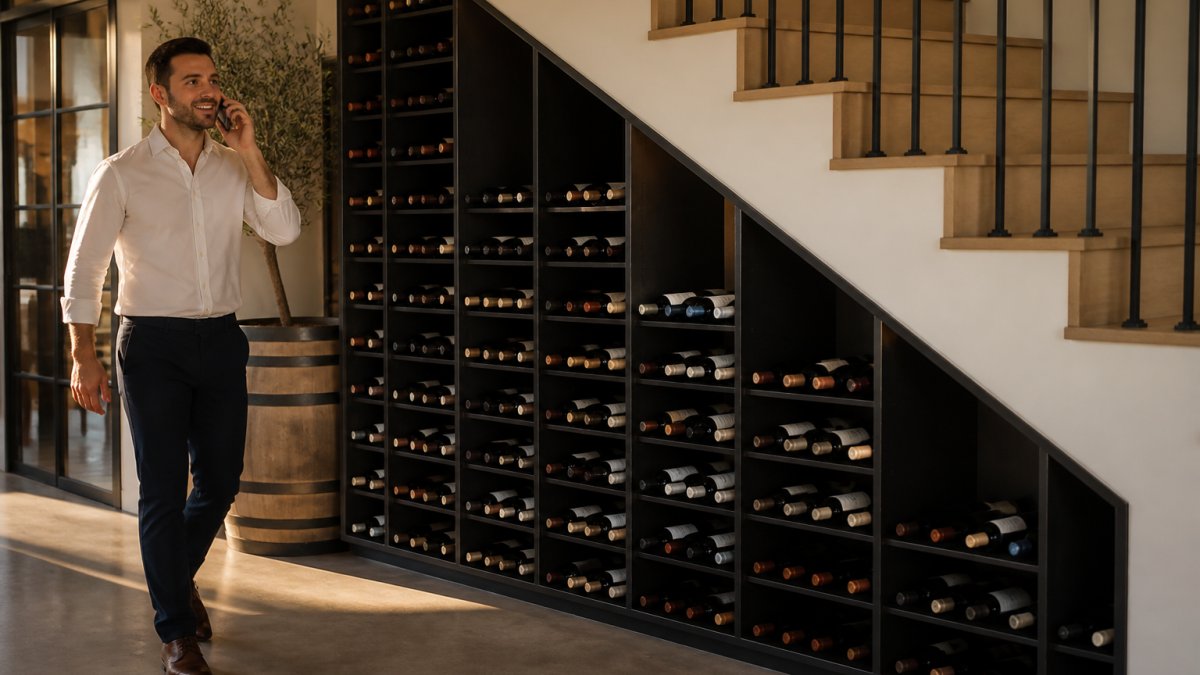 Matte black wine racks arranged in a stepped pattern under a staircase in a modern, sunlit home interior.
The real advantage isn't just flexibility, it's the ability to start small and expand as your collection grows. You buy what you need today, add more components later, and the system grows with you.
Awkward spaces are everywhere. Under stairs, between walls, in corners, along sloped ceilings, these areas often sit empty or hold clutter. Modular wine storage reclaims them. The stepped configurations follow staircase slopes naturally.
What makes modular systems work is simple: individual components connect, stack, and arrange without requiring permanent structural changes. You're not committed to one layout forever.
Measuring Your Space: The Foundation of Successful Planning
Getting accurate dimensions is the most critical step. A small measurement error compounds across your entire installation and can mean the difference between a system that fits perfectly and one that doesn't work at all.
Taking Accurate Dimensions
Start with the basics: height, width, and depth. But don't stop there. Awkward spaces have obstacles. Measure from multiple points, not just one spot. Walls aren't always perfectly straight, and floors aren't always level.
For under-stair installations, measure the vertical height at the front and back of each step. Measure the depth from front to back. Note where the slope changes.
Use a steel measuring tape, not a cloth one. Steel won't sag and gives you accuracy to within a quarter-inch. Take photos of your space from multiple angles. Note any obstacles: electrical outlets, vents, pipes, baseboards, or architectural features that will affect placement.
Write everything down. Don't rely on memory. Create a simple sketch with dimensions labeled. This becomes your reference when you're planning your layout and ordering components.
Identifying Obstacles and Load-Bearing Points
Before you secure anything, identify where the wall can actually support weight. Not all walls are created equal. Drywall alone won't hold a wine collection. You need studs.
Studs are typically 16 inches apart in most homes. Use a stud finder to locate them. Mark their positions. Your modular system's mounting brackets should align with studs whenever possible.
For under-stair installations, check what's behind the staircase. Some stairs have solid backing; others have open space below. This affects how you'll secure your system. For corner installations, identify studs in both walls.
Look for other obstacles too: electrical outlets, light switches, heating vents, or plumbing. These affect where you can place brackets and components.
Document everything. Take photos. Mark stud locations on your sketch. This planning phase prevents problems during installation.
Wine Rack Dimensions and Capacity: Matching Your Collection
Understanding standard bottle sizes and how they fit into your modular system ensures you plan for the right capacity.
Standard Bottle Sizes and Spacing
Most wine bottles follow a standard shape, but they vary slightly. Standard Bordeaux bottles are about 3 inches in diameter. Burgundy bottles are slightly wider, around 3.25 inches. Champagne bottles are taller and heavier. Specialty bottles, magnums, half-bottles, or unique shapes, require different spacing.
Modular wine racks account for these variations. Most systems use 3-inch spacing as the standard, which accommodates typical bottles comfortably. Some components offer tighter spacing for narrow areas; others offer wider spacing for larger bottles or display purposes.
The depth of your rack matters too. A 1-bottle-deep configuration holds bottles horizontally, perfect for display. A 2-bottle-deep or 3-bottle-deep configuration stacks bottles front to back, maximizing capacity in limited floor space. For under-stair installations where space is tight, depth becomes critical.
Calculating Bottle Capacity for Your Layout
Capacity isn't just about how many bottles fit, it's about whether your space can actually support the weight.
A standard wine bottle weighs about 1.5 to 2 pounds. A full bottle of wine adds another 1.5 pounds, bringing the total to roughly 3 to 3.5 pounds per bottle. Multiply that by your planned capacity, and you understand the total load your system must handle.
For example, a 30-bottle configuration under stairs carries about 90 to 105 pounds total. A 60-bottle system carries roughly 180 to 210 pounds. These loads must be distributed across multiple mounting points, typically with brackets anchored to studs.
| Configuration | Bottle Capacity | Best For |
|---|---|---|
| 1-deep, single row | 12-15 bottles | Narrow walls, alcoves, display focus |
| 2-deep, stacked | 30-40 bottles | Under stairs, corner spaces |
| 3-deep, stacked | 60+ bottles | Large alcoves, dedicated wine walls |
This table helps you match your collection size to your available space and the load capacity your walls can handle.
Narrow Space Wine Storage Solutions
Narrow spaces demand creative thinking. A hallway, the gap between two doorways, or the space between a window and a corner can all become premium wine display areas.
Maximizing Vertical Display in Tight Areas
When floor space is limited, go vertical. Modular systems stack upward, turning a narrow wall into a tall display. A 6-foot-tall, 18-inch-wide space can hold 40 to 50 bottles arranged in a vertical configuration.
The key is using components designed for narrow spaces. Slim frames, single-bottle-deep configurations, and vertical stacking arrangements all work here. The visual impact is striking, a floor-to-ceiling wine wall in an otherwise unused corner becomes an architectural feature.
Lighting matters in narrow spaces. A single LED strip running along one edge of your display illuminates the bottles and creates depth.
For narrow hallways, consider a single-column configuration. Bottles arranged vertically in one narrow line use minimal floor space but create maximum visual interest. A 12-bottle vertical stack in a hallway corner becomes a conversation piece.
Wine Storage Ideas for Small Spaces
Small spaces require systems that maximize every inch. The approach depends on the specific shape and obstacles you're working with.
Matte Black Modular Wine Display Under The Stairs 1-deep →
Under-Stair Storage and Sloped Configurations
Under-stair spaces are some of the most underutilized real estate in homes. The slope of the stairs creates a natural stepped pattern that modular systems follow perfectly.
A typical under-stair space might be 3 feet wide, 6 feet long, and 4 feet high at the front, sloping down to 2 feet or less at the back. This awkward geometry is exactly what modular wine storage for awkward spaces solves.
The VintageView Matte Black Modular Wine Display Under The Stairs kits are built for this exact purpose. The stepped configuration follows the staircase slope, holding 30 bottles in a 1-deep arrangement or 60 bottles in a 2-deep setup.
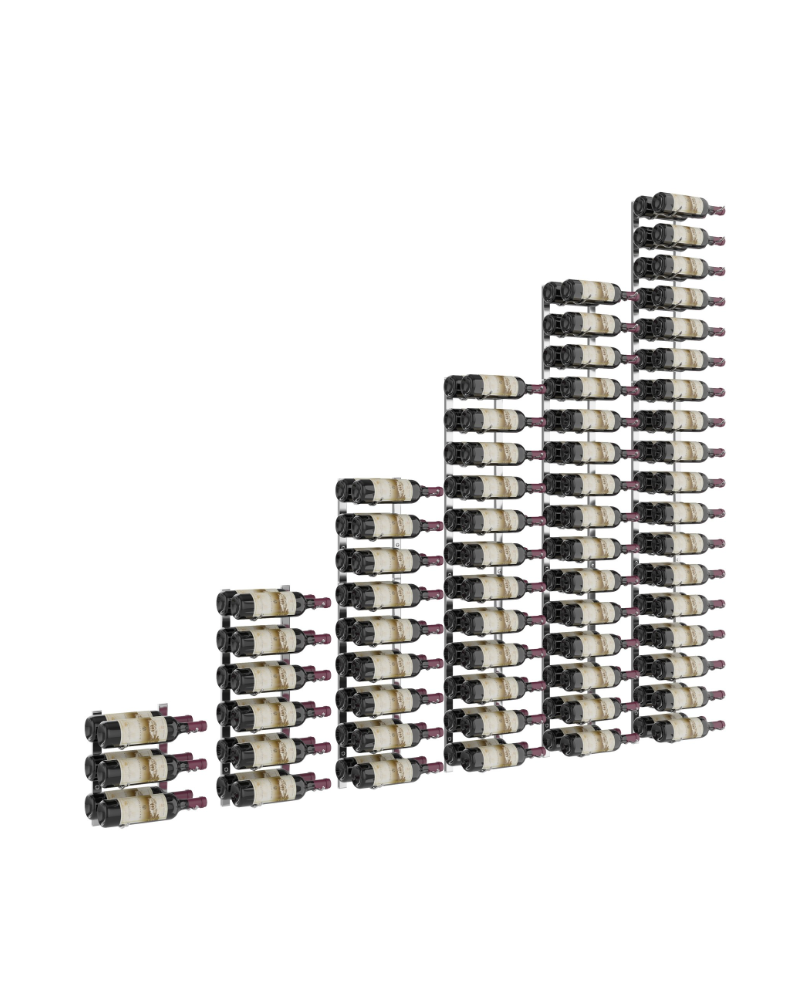 Matte Black Modular Wine Display Under The Stairs 2-deep
The real benefit: you transform wasted space into a premium display. Your wine collection becomes part of your home's design rather than hidden in a closet or cabinet.
Corner and Alcove Installations
Corners are dead space in most homes. An unused corner becomes a corner wine display that maximizes the awkward geometry instead of fighting it.
Modular systems designed for corners use both walls efficiently. L-shaped configurations wrap around the corner, creating a display that's visible from multiple angles. A 6-foot-tall corner installation can hold 40 to 60 bottles depending on depth.
Alcoves, recessed spaces in walls, are ideal for modular storage. The back wall and side walls provide natural anchoring points.
The advantage of corners and alcoves: they're already defined spaces. Your display doesn't need to "fit" into the room, it's already part of the room's architecture. This makes even modest collections look intentional and well-integrated.
Expandable Wine Storage: Building for Future Growth
The best modular systems grow with you. You don't need to buy your entire collection's storage capacity upfront.
Start with a base configuration that matches your current collection. As your wine purchases grow, add components. The system expands horizontally, vertically, or in depth without requiring you to remove what you've already installed.
This approach makes financial sense too. You invest in storage as your collection grows, not all at once. It also lets you test how a system works in your space before committing to a larger installation.
Modular components from VintageView connect seamlessly. Whether you start with a 12-bottle display and expand to 40 bottles later, or begin with a 30-bottle under-stair configuration and add a wall display next year, the system adapts.
Installation, Safety, and Long-Term Performance
A beautiful display means nothing if it's not secure. Installation and ongoing maintenance determine whether your system stays functional and safe for years.
Securing Your Modular System
Proper installation starts with proper planning. Use the measurements and stud locations you identified earlier. Mark where each bracket will go before you drill anything.
Brackets must anchor into studs or use heavy-duty wall anchors rated for the weight you're hanging. Standard drywall anchors aren't sufficient for wine storage.
Use the correct fasteners. Lag bolts work well for stud mounting. Toggle bolts or expansion anchors work for drywall between studs, but only if they're rated for your load.
Install brackets level. Use a level tool, not your eye. Uneven installation looks poor and creates uneven weight distribution, which stresses some brackets more than others.
Test your installation before loading it fully. Hang a few bottles, check for movement or flex, and verify everything feels solid. Only after confirming stability should you load your full collection.
Maintaining Wine Preservation in Open Storage
Modular wine racks are open systems. They don't provide the climate control of a wine cooler or the darkness of a wine cabinet. This affects how you store your wine.
Open storage works best for wines you plan to drink within a few years. Long-term collectors need to consider temperature, humidity, and light exposure.
If your awkward space is in a cooler area of your home, a basement alcove or under-stair space in a cooler climate, open storage works well.
Dust accumulates on open displays. Wipe bottles periodically. Check labels occasionally to catch any issues with capsules or corks.
Modular wine storage transforms awkward spaces into functional displays that work as hard as they look beautiful.
VintageView's modular systems are built for exactly this challenge.
Frequently Asked Questions
How do I measure my awkward space before choosing a modular wine storage system?
Start by measuring the height, width, and depth of your space at multiple points, awkward areas often have varying dimensions. For sloped spaces like under stairs, measure the height at the tallest and shortest points. Check for obstacles like electrical outlets, baseboards, or architectural features. Use a level to confirm the wall is plumb. Document any load-bearing studs or solid anchor points. Take photos from multiple angles to share with professionals if needed. Accurate measurements prevent costly installation mistakes and ensure your modular system fits perfectly.
What wine rack dimensions should I consider for a narrow wall or alcove?
Narrow spaces typically work best with single or double-depth modular wine racks that extend vertically rather than horizontally. Most standard wine bottles are 75mm in diameter, so depth requirements range from 100-150mm for single-depth storage to 200-300mm for double-depth. Wall width matters more, even a 600mm-wide alcove can hold 12-24 bottles when stacked vertically. Measure your exact width, height, and depth, then choose modular components that fit those constraints. Vertical orientation maximizes capacity without requiring deep wall penetration.
Can modular wine storage really be expanded as my collection grows?
Yes, true modular systems are designed for growth. You can add components vertically, horizontally, or in depth depending on your space and the system design. For example, under-stair installations can expand to fill the entire slope with additional stepped units. Modular rail systems allow you to add new sections without removing existing bottles. Plan your initial layout with future expansion in mind, leave access to wall studs and ensure your chosen system offers compatible add-on pieces. Check with the manufacturer about expansion options before purchasing your first kit.
What should I know about installation safety and weight capacity?
Proper installation is critical for safety and wine preservation. All wall-mounted modular systems must anchor to wall studs or use appropriate heavy-duty fasteners rated for your bottle count. Verify that your walls can support the weight of your collection and that all mounting hardware is rated accordingly. Ensure your system is level to prevent bottles from rolling.