
Last Updated: November 15, 2026
Quick Summary
To organize wine bottles in a narrow pantry, measure usable shelf depth, clear height and walkway width first, then choose label-forward wall-mounted racks that use vertical height instead of floor depth. Fix racks into studs or masonry, load rear rows first, and keep your most-opened bottles at eye level.
- A flat-lying bottle needs about 330mm of shelf depth to sit fully supported.
- A 600mm shelf holds roughly seven bottles laid side by side.
- Fix wall racks into studs or solid masonry, never plasterboard alone.
- A full bottle weighs around 1.2kg to 1.5kg, so check the rack's load limit.
- Keep the lowest row above knee height to protect the walkway and avoid drops.
Table of Contents
- Wine Rack for Small Spaces: Measuring Your Narrow Pantry First
- Step-by-Step Plan for Organizing Wine in a Narrow Pantry
- Pantry Wine Storage Ideas That Use Vertical Space
- Small Pantry Organization: Sorting, Grouping, and Rotation
- Wine Fridge for Pantry: When Cool Storage Belongs in the Plan
- Safe Load Limits and Anti-Tip Measures for Narrow Pantry Racks
- Choosing the Right Modular Rack for Your Pantry Wall
- Frequently Asked Questions
Wine Rack for Small Spaces: Measuring Your Narrow Pantry First
A wine rack for small spaces only works when you measure before you buy. Organizing wine bottles in a narrow pantry starts with three numbers: usable shelf depth, clear height between shelves, and the width you can give up without blocking the walkway. A standard bottle lying flat needs far more front-to-back room than people expect, which is why storage plans often fail on depth rather than width.
Grab a tape measure and note these figures:
- Shelf depth: measure from the back wall to the front edge, not the shelf label.
- Clear height: the gap between one shelf and the next, plus the gap to the ceiling.
- Door swing: how far the door travels and what it sweeps past.
- Walkway width: the clear floor strip you need to reach the back shelves.
Write the numbers down. Guessing here costs you a return label later.
Bottle Dimensions, Shelf Depth, and Capacity Calculations
Standard wine bottles run about 300mm tall and roughly 75mm across the base, though Burgundy and Champagne shapes are wider.
For capacity, divide usable shelf length by bottle diameter, then multiply by the number of shelves. If you would rather not do the arithmetic by hand, our guide on how to calculate wine cellar storage capacity walks through the sums with real bottle sizes.
Label-forward wall racks change the maths. A wall-mounted rack holds bottles horizontally with the label facing out, so it uses height instead of depth. That is why they suit narrow pantries so well.
Step-by-Step Plan for Organizing Wine in a Narrow Pantry
A narrow pantry rewards a sequence, not a shopping spree. Work through these steps in order and you will buy the right rack once, fit it without wasted depth, and keep every bottle reachable.
- Clear one shelf at a time. Empty a shelf, wipe it down, and check the back wall for damp, cracks, or loose fixings. Do not pull everything at once; a narrow floor fills up fast and you will be stepping over bottles.
- Audit every bottle. Set aside anything you plan to drink within the month, anything past its drinking window, and duplicates. Count what remains by bottle shape, not just by total, because Burgundy and Champagne bases are wider than a standard Bordeaux bottle.
- Measure the empty pantry. Note usable shelf depth (back wall to front edge), clear height between shelves, clear height to the ceiling, door swing, and the walkway strip you need to reach the back. Write the numbers on the shelf edge in pencil so they travel with the plan.
- Run the fit calculation before choosing a rack. For flat-lying storage, usable depth must be at least the bottle length plus a finger's clearance at the neck; for label-forward wall racks, the constraint is height and wall length, not depth. Divide usable shelf length by bottle diameter to get bottles per row, then multiply by rows.
- Assign zones by reach. Eye-level and waist-level shelves get the bottles you open most; the top and the deepest back corner get ageing bottles. Keep the lowest row above knee height so you are not bending into the doorway.
- Sketch the wall elevation. Draw each column to scale, mark fixing points, and confirm the tallest column clears the ceiling and any door swing. A paper plan catches overlap that a tape measure alone misses.
- Fix the rack, then load back to front. Load the rear rows first, then work forward so you never have to unload a front row to reach the back.
- Label and set a rotation check. A shelf-edge note per zone plus a quarterly pass that moves near-window bottles to the front keeps the system honest.
Watch out: measuring a loaded shelf gives you the gap above the bottles, not the true clear height. Always re-measure with the pantry empty before you commit to a rack height.
When you are ready to turn the plan into a fitted system, our walkthrough on installing modular wine racks covers the sequence from wall prep to the final row.
Pantry Wine Storage Ideas That Use Vertical Space
Vertical space is the answer in a narrow pantry, but which vertical solution fits depends on your wall length and how much depth you can spare.
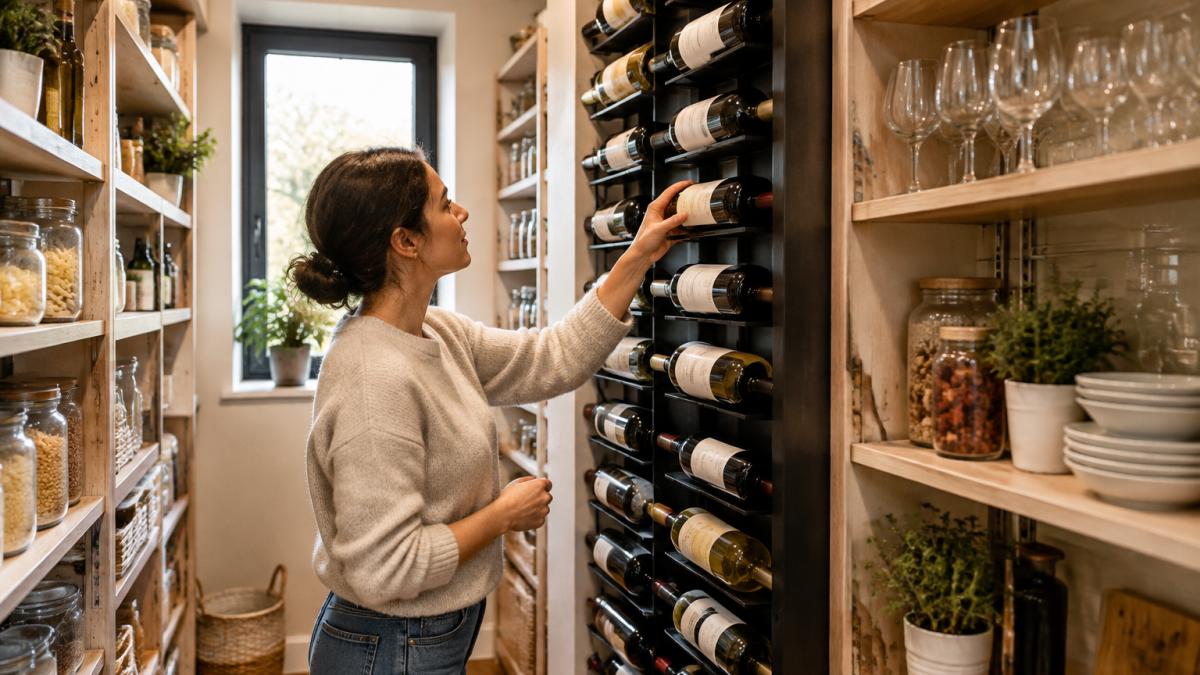 Matte black wall-mounted wine rack displaying bottles in a narrow pantry with organized shelves and warm lighting
Match the option to your wall:
- Under 400mm of clear wall length: a single narrow column of label-forward racks. One column uses height instead of width, so it fits beside a door frame or in the gap between shelving units.
- 400mm to 800mm: two columns side by side, or one column plus under-cabinet storage beneath an existing shelf for the bottles you drink within the month.
- 800mm and up: a full-height bank of columns from skirting to cornice, with the lowest row kept above knee height and the top row reserved for ageing bottles you rarely touch.
- Awkward corners and odd angles: mixed-height columns that step around a chimney breast or sloped ceiling fill shapes a single rectangular unit cannot.
Run the capacity math before you commit. A label-forward wall rack holds bottles horizontally with the label facing out, so capacity scales with wall height and column count, not shelf depth.
For awkward corners and odd angles, our collection of modular wine storage for awkward spaces shows how mixed-height columns fill shapes a single unit cannot.
Wall-Mounted and Under-Cabinet Racks for Tight Layouts
Wall-mounted racks win on floor space, but the wall has to carry the load. Fix into studs or solid masonry, never into plasterboard alone, and confirm the fixing pattern matches your stud spacing before you drill. Under-cabinet racks work well for a short row you plan to drink within the month, since they sit close to the door and are easy to reach, but they eat the clear height beneath the shelf, so check that the bottles below still clear the counter or floor.
Keep the lowest row above knee height. Bending to the floor in a narrow space is how bottles get dropped, and a low row also blocks the walkway strip you measured in step three.
Small Pantry Organization: Sorting, Grouping, and Rotation
Small pantry organization lives or dies on rotation. A bottle that disappears into the back row for two years is money wasted, so build a first-in, first-out system from day one.
Try this simple method:
- Drink-first row: the front row holds bottles ready to open.
- Ageing rows: the back holds bottles you plan to keep.
- Label out: face labels forward so you can read them without lifting.
- Tag the shelf: a small note on each shelf edge records what sits there.
Group similar items together. Reds with reds, glassware with glassware, entertaining supplies on one shelf. Clutter builds when categories mix, and a cluttered pantry hides the bottles you meant to open.
Wine Fridge for Pantry: When Cool Storage Belongs in the Plan
A wine fridge for pantry use makes sense when your pantry runs warm. Wine quality depends on steady temperature and low vibration, and a pantry next to an oven or a sunny window will swing too far for long-term storage. A fridge gives you a stable zone inside the same room.
Where a fridge fits the plan:
- You keep bottles for more than a year.
- The pantry sits against a hot wall or beside an appliance.
- You collect premium bottles where condition matters.
Where it does not:
- The pantry is your only floor space.
- You drink bottles within weeks of buying.
- Your collection is a display you want to see.
In a narrow pantry, pair a small fridge with wall-mounted racks above it to reclaim the height.
Safe Load Limits and Anti-Tip Measures for Narrow Pantry Racks
Safe loading is the step most guides skip. A full bottle weighs around 1.2kg to 1.5kg, so a 30-bottle rack carries roughly 40kg before you add the rack itself. Fixings rated for a picture frame will not hold that.
Check these before you load:
- Fixings go into studs, masonry, or rated anchors, not plasterboard alone.
- The rack maker's stated load limit covers your full bottle count.
- Tall units are fixed to the wall at the top as well as the base.
- Heavy bottles sit on the lowest rows.
- The floor is level and the unit does not rock.
Watch out: a freestanding rack in a narrow pantry is easy to knock on the way past. If it is not fixed to the wall, a shoulder brush can bring the whole column down. Anchor it, or choose a wall-mounted system that cannot tip.
Choosing the Right Modular Rack for Your Pantry Wall
Modular systems let you start small and grow. That matters in a narrow pantry, where you may only have room for one column today but want a second next year.
The Wall Series W11 holds three bottles label-forward in a compact footprint at €54.45. The Wall Series W41 is priced at €186.34.
Compare the options:
| Model | Bottle Capacity | Profile | Price |
|---|---|---|---|
| W11 | 3 bottles | Compact | €54.45 |
| W21 | 3 bottles | Mid height | €99.22 |
| W31 | 3 bottles | Tall | €148.83 |
| W41 | 3 bottles | Tallest | €186.34 |
Price
For a full comparison of systems, our buyer's guide to modular wine rack systems sets out the differences. If you want to see which compact racks exist before you commit, browse the best wine racks for small spaces.
A narrow pantry does not have to mean cramped storage. Measure first, sort before you buy, and use the wall height you already have.
Frequently Asked Questions
How do you keep wine bottles from rolling on a pantry shelf?
Loose bottles roll because a flat shelf gives them nothing to sit against. The fix is a rack that holds each bottle in a fixed position, either label-forward on steel supports or in a cradle that stops movement. If you are not ready to install a rack, lay bottles on their side in a shallow tray or a divided box so each one sits in its own slot. Avoid standing bottles upright for long periods in a narrow pantry, since space is tight and a knocked bottle is more likely to fall.
How much space should you leave between wine bottles in a narrow pantry?
Leave enough gap that your fingers fit around the neck and shoulder when you pull a bottle out, roughly the width of two fingers on each side. In a narrow pantry the bigger constraint is depth, not width: check that the rack plus the bottle length still leaves you a clear walkway. If the pantry is under 60 cm deep, a single-depth wall rack keeps the aisle usable. Measure with your widest bottle in hand before you fix anything to the wall.
Can a wine rack fit in a narrow pantry?
Yes, and a narrow pantry is often the best candidate for one. Wall-mounted modular racks sit flush against the back or side wall and use vertical space that shelves waste. A compact unit such as the Wall Series W11 holds three bottles label-forward in a small footprint, and you can add matching sections as the collection grows. Measure the wall width, the available depth, and the height to the ceiling first, then plan the rack around those numbers.
Where should wine bottles go in a pantry?
Keep bottles low and toward the back wall, away from the door and any heat source such as an oven, radiator, or dishwasher. Heat and light are the two things that spoil wine fastest, so a spot that stays cool and dim matters more than convenience. Store bottles on their side so the cork stays in contact with the wine. In a narrow pantry, the lower half of the back wall is usually the coolest, most stable position and the easiest place to mount a rack safely.
