
Last Updated: November 5, 2026
Quick Summary
Modular wine storage is a racking system built from repeatable steel elements that can be added to, rearranged or extended as a collection grows. For hotels, it turns a fixed cost into an asset that keeps earning, letting a wine wall that starts at 144 bottles become a 360-bottle feature without a rebuild.
- Wall-mounted modular wine walls use vertical space, so capacity grows without taking dining or circulation floor.
- VintageView kits scale in steps: the 7-piece display kit holds 144 bottles and the WS8 holds 360 across a 244 cm high wall.
- Specify steady temperature, controlled humidity, light protection and freedom from vibration, then confirm the rack supports them.
- Zone the wall and log temperature and humidity so a shift is caught before a guest notices a dull bottle.
- Plan in five steps: audit the list, survey the wall, choose the capacity step, plan the zones, then phase the build.
Table of Contents
- Why Modular Wine Storage Pays Off for Hotels
- Increased Storage Capacity Without Losing Floor Space
- Hotel Wine Cellar Design That Works With the Building
- Wine Preservation and Cellar Conditions Behind the Display
- Commercial Grade Wine Racking Systems: Steel, Load and Wear
- Wine Bottle Storage Best Practices for Busy Hotel Teams
- Restaurant Wine Display Ideas That Sell the List
- Planning a Modular Wine Wall for Your Hotel
- Frequently Asked Questions
Why Modular Wine Storage Pays Off for Hotels
Modular wine storage is a racking system built from repeatable steel elements that can be added to, rearranged or extended as a collection grows. For hotels, that flexibility turns a fixed cost into an asset that keeps earning: a wine wall that starts at 144 bottles can become a 360-bottle feature without a rebuild. Expandable wine storage: key benefits and planning explains the concrete advantages of modular systems before you commit.
This guide covers how hotel and restaurant teams plan, specify and run these systems. Below, we'll show you exactly how capacity, preservation, staff workflow and presentation fit together, and where most hotel projects go wrong.
The stakes are higher than they look. A wine list is one of the few hotel assets that sells itself twice: once when a guest sees the display, and again when the bottle reaches the table. UKHospitality industry guidance on hospitality operations repeatedly flags stock control and staff efficiency as pressure points for venues, and a racking system that supports both pays for itself faster than one that only looks good.
Increased Storage Capacity Without Losing Floor Space
The core argument for modular systems is density. A wall-mounted modular wine wall uses vertical space, so capacity can be added without taking up dining or circulation floor.
High-Density Kits That Fit a Working Cellar
Capacity scales in steps, which matters when budgets are approved in phases. VintageView's modular kits illustrate the range: the 7-piece display kit holds 144 bottles, the WS6 wine wall holds 270 across 184 cm high, the WS7 holds 315 across 214 cm high and the WS8 holds 360 across a 244 cm high wall. A hotel can open with one and extend later using the same components.
Hotel Wine Cellar Design That Works With the Building
Hotel wine cellar design starts with the building, not the catalogue. Awkward corners, low soffits, service doors and structural columns decide what is possible long before finish or style enters the conversation.
This is where modular systems can suit a building layout. The floor-to-ceiling post kit is a good example: it creates a freestanding column without wall fixing, useful for dividing a tasting area from a dining room.
For a structured approach to the whole room, our step-by-step wine cellar layout guide walks through measuring, zoning and sequencing the build.
Wine Preservation and Cellar Conditions Behind the Display
Wine preservation depends on four conditions: steady temperature, controlled humidity, protection from light and freedom from vibration. Racking affects all four, and a display that ignores them will cost a hotel more in spoiled stock than it saved on installation.
Practical Targets for a Hotel Wine Display
Rather than treating preservation as a vague aspiration, specify the conditions the room must hold and then check that the rack supports them:
- Temperature: aim for a stable band rather than a single number. Fluctuation is harder on wine than a slightly warmer but steady room, so site displays away from doors, kitchen pass-throughs and direct sun.
- Humidity: moderate humidity keeps corks from drying on long-held bottles.
- Light: label-forward display is the point of a wine wall, but UV and direct sun degrade wine over time. Use directional lighting that illuminates labels without baking the bottles, and keep long-held back-vintage away from the brightest zone.
- Vibration: compressors, lifts, service doors and foot traffic all transmit vibration. A wall-fixed rack should be checked against the substrate before installation.
Monitoring and Zoning
A single room sensor is not enough for a large display. Zone the wall, display rows, back-vintage storage and magnum positions, and monitor the zones that hold the oldest or most valuable bottles. Log temperature and humidity so a shift is caught before a guest notices a dull bottle.
Watch out: placing a display against a wall that receives direct afternoon sun or sits next to kitchen heat will undermine any room-level climate control. Site the wall first, then specify the rack, and confirm the climate system can hold the target band across the whole display before installation.
Commercial Grade Wine Racking Systems: Steel, Load and Wear
Commercial grade wine racking systems are specified on three things: material, load path and finish durability. In a hotel, the rack is touched dozens of times a day by staff and guests, so wear resistance matters as much as capacity.
The matte black finish is available across the range, and the steel construction is described as heavy-duty.
Load is the question every buyer should ask before fixing anything to a wall. A full rack of premium bottles is heavy, and the fixing method must match the substrate, whether that is masonry, studwork or a structural column. Our commercial storage systems comparison sets out the options by capacity and construction.
Matte Black Modular Wine Rack Display kit Deluxe (15-Piece Set) →
Wine Bottle Storage Best Practices for Busy Hotel Teams
Wine bottle storage best practices at hotel scale come down to three habits: consistent placement, clear labelling and a rotation rule that staff actually follow. The difference between a well-run wine wall and a chaotic one is rarely the rack, it is whether the layout matches how the floor team works during a busy service.
Layout That Matches Service Flow
Design the rack around the order in which staff reach for bottles, not around supplier deliveries:
- Store bottles in the same position every time so anyone can find a vintage during service
- Group by list section, not by supplier, so the floor team thinks in the same order as the menu
- Rotate older stock to the most accessible rows and keep back-vintage in higher or deeper positions
- Record every movement so inventory accuracy survives shift changes and event nights
- Keep magnums and larger formats in dedicated positions rather than forcing them into standard rows
A common pattern is to place the fastest-moving list sections at eye level and within arm's reach, with slower back-vintage higher or deeper. That single decision shortens the walk between the pass and the bottle and reduces the chance a server pulls the wrong vintage under pressure.
Staff Training and Onboarding
A wine wall is only as fast as the newest server on shift. Build a short onboarding routine: walk new staff through the zones, show them how labels read from the floor, and have them locate three bottles from the list before their first service. Label the zones physically so a temporary or agency worker can find a bottle without asking.
Measurable Habits
Track a few simple indicators to see whether the layout is working: how long it takes to locate a bottle during service, how often a vintage is recorded as out of stock when it is actually on the wall, and how many bottles are broken during retrieval. Review these after event nights, when pressure exposes weak spots in the layout.
Watch out: treating the rack as storage only is the most common mistake. In practice it is the physical index of the wine list, and the faster a server can locate a bottle, the more tables that server can serve.
Restaurant Wine Display Ideas That Sell the List
A wine display sells when a guest can read it from where they sit. Label-forward presentation, warm directional lighting and a wall positioned on the route between entrance and table do more for average bottle spend than any printed list.
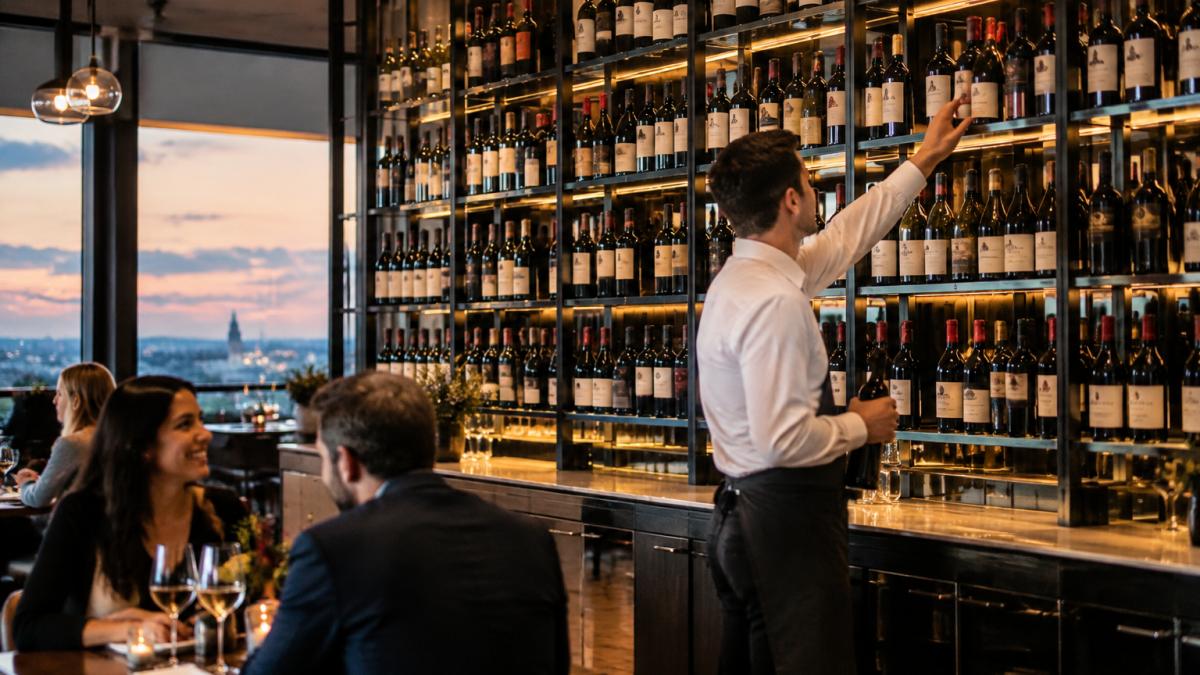 Waiter reaching for a bottle from a floor-to-ceiling black steel wine wall in a dimly lit restaurant dining room
The Matte Black Modular Wine Wall - WS8 holds 360 bottles across ten racks at 244 cm high, displayed label-forward. Where the room is smaller, the 81-bottle waterfall display kit creates the same effect on a compact footprint.
 Matte Black Modular Wine Wall - WS8
Planning a Modular Wine Wall for Your Hotel
Planning a modular wine wall is a five-step process, and the order matters more than the detail.
- Audit the list. Count current bottles, then add the growth you expect over three years.
- Survey the wall. Record height, width, obstructions, substrate and light exposure.
- Choose the capacity step. Pick the kit that covers year-one stock with headroom, not the one that fits today exactly.
- Plan the zones. Separate display rows from back-vintage storage and magnum positions.
- Phase the build. Install the first section, run it for a season, then extend with matching components.
| Decision | What to check | Why it matters |
|---|---|---|
| Capacity step | Bottles now plus three-year growth | Avoids a second purchase within two years |
| Wall substrate | Masonry, studwork or column | Determines fixing method and load rating |
| Display vs. storage | How much of the list is on show | Drives kit choice and lighting budget |
| Format mix | Standard, magnum, large format | Prevents forced storage and breakage |
| Expansion path | Matching components available | Keeps the wall visually consistent |
Our modular steel buying guide goes deeper on component matching for phased projects.
Hotel wine storage is a capital decision that keeps paying back only if the system can grow with the list. Get the capacity step wrong and you will be buying twice; get the display wrong and the room's best marketing asset sits in the dark.
At VintageView, modular steel systems scale from a 144-bottle display to a 360-bottle wall, finished in matte black and presented label-forward. Get started with VintageView and turn an unused wall into a wine feature that sells the list every service.
Frequently Asked Questions
How can modular wine storage adapt to changing hotel needs?
Modular wine storage is built from repeatable rack elements, so a hotel can add capacity in stages rather than rebuilding a cellar. Start with a 7-piece kit for 144 bottles, then extend with additional racks or a larger wall kit as the list grows.
Can modular wine racks make better use of limited hotel space?
They can. Modular wine storage works on vertical wall area and irregular footprints rather than requiring a separate room. Floor-to-ceiling post kits hold up to 63 bottles in a column that needs no wall fixing and can act as a room divider, while high-density wall kits such as the WS8 hold 360 bottles on a single 244 cm high run. That lets a hotel turn a corridor end, back bar or unused alcove into revenue-generating storage.
Is a dedicated wine cellar necessary for a hotel wine collection?
Not always. A dedicated wine cellar gives the tightest control over temperature, humidity and light, which matters for ageing stock. But a hotel can run a split approach: a conditioned back-of-house cellar for long-term ageing and a modular wine display in the restaurant or lobby for the bottles sold nightly. The display handles presentation and fast service; the cellar handles preservation. Modular systems make that split practical because the front-of-house element can grow with demand.
What should hotels consider when planning a wine display?
Plan around four things: bottle capacity with room to grow, the load the wall or floor must carry, how staff will reach the bottles during service, and the light and temperature the display will sit in. Label-forward layouts speed up picking, and reconfigurable racks let you reorganise by region or price as the list changes. Confirm the fixing method suits the wall construction before ordering, and keep the most-sold bottles at hand height.
