
Table of Contents
- What Makes Modular Steel Wine Racks the Right Choice
- Wall-Mounted vs. Floor-Standing: Which Configuration Suits Your Space
- Best Wine Racks for Small Spaces: Maximizing Storage Density
- Benefits of Modular Wine Storage and Expandability
- Material Durability: Why Steel Alloy Outperforms Alternatives
- How to Plan a Home Wine Cellar with Modular Components
- Installation, Assembly, and Structural Integrity
- Maintenance and Corrosion Prevention for Long-Term Performance
- Frequently Asked Questions
Last Updated: September 26, 2026
What Makes Modular Steel Wine Racks the Right Choice
 Contemporary wine display wall featuring matte black modular steel racks holding bottles with visible labels in a modern living room with warm ambient lighting
Modular steel wine racks are engineered storage systems that combine heavy-duty construction with flexible, expandable design. Unlike fixed installations, they let you scale your collection storage as your wine grows, adding components without replacing the entire system.
The core advantage is straightforward: steel alloy construction delivers structural integrity that holds serious bottles safely, while modularity means you're not locked into one configuration. Whether you're starting with 12 bottles or planning for 300, modular systems grow with your needs.
At VintageView, we've worked with collectors, interior designers, and hospitality venues who all share the same challenge: they need storage that's both architecturally stunning and genuinely durable. A wine rack isn't just a shelf, it's part of your interior. The right system becomes a design feature, not an afterthought.
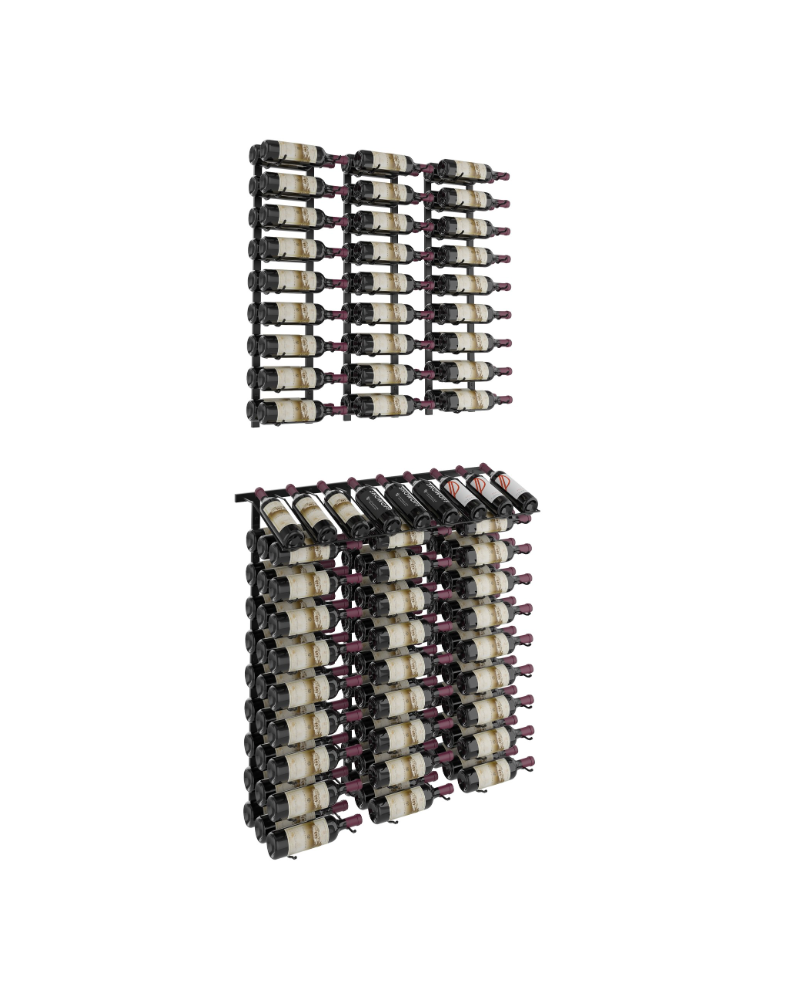 Matte Black Modular Wine Rack Display Kit (7-Piece Set)
Most people assume wine storage is a one-time purchase. It rarely is. Collections expand, spaces change, and what worked two years ago suddenly feels cramped. That's where modularity transforms the equation. You're not replacing; you're extending.
Steel alloy construction resists corrosion better than alternatives, handles temperature fluctuations without warping, and supports heavy loads consistently. The matte black finish on premium modular systems maintains its appearance through years of use without the wear that shows on lighter finishes.
Wall-Mounted vs. Floor-Standing: Which Configuration Suits Your Space
Wall-mounted and floor-standing modular steel wine racks solve different spatial problems, and the choice depends on your available space and aesthetic goals.
Wall-mounted configurations maximize vertical space and create a label-forward display that works like art on your wall. They're ideal for dining rooms, kitchens with limited floor space, or wine cellars where you want to showcase your collection prominently. Installation requires solid wall structure, studs, masonry, or reinforced drywall, but once secured, they free up floor area entirely. Wall-mounted systems can reach floor-to-ceiling heights, turning an otherwise blank wall into a dramatic architectural feature.
Floor-standing modular racks offer flexibility without wall commitment. You can reposition them, reconfigure layouts, and adjust heights to suit your space. They work in wine cellars, basements, or dedicated wine rooms where wall space may be limited or you prefer not to anchor permanently. These systems typically handle high bottle density efficiently, making them popular for serious collectors with substantial collections.
The practical difference: wall-mounted works best when your wall can bear the load and you want permanent, high-impact display. Floor-standing suits spaces where you value flexibility or where wall mounting isn't feasible. Many collectors use both, wall-mounted racks for showcase bottles and floor-standing units for bulk storage.
Space optimization is where most decisions get made. A triangular space under stairs, an awkward alcove, or an irregular wall shape? Modular components let you build around real-world geometry instead of forcing a standard solution into a non-standard space.
Best Wine Racks for Small Spaces: Maximizing Storage Density
Small spaces demand intelligent design, not compromise. Storage density, how many bottles fit per square foot, becomes critical when you're working with limited room.
Modular steel wine racks achieve high storage density through vertical stacking and efficient component design. A single wall section can hold 12-36 bottles depending on configuration, and stacking multiple sections vertically multiplies capacity without expanding the footprint. This is why label-forward display systems work so effectively in compact spaces: they show bottles standing upright in minimal floor or wall area.
For rooms under 100 square feet, focus on vertical solutions. Wall-mounted modular systems let you use the full height of a wall, something floor-standing units can't match. A 10-foot wall height with a modular system can hold 100+ bottles in a space that would feel cramped with traditional shelving.
Narrow spaces, like the area under stairs or between architectural features, benefit from modular flexibility. You can build custom configurations that fit irregular dimensions precisely. Standard racks often leave dead space; modular systems eliminate waste.
The real efficiency gain comes from label-forward display. When bottles stand upright with labels visible, you see your entire collection at a glance. This visibility often leads collectors to use space more strategically, organizing by region, vintage, or preference rather than randomly filling available slots.
VintageView's modular approach lets you build storage that fits your actual space, not a theoretical one. That's the difference between a wine rack that feels like an afterthought and one that feels intentional.
Benefits of Modular Wine Storage and Expandability
Expandability changes how you think about wine storage investment. Instead of replacing your system when your collection grows, you add components.
Scalability without replacement is the core benefit. Start small, perhaps a 7-piece set holding 144 bottles, then expand to 15-piece configurations holding 288 bottles plus magnums. You're not discarding the original investment; you're building on it. This approach saves money over time and eliminates the waste of replacing functional storage.
Customizable display configurations let you match your aesthetic preferences and collection characteristics. Different bottle types, standard bottles, magnums, larger formats, require different component arrangements. Modular systems accommodate these variations without redesign.
Adaptability to space changes matters more than most guides acknowledge. You renovate a room, move to a new space, or reorganize a wine cellar. Fixed systems become liabilities. Modular components move with you, reconfigure for new dimensions, and adapt to evolving layouts.
Load-bearing flexibility is engineering-focused but practically important. A modular system distributes weight across multiple anchor points rather than concentrating it on a single installation. This redundancy improves safety and allows for higher total capacity in a given space.
Future-proofing your collection means your storage grows with your passion. Serious collectors often underestimate how quickly 50 bottles becomes 200. A modular system that expands prevents the frustration of outgrowing your storage in two years.
Matte Black Modular Wine Rack Display →
The expandability benefit extends beyond capacity. As your palate matures and your collection becomes more curated, you might want different display arrangements. Modular systems let you reconfigure without starting over.
Material Durability: Why Steel Alloy Outperforms Alternatives
Steel alloy construction is the engineering standard for wine storage because it delivers reliability that other materials can't match.
Corrosion resistance matters in wine storage environments. Temperature fluctuations, humidity, and ambient moisture create conditions that degrade inferior materials. Steel alloy, particularly when finished with protective coatings like matte black, resists oxidation and corrosion far longer than alternatives. This durability means your system looks premium and functions reliably for decades.
 Matte Black Modular Wine Wall - WS8
Load-bearing capacity is where steel's structural advantage becomes obvious. A heavy collection, serious bottles worth thousands of dollars, demands storage that won't flex, warp, or fail under sustained weight. Steel alloy handles consistent loads without degradation. This is non-negotiable for valuable collections.
Temperature stability is an engineering property that affects your wine's condition. Steel conducts temperature changes gradually, avoiding the rapid fluctuations that degrade wine. Materials with poor thermal properties can create micro-temperature swings that accelerate aging.
Finish durability distinguishes premium systems from budget alternatives. A matte black finish on quality steel maintains its appearance through years of use. Lesser finishes show wear, scratches, and fading. When your wine rack is part of your interior design, finish quality matters aesthetically and functionally.
Structural integrity over time is where modular steel systems excel. Components don't degrade, warp, or require replacement as your collection grows. You're not managing a system that deteriorates; you're managing one that stays reliable.
The practical difference: a steel alloy modular system from VintageView holds your collection safely today and will hold it safely in 10 years. That consistency is worth the investment.
How to Plan a Home Wine Cellar with Modular Components
Planning a wine cellar with modular components means thinking about current needs and future growth simultaneously.
Start with collection assessment. How many bottles do you own now? How many do you anticipate in five years? This determines your starting configuration and expansion pathway. A collector with 80 bottles today might need 250 in five years, plan for that trajectory.
Evaluate your space. Measure wall dimensions, note architectural features, and identify load-bearing capacity. Wall-mounted systems need solid structure, studs or reinforced drywall. Floor-standing systems need level surfaces and clearance for access. Irregular spaces (angled walls, alcoves, under-stair areas) often benefit most from modularity because standard solutions won't fit.
Consider display philosophy. Label-forward display showcases your collection visually. Horizontal storage maximizes density but reduces visibility. Most collectors combine both, label-forward sections for favorites and higher-density storage for bulk inventory.
Plan for climate integration. If your cellar has temperature and humidity control, position racks to allow air circulation. Modular systems let you leave space between components for airflow, something fixed installations often can't accommodate.
Design for access. Bottles should be reachable without climbing or contorting. Consider how you actually retrieve bottles, frequently accessed favorites versus long-term storage, and position components accordingly.
Account for future reconfiguration. Your needs will change.
Installation, Assembly, and Structural Integrity
Installation quality determines whether your system performs reliably and looks intentional rather than hastily assembled.
Maintenance and Corrosion Prevention for Long-Term Performance
Steel alloy systems require minimal maintenance, but the right care extends their lifespan and preserves their appearance.
Frequently Asked Questions
Are modular steel wine racks durable enough for valuable wine collections?
Yes. Modular steel wine racks are engineered with heavy-duty steel alloy construction to safely hold serious collections. The load-bearing capacity of each component is tested to ensure your bottles, even those worth thousands, remain secure. Steel's inherent strength resists warping and sagging over time, making it ideal for long-term storage of premium wines. Corrosion-resistant finishes like matte black protect against oxidation in varied climates.
Can I expand my modular steel wine rack system as my collection grows?
Absolutely. The modular design lets you add components whenever you need more capacity. Start with a compact setup and click additional pieces together as your collection expands. This scalability means you avoid buying oversized systems upfront and only invest in storage when you actually need it. Most modular systems support hundreds of bottles through stackable, expandable configurations.
How do modular wine racks work in oddly-shaped spaces like under stairs or narrow walls?
Modular systems excel in unconventional spaces because components can be arranged in custom layouts. Whether your space is triangular, narrow, or angled, you can mix and match rack heights and configurations to fit. This flexibility transforms awkward areas into functional wine displays rather than wasted space. Professional designers often use modular systems specifically for irregular layouts that standard racks cannot accommodate.
What is the cost-per-bottle when buying modular steel wine racks?
Cost-per-bottle varies by system size and configuration. Larger systems typically offer better per-bottle economics than smaller starter kits. For example, a comprehensive modular setup holding 288 bottles spreads the investment across more bottles than a compact 3-bottle wall unit.