
Last Updated: October 22, 2026
Quick Summary
Expandable wine storage is a modular racking system built from repeatable components, so capacity grows with your collection instead of being locked in at purchase. Elements can be added, rearranged or moved as your bottle count changes, deferring the capacity decision rather than committing to it once.
- Plan capacity by counting current bottles, adding annual acquisitions times three to five years, plus 15 to 20 percent headroom.
- A 200-bottle collector adding 40 bottles a year should plan for around 400 bottles over five years.
- Buy the support structure for the wall you eventually want, not the wall you are building today.
- Fill walls from the top down so frequently reached bottles sit at eye level, not behind a ladder.
- Confirm later add-on parts share the same support system and depth standard as your original purchase.
Table of Contents
- Why Expandable Wine Storage Beats Fixed Racks
- How Modular Systems Actually Work
- Expandable vs. Fixed vs. Custom-Built Storage
- Wine Rack Capacity Planning for Future Growth
- Wine Bottle Organization and Access
- Wine Storage for Small Spaces: Odd Corners and Narrow Walls
- Modern Wine Storage Ideas That Scale With You
- Installation, Compatibility, and Structural Safety
- Costs and Total Cost of Ownership
- Conclusion
- Frequently Asked Questions
Why Expandable Wine Storage Beats Fixed Racks
An expandable wine storage system is a modular racking setup built from repeatable components, so capacity grows with your collection instead of being locked in at purchase. That flexibility matters because wine collections rarely stay the same size.
Here's the core argument: most storage decisions are made against today's bottle count, when they should be made against the count you'll have in three years. Expandable systems cost a little more thought upfront and considerably less regret later.
How Modular Systems Actually Work
Modular wine storage works by combining standardized rack elements, such as single-depth columns, display rows and depth extensions, onto shared wall-mounted supports. Each element holds a defined bottle count, and elements can be added, rearranged or moved as the collection changes.
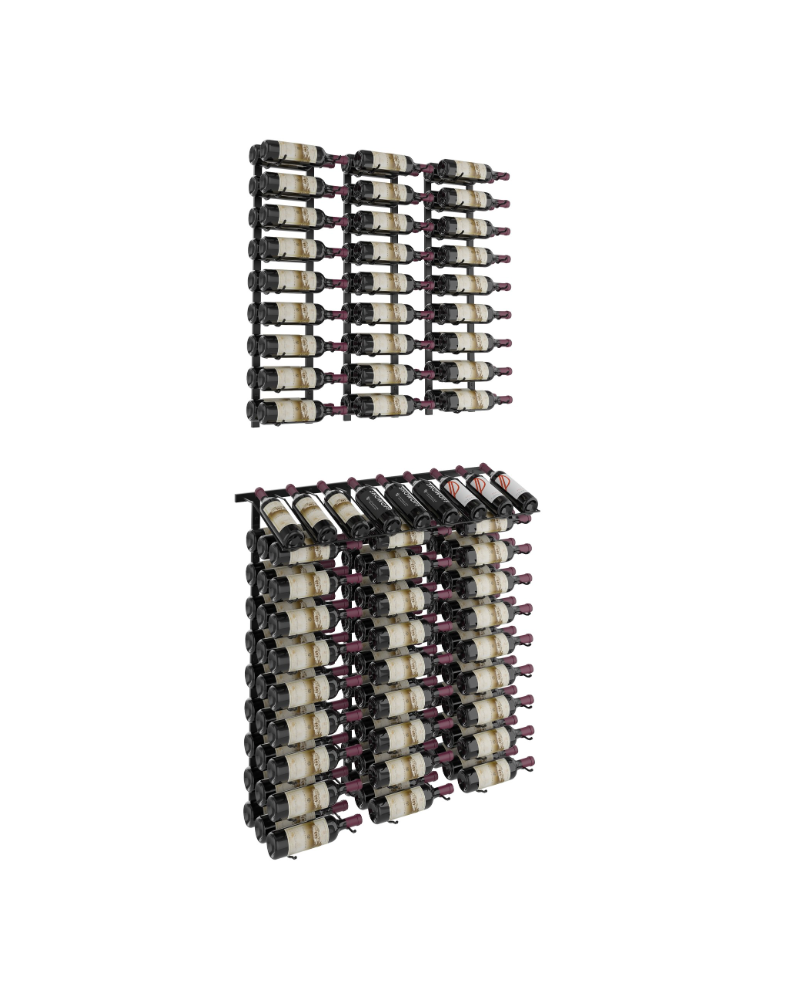 Matte Black Modular Wine Rack Display Kit (7-Piece Set)
The practical consequence is that a wall can start as a compact display and later become a floor-to-ceiling wine wall using the same family of parts. VintageView's kits illustrate the principle well: the Matte Black Modular Wine Rack Display Kit (7-Piece Set) holds 144 bottles, while the Deluxe 15-Piece Set scales to 288 standard bottles and 32 magnum bottles using the same modular logic.
 Matte Black Modular Wine Rack Display kit Deluxe (15-Piece Set)
Expandable vs. Fixed vs. Custom-Built Storage
Most wine storage guides compare rack styles on looks alone. The more useful comparison is on decision criteria: how much flexibility you need, how much space you have, how often your collection changes, and how much planning you're willing to do upfront. Expandable storage wins on adaptability, fixed racks win on simplicity, and custom-built joinery wins on fitting unusual architecture, but only expandable systems let you change your mind without starting over.
| Criterion | Expandable modular | Fixed rack | Custom-built |
|---|---|---|---|
| Flexibility after purchase | High, add, remove or rearrange elements | Low, capacity locked at purchase | Low, fixed once built |
| Best for | Growing collections, renters, renovators, hospitality | Stable collections, tight budgets | Awkward architecture, one-off interiors |
| Space requirements | Uses vertical wall area; floor stays clear | Depends on footprint; often floor-standing | Dictated by the room's geometry |
| Installation effort | Moderate, shared supports, repeatable elements | Low to moderate | High, bespoke fabrication and fitting |
| Reconfiguration | Straightforward with compatible parts | Not possible | Difficult and costly |
| Relocation | Can generally be dismantled and reinstalled | Possible but awkward | Usually not feasible |
| Long-term fit | Grows with the collection | Outgrown quickly, replacement cost | Fixed to the original brief |
| Main trade-off | Needs upfront layout planning | Capacity ceiling reached fast | Hard to alter, slow to deliver |
A simple way to choose: if you can honestly predict your bottle count for the next five years within about 10 percent, a fixed rack is fine. If your space has difficult geometry, a sloped ceiling, an under-stair void, an irregular alcove, custom-built solutions may be the only thing that fits cleanly. For everyone in between, which is most collectors and nearly all hospitality buyers, modular is the safer bet because it defers the capacity decision rather than locking it in.
The decision framework most buyers find useful:
- Collection trajectory: flat, steady growth, or unpredictable? Only flat collections suit fixed racks.
- Space type: standard wall, awkward corner, or full room? Modular handles the first two; custom handles the third.
- Time horizon: under three years, three to ten years, or permanent? Modular pays off across the middle band.
One practical note on compatibility: expandable systems only stay expandable if the parts you add later share the same support system and depth standard as the parts you bought first. Before committing to any modular family, confirm that the manufacturer still produces compatible elements, and buy the support structure for the wall you eventually want, not the wall you're building today.
Wine Rack Capacity Planning for Future Growth
Capacity planning starts with an honest count: current bottles, plus bottles you expect to acquire per year, multiplied by the number of years you want the wall to serve.
A simple planning method we recommend:
- Count every bottle you own today, including bottles in cases and overflow storage
- Estimate annual acquisitions from past purchasing patterns, not intentions
- Multiply by three to five years, the realistic planning horizon
For a collector sitting at 200 bottles and adding roughly 40 a year, planning for around 400 bottles over five years is more realistic than buying a 220-bottle wall and repeating the exercise in two years.
Wine Bottle Organization and Access
Bottle organization determines whether a large collection stays usable or becomes a storage problem you avoid. Label-forward display, consistent grouping and clear sightlines let you find a bottle without pulling out six others.
Group by region, varietal or drinking window, then keep the categories stable as the collection grows so new bottles slot into an existing logic. Single-depth storage keeps every label visible; double-depth and triple-depth configurations raise density but push rear bottles out of sight, so reserve deeper configurations for aging stock you rarely touch.
Matte Black Modular Wine Rack Display Kit (7-Piece Set) →
Wine Storage for Small Spaces: Odd Corners and Narrow Walls
Small or awkward spaces reward modular systems more than any other setting, because elements can be arranged around obstacles instead of forcing the space to suit a single rigid frame.
Wine storage for small spaces is really a question of using vertical room and unused wall area rather than floor space. Wall-mounted modular racks leave the floor clear, which matters in kitchens, home bars and corridors.
Modern Wine Storage Ideas That Scale With You
Modern wine storage ideas tend to converge on the same principle: treat the rack as part of the interior architecture, not as furniture pushed against a wall. A floor-to-ceiling matte black modular wall in a dining room, bottles displayed label-forward under warm lighting, does more for a room than a freestanding cabinet ever will.
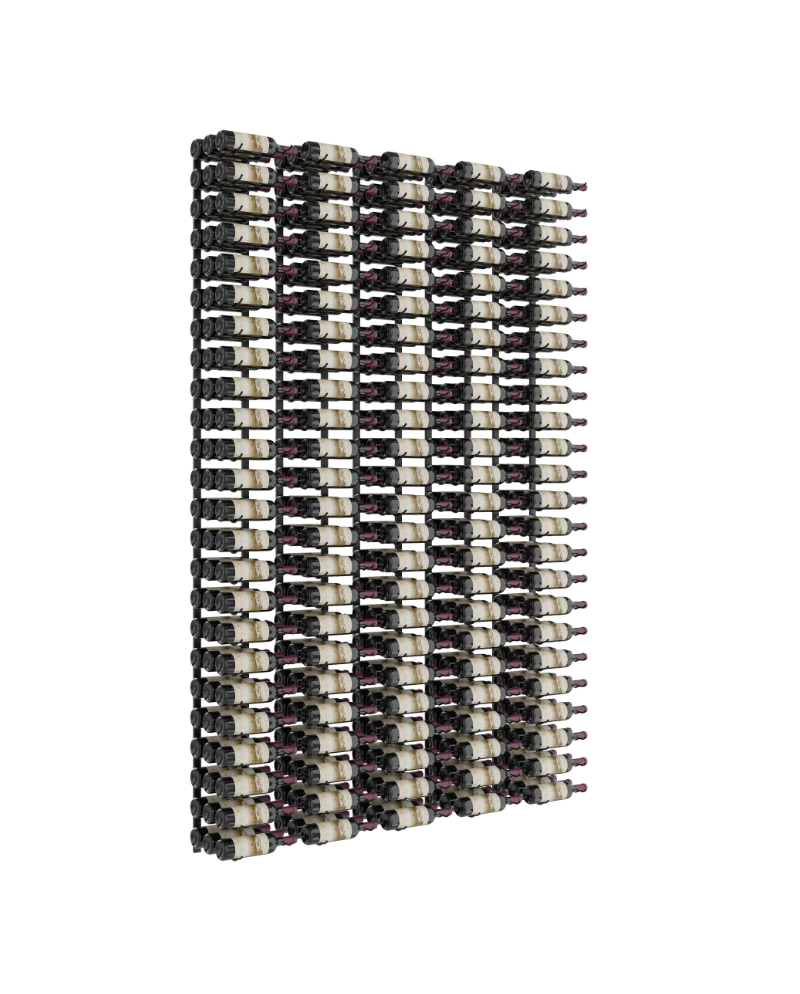 Matte Black Modular Wine Wall - WS7
Scaling is where design and practicality meet. A wall that begins as a 144-bottle display can extend upward and outward using the same components, and larger kits such as the Matte Black Modular Wine Wall WS7 at 315 bottles and the WS8 at 360 bottles show how far the same design language stretches.
 Matte Black Modular Wine Wall - WS8
Installation, Compatibility, and Structural Safety
Structural safety comes down to three things: the wall substrate, the weight of a full load, and the quality of the fixings. A loaded rack is heavy, and the load is concentrated where the supports meet the wall, so fixing into studs, masonry or properly rated anchors is not optional.
Compatibility matters too. Before buying elements from different sets, confirm they share the same support system and depth standard, because mixing systems mid-project is where most layout problems begin.
Costs and Total Cost of Ownership
Most wine storage articles either avoid cost entirely or quote a single headline figure that means nothing without context. The more useful approach is to break total cost of ownership into its components so you can compare systems on a like-for-like basis, and to recognise that the cheapest entry point is rarely the cheapest system over time.
The components that belong in any comparison:
- Initial kit or system cost. The entry purchase, whether a fixed rack, a modular starter kit, or a bespoke build.
- Cost per bottle of capacity. Divide the system cost by the bottle count it holds. This is the single most useful comparison figure, and it changes dramatically once you expand.
- Future expansion cost. The cost of each add-on element or extension. A system that looks cheaper per bottle at the entry point often loses that advantage the moment you expand it.
The pattern most buyers find is that expandable systems cost a little more thought and slightly more per bottle at the entry point, but considerably less regret later. A fixed rack sized for today's collection typically needs replacing within a few years once the collection grows, and the second purchase resets the cost-per-bottle calculation from scratch. A modular wall avoids that reset because each expansion is an add-on rather than a replacement.
For hospitality buyers, the calculation shifts again. Durability under daily use, the ability to reconfigure for a new floor plan, and the continuity of design language across an expanding display all belong in the same total-cost picture.
Conclusion
The hard part of wine storage isn't choosing a rack, it's predicting a collection that refuses to stay the same size. Expandable systems solve that problem by treating capacity as something you add to rather than something you commit to once. If you're planning a wall for a cellar, dining room or restaurant, explore the modular kits at Winerack Solutions and start with a layout built to grow.
Frequently Asked Questions
What are the benefits of an expandable wine storage system?
An expandable wine storage system grows with your collection instead of locking you into a fixed bottle count. You add modules as your cellar fills, so you avoid replacing a rack that is only two years old. Modular steel systems also let you reconfigure layouts when you move or renovate, and they typically deliver higher storage density per square metre than fixed units. For collectors planning to grow from 100 to 1,000 bottles, that flexibility saves both money and wall space over time.
Can modular wine racks be expanded as a collection grows?
Yes. Modular racks are built from repeating elements that connect to one another, so you can add capacity without removing what is already installed. A seven-piece kit holding 144 bottles can be extended later with additional racks or combined into a larger wall configuration. This is the core advantage over fixed racks: capacity planning becomes an ongoing process rather than a one-time guess. Plan your first layout with spare wall space in mind so future expansion stays simple.
How do you plan a wine storage system for a small space?
Start by measuring height, width, and depth, then use vertical space rather than floor space. A wall-mounted modular system can turn a narrow 60 cm gap or an awkward corner into usable storage. Choose single-depth racks for corridors and double-depth only where you have clearance. Count your current bottles, add 30 percent for growth, and pick a system that accepts additional modules. Label-forward display also helps you see what you own without pulling bottles out.
Are modular wine racks suitable for kitchens and wine rooms?
They work well in both. In kitchens, a compact wall display keeps everyday bottles within reach while doubling as a design feature. In dedicated wine rooms, floor-to-ceiling modular walls hold hundreds of bottles with high density. Steel construction handles the wear of a busy household or restaurant. Keep bottles away from direct sunlight, heat sources, and heavy vibration, and the same system that looks sharp in a dining room will perform in a working cellar.