
Last Updated: November 1, 2026
Quick Summary
The best space-saving wine rack designs mount bottles against wall space instead of floor space, using label-forward steel panels, Vino Pins, or floor-to-ceiling posts. A space-saving wine rack keeps clear floor area intact while turning your collection into part of the architecture, and modular panels scale from three bottles upward without widening the footprint.
- Wall Series panels hold three bottles label-forward each and stack in columns or rows to scale capacity.
- Label-forward wall racks typically project 100-150 mm, so confirm they clear door swings and walkways.
- Keep at least 50 mm around sockets, switches and radiators so the rack does not block access or trap heat.
- A floor-to-ceiling post kit holds up to 63 bottles without wall mounting and can act as a room divider.
- Fix directly into timber studs, use expansion anchors on masonry, and never substitute a lighter anchor.
Table of Contents
- Why Space-Saving Wine Rack Designs Suit Modern Interiors
- Wall-Mounted Wine Display Ideas for Compact Rooms
- Wine Rack Finishes for Modern Interiors
- Wine Wall Layout Ideas for Odd and Awkward Spaces
- Wine Rack Installation Planning for a Flawless Fit
- Load Capacity, Wall Types and Safety Before You Mount
- Room-by-Room Space-Saving Wine Rack Recommendations
- Choosing Your Modular Wine Rack System
- Frequently Asked Questions
Why Space-Saving Wine Rack Designs Suit Modern Interiors
The best space-saving designs that blend functionality with modern aesthetics for easy rack installation start with a simple shift in thinking: wine storage should occupy wall space, not floor space.
A space-saving wine rack is a mounting system that holds bottles against a wall, inside a recessed area, or along a structural post rather than in a freestanding cabinet.
Floor area is the scarcest resource in a modern apartment, kitchen, or dining alcove. Vertical space is usually empty. That gap is the entire opportunity.
Wall-Mounted Wine Display Ideas for Compact Rooms
Wall-mounted wine display ideas work best when the rack follows the wall's natural rhythm: a horizontal run above a sofa, a vertical column beside a doorway, or a tight grid in a narrow galley kitchen.
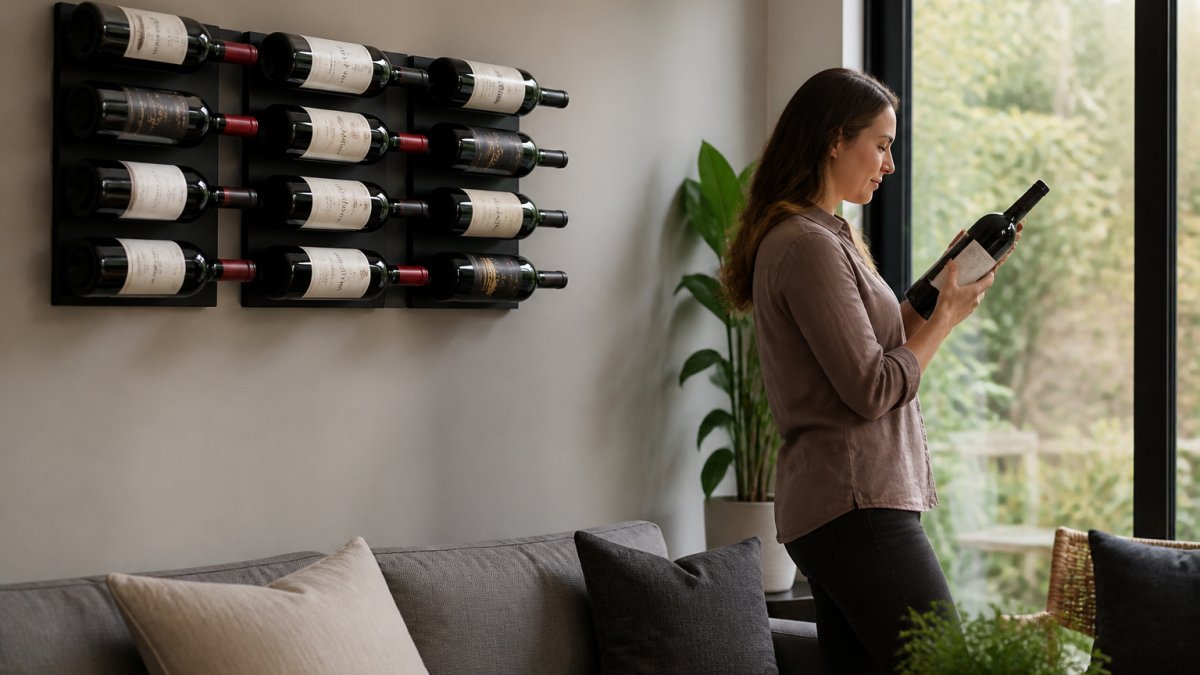 Matte black label-forward wine rack mounted on a living room wall above a sofa with warm ambient lighting
Label-Forward Wall Series and Vino Pins Configurations
Label-forward racks hold bottles horizontally with the label facing out, so every bottle is identifiable at a glance. Two configurations cover most compact rooms:
- Wall Series panels: fixed-depth steel racks such as the W11, which holds three bottles label-forward in a compact footprint, up through the larger W21, W31 and W41 panels. Stack them in columns or rows to scale capacity without widening the footprint.
- Vino Pins and Vino Rails: individual bottle holders that mount directly to the wall with proprietary anchors. Vino Pins suit a minimalist floating look; Vino Rails add collars for a more defined presentation.
For a compact room, a single column of Wall Series panels beside a doorway often stores more than a bulky floor cabinet, at a fraction of the footprint.
Wine Rack Finishes for Modern Interiors
Wine rack finishes for modern interiors come down to one decision: does the rack disappear into the wall, or become the feature? The answer depends less on taste than on three practical factors, how the finish wears, how it is maintained, and how it reads against the room's existing materials.
Matte Black, Bronze and Metallic Tones Compared
Matte black is the default for a reason. It recedes against pale plaster, holds contrast against white or concrete, and reads as deliberate in both residential and hospitality settings.
Chrome and polished steel are the least forgiving: they reflect every light source and every fingerprint, which is why they are rare in residential wine walls and more common in commercial displays where cleaning is scheduled.
A simple comparison of the common options:
| Finish | Best suited to | Maintenance | Watch-outs |
|---|---|---|---|
| Matte black powder coat | Modern, industrial, minimalist rooms | Wipe with dry cloth; no polish | Can look heavy on very small walls if over-scaled |
| Bronze / warm metallic | Traditional-modern blends, hospitality | Damp cloth, dry immediately | Shows water marks; avoid abrasive cleaners |
| Polished / chrome | Commercial, gallery-style displays | Frequent polishing | Fingerprints and glare; high upkeep |
| Mixed metal + black | Feature walls, statement runs | As per dominant finish | Needs deliberate pairing, not accidental mixing |
Matching Finish to Room and Lighting
Lighting changes the calculation.
Browse the matte black modular wine wall to see how a single finish carries an entire wall.
Wine Wall Layout Ideas for Odd and Awkward Spaces
A triangular under-stair void, a chimney breast recess, or a wall interrupted by a radiator will defeat any fixed-grid rack.
Under-Stair, Corner and Floor-to-Ceiling Solutions
Three layouts handle the awkward cases:
- Under-stair runs. Mount individual panels in a stepped line that follows the stair's slope. The triangular void becomes a display instead of dead space.
- Corner columns. A floor-to-ceiling post system, such as the 63-bottle floor-to-ceiling kit, builds a vertical column that needs no wall mounting and can act as a room divider. It turns an unused corner into a structural feature.
- Over-furniture walls. A modular run mounted above a sofa or console keeps the floor clear and uses the wall's upper half. The over-the-couch display is designed for exactly this.
Watch out: measuring the wall before ordering is not enough. Measure the obstructions too, including skirting, sockets, and anything that protrudes, because a panel that overlaps a socket cannot sit flush.
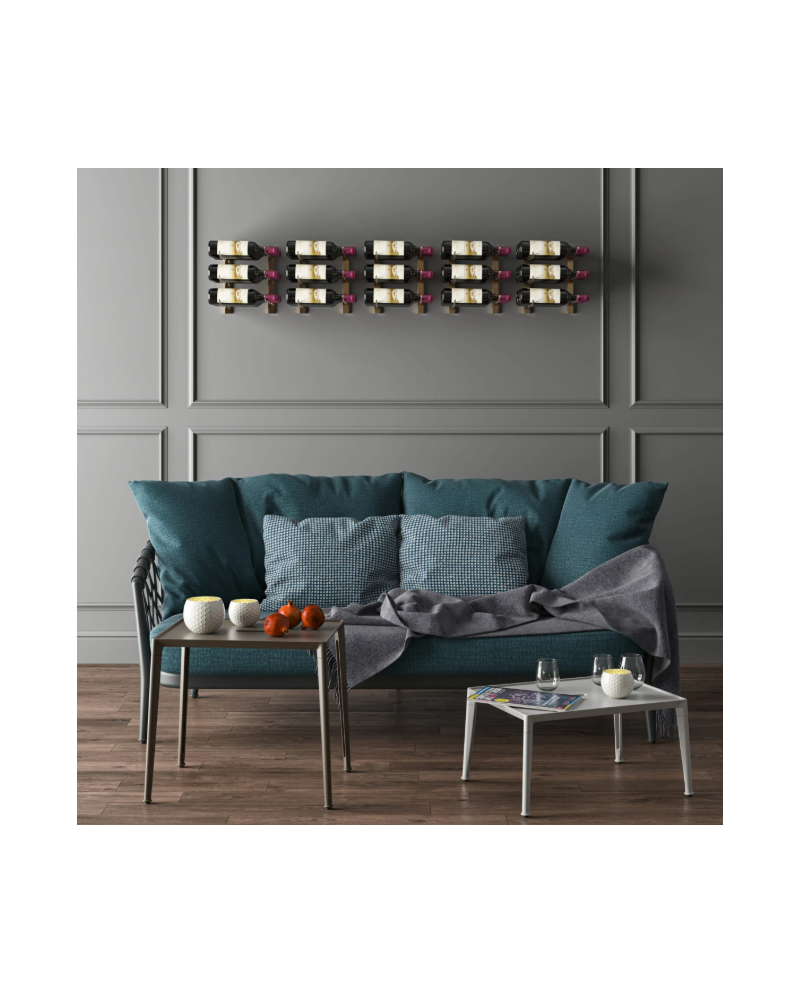 Matte Black Modular Wine Display Over the Couch
Wine Rack Installation Planning for a Flawless Fit
Wine rack installation planning starts with a paper layout, not a drill. Map the wall to scale, mark every stud, socket and obstruction, then place rack positions on the plan before anything is mounted. A thirty-minute planning session prevents the most common outcome: a display that is level, secure, and in the wrong place.
Measurements and Clearances to Confirm First
Before ordering, confirm these dimensions, they are the ones that most often force a redesign after delivery:
-
Usable wall width and height, excluding skirting and cornices.
-
Rack depth clearance. Label-forward wall racks typically project 100-150 mm from the wall; confirm the display clears door swings and does not intrude into a walkway narrower than about 900 mm.
-
Service clearances. Keep at least 50 mm around sockets, switches and radiators so the rack does not block access or trap heat.
-
Centre line. Decide the display's centre line first, then work outward, centring on a feature (a window, a console) looks intentional; centring on a stud rarely does.
Tools, Wall Types and the Fixing Decision
A typical modular rack install needs: a stud detector, a spirit level (a laser level speeds up long runs), a tape measure, a pencil, a drill with bits suited to the wall, the anchors supplied with the rack, and a screwdriver or driver bit. For masonry you will also need a masonry bit and possibly a hammer drill.
The fixing decision follows the wall, not the rack:
- Timber stud walls: fix directly into studs. Locate stud centres (commonly 400 mm or 600 mm apart) and align panel mounting points to them where possible.
- Masonry (brick, block, concrete): use expansion anchors rated for the load; avoid drilling into mortar joints where you can.
- Drywall without a stud behind the fixing point: use a rated toggle anchor, and route heavy loads to a stud wherever the layout allows.
A Practical Planning Sequence
- Measure the usable wall width and height, excluding skirting and cornices.
- Locate studs with a detector and mark their centres on the wall.
- Note sockets, switches, radiators and any pipe runs.
- Decide the display's centre line and work outward.
- Confirm the rack depth clears door swings and walkways.
- Check the fixing type suits the wall construction.
- Dry-fit the layout on the wall with pencil marks before drilling.
The last point matters most. Drywall, masonry and timber stud walls need different anchors, and a rack rated for one wall type is not automatically safe on another. Our Vino Pins and Rails are designed to mount direct to the wall, but the wall itself still has to be right for the load. If any of this is uncertain, have the wall assessed before drilling, a rack is only as secure as the surface behind it.
Load Capacity, Wall Types and Safety Before You Mount
Load capacity, wall types and safety decide whether a display stays on the wall for a decade or comes down in a hurry.
Three checks before you mount:
- Identify the wall. Timber studs take fixings directly into the frame. Masonry takes expansion anchors. Drywall alone needs either a stud behind the fixing point or a rated toggle anchor, and heavy loads should always reach a stud.
- Match the anchor to the load. Follow the fixing specification supplied with the rack, and never substitute a lighter anchor because it is what is in the drawer.
- Spread the load. A long horizontal run distributes weight better than a single concentrated cluster. Where a wall is marginal, more mounting points beat fewer.
If any of this is uncertain, have the wall assessed before drilling. A rack is only as secure as the surface behind it.
Room-by-Room Space-Saving Wine Rack Recommendations
Room-by-room planning beats a single generic layout, because every room has a different constraint. The kitchen lacks wall length. The dining room lacks floor. The cellar lacks nothing except organisation. Match the system to the constraint:
| Room | Constraint | Recommended approach | Typical capacity |
|---|---|---|---|
| Small kitchen | Short wall runs | Vertical column of Wall Series panels | 15-30 bottles |
| Living or dining area | Floor space | Horizontal run above furniture | 15-40 bottles |
| Under-stair void | Triangular shape | Stepped individual panels | 20-60 bottles |
| Open-plan space | No suitable wall | Floor-to-ceiling post | Up to 63 bottles |
| Cellar or wine room | Volume, not floor | Full modular wall kit | 100+ bottles |
For kitchens specifically, minimalist wine display ideas for small kitchens show how a narrow column fits beside a run of cabinetry without eating counter space.
Choosing Your Modular Wine Rack System
Choosing a modular wine rack system is a capacity decision first and a design decision second.
Capacity by system type:
- Single panels (W11 to W41): three bottles each, stacked to scale. Best for tight walls and phased builds.
- Vino Pins and Rails: one or two bottles per holder, arranged freely. Best for floating, gallery-style layouts.
- Complete kits: 15 to 144 bottles, pre-configured. Best when the wall is known and the collection is settled.
If you are still weighing systems, the modern wine display guide walks through the full range before you commit.
The hardest part of a compact wine display is not choosing a rack. It is trusting that a wall-mounted system will hold a collection worth more than the room around it.
Frequently Asked Questions
How can I display wine bottles in a small space?
Use vertical wall space rather than floor area. A space-saving wine rack such as a wall-mounted label-forward system keeps bottles off the floor and frees up room for furniture. The Wall Series W11 holds three bottles in a compact footprint. For tight alcoves, Vino Pins mount direct to the wall with a minimalist profile. Plan the layout on paper first so the rack fits the wall without crowding the room.
What makes a wine rack suitable for a modern interior?
Clean lines, a slim profile and a finish that matches the room's palette matter most. Label-forward designs turn bottles into a display rather than hidden storage. Modular systems let you scale the rack as your collection grows, so the piece stays proportionate to the room instead of dominating it.
How do I plan a space-efficient wine wall display?
Measure the available wall width and height, note where studs and power points sit, and decide how many bottles you want visible at once. A wine wall layout ideas session on paper helps you test grids, floating lines and diagonal patterns before drilling. Leave clearance around the display so bottles can be added and removed easily, and keep the layout modular so you can extend it later.
Which metal finishes work well in contemporary interiors?
Matte black is the most versatile choice for modern spaces because it recedes into shadow and lets the bottle labels carry the colour. It pairs well with light walls, natural timber and stone surfaces.
What should I consider before installing a wall-mounted wine rack?
Check the wall type first: drywall needs appropriate anchors, while masonry and studs offer more holding power. Mount into studs wherever possible, and plan the layout before drilling to keep mistakes to a minimum.
How do I choose a wine rack for a compact kitchen or wine room?
Start with the bottle count you need to store and the wall space you can spare. A 15-bottle kit such as the Matte Black Modular Wine Display Over the Couch suits a kitchen accent wall, while a floor-to-ceiling post kit holds up to 63 bottles without wall mounting. For a dedicated wine room, the 144-bottle seven-piece kit gives a striking full-wall display. Match the finish to the room and keep the system modular for future growth.
