
Table of Contents
- Why Minimalist Wine Displays Work in Small Kitchens
- Wall Mounted Wine Racks for Small Kitchens: Vertical Style
- Under Cabinet Wine Storage Ideas to Clear the Counter
- Integrating Displays into Kitchen Islands and Built-In Cabinetry
- Small Kitchen Wine Bar Ideas with Multi-Functional Furniture
- Maintenance and Installation: DIY vs. Professional
- Budget-Friendly Minimalist Hacks and Finishing Touches
- Conclusion: Curate Your Kitchen's Focal Point
- Frequently Asked Questions
Last Updated: September 7, 2026
Why Minimalist Wine Displays Work in Small Kitchens
A minimalist wine display is the practice of storing and showcasing bottles with clean lines, open space, and intentional restraint rather than bulky furniture. Small kitchens reward this approach because it keeps the room functional while turning a practical necessity into a design feature, freeing up valuable counter space that traditional wine racks consume.
The appeal goes beyond looks. Bottles stored horizontally keep corks moist, which preserves the wine, and sleek metal racks allow air to circulate around each bottle more effectively than closed cabinetry. Winerack Solutions offers modular systems that scale from small niches to complete wine cellars.
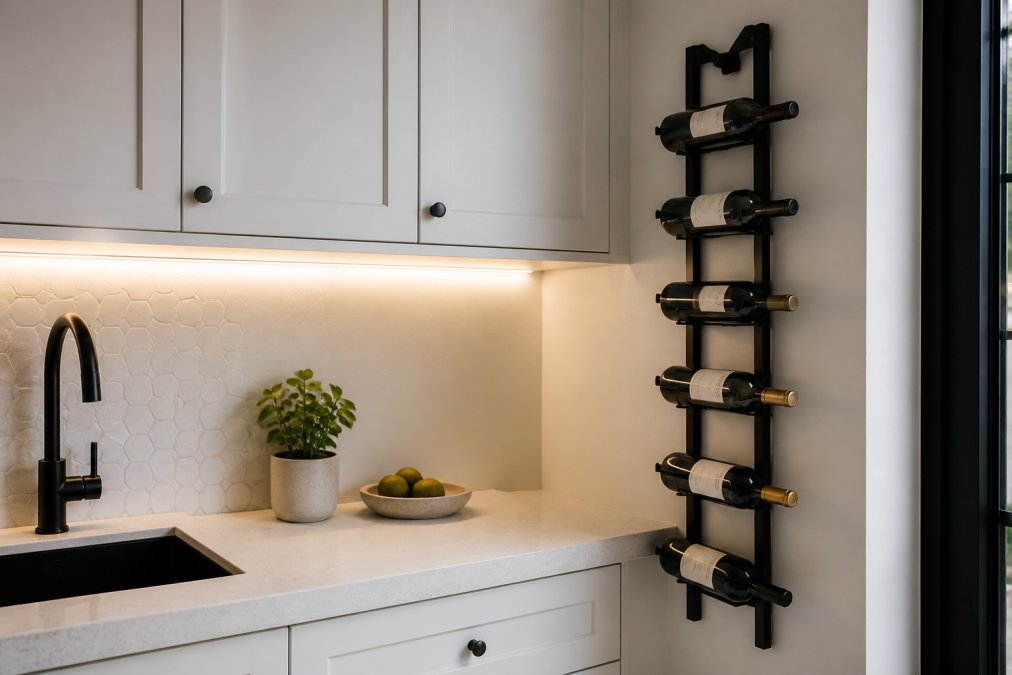 A bright, modern small kitchen with a sleek matte black wall-mounted wine rack holding several bottles, illuminated by subtle LED strip lighting beneath white shaker cabinets
The real advantage is that a well-chosen display becomes a custom focal point. Instead of hiding your collection, you let the bottles themselves contribute to the room's aesthetic appeal, aligning with contemporary design trends that favor open shelving and multi-functional furniture.
Wall Mounted Wine Racks for Small Kitchens: Vertical Style
Wall mounted wine racks for small kitchens are the single most effective way to add bottle capacity without sacrificing floor space. By using the vertical plane, you keep the kitchen layout open and the compact area below clear for prep work or foot traffic, while drawing the eye upward to make a low-ceilinged room feel taller.
The Math of Vertical Capacity
Before choosing a system, calculate the load. A standard 750ml bottle weighs roughly 2.65 to 3.5 pounds, so a six-bottle rack is a 16-to-21-pound load and a twelve-bottle configuration approaches 40 pounds (wineinstitute.org). Most residential wall studs are spaced 16 inches on center, and a rack spanning two studs can safely support 50 to 75 pounds when properly anchored (hud.gov). Beyond that threshold, you are engineering a structural element, not designing a display.
Mounting Mechanics: Studs, Anchors, and Spacing
The critical factor is weight distribution across the mounting points. A fully loaded rack exerts both downward shear force and outward pull, especially when bottles are removed at an angle. Lag bolts (minimum 3/8-inch diameter) driven directly into studs are the industry standard (osha.gov). If a stud is not where you need it, a 3/4-inch plywood backer board secured across two studs gives you a safe mounting surface, but this adds visual bulk, which works against a minimalist aesthetic.
Layout Patterns That Maximize Awkward Walls
For oddly shaped spaces, such as a narrow gap beside a refrigerator, a wall system with adjustable bottle orientation offers flexibility that pre-built units lack. A staggered or offset bottle arrangement, alternating neck-left and neck-right, reduces the depth required from roughly 14 inches to 9 inches.
Another overlooked layout is the corner wall mount. A 90-degree corner bracket system lets you wrap a rack around an inside corner, turning dead space into a deliberate architectural feature. Measure the corner clearance carefully: bottles need at least 2 inches of clearance from the adjacent wall for easy removal.
Finish and Heat Considerations Specific to Walls
Wall-mounted racks sit closer to ceiling-level heat and lighting than floor units. Choose a powder-coated finish, which handles temperature swings better than painted steel and resists the fine grease film that cooking generates. Position the rack at least 24 inches away from the stovetop exhaust vent, rising steam carries moisture and heat that degrade both the finish and the wine.
When to Expand Vertically vs. Horizontally
A vertical wall rack is not always the answer. If your collection exceeds 24 bottles, the wall space required becomes visually overwhelming. A combination of a modest wall rack (6 to 12 bottles) plus an under-cabinet system or a narrow floor-standing tower distributes the visual weight more effectively. Keep any single wall-mounted display under 36 inches in height to maintain a minimalist proportion in a standard 8-foot kitchen.
For a truly custom fit, measure your wall width and bottle count first, then select a modular system that matches those dimensions exactly. Modular designs let you expand upward as your collection grows and adapt to awkward wall widths that fixed racks cannot fit.
Under Cabinet Wine Storage Ideas to Clear the Counter
Under cabinet wine storage ideas solve the eternal small-kitchen problem of clutter by using the dead zone between countertop and upper cabinets. This typically wasted space is perfect for stemware holders and shallow bottle racks that keep everything within arm's reach.
The best configurations use a horizontal bottle orientation with a lip or rail to prevent rolling. Stemware hangs below, allowing glasses to dry and stay dust-free. This setup clears the counter for food preparation while keeping the wine ritual integrated into the cooking flow, and many designs incorporate display lighting for ambiance during evening entertaining.
Because this zone is close to heat sources like ovens, be mindful of temperature. A rack near the stovetop looks elegant but exposes bottles to frequent warmth, so position under-cabinet storage away from appliances that radiate heat.
Integrating Displays into Kitchen Islands and Built-In Cabinetry
Kitchen islands and built-in cabinetry offer the most seamless integration for a minimalist wine display. An island end panel can house a vertical display of bottles, turning a structural element into a conversation piece. Built-in cabinetry, meanwhile, can include dedicated wine slots with bottle dividers that keep each bottle stable and visible.
For interior designers and architects, this is where bespoke layouts shine. Custom cabinetry allows for precise bottle capacity planning, accommodating anything from a casual six-bottle selection to a serious collection. The key is designing the rack depth to match bottle length, which varies significantly between Burgundy and Bordeaux shapes.
An integrated system also supports multi-functional furniture. A kitchen island with a wine rack below and prep surface above serves double duty, maximizing utility in a compact area and appealing to homeowners who want the function of a wine cellar without dedicating an entire room to it.
Small Kitchen Wine Bar Ideas with Multi-Functional Furniture
Small kitchen wine bar ideas often rely on furniture that performs several roles at once. Console tables with built-in racks provide a serving surface while storing bottles below, working well against a wall or in a kitchen corner to create a dedicated wine bar without permanent construction.
Consider a cart or trolley with steel racks that can move between kitchen and dining area, a flexibility that suits renters. For a more permanent solution, a narrow vertical rack beside a console table offers additional capacity while maintaining a minimalist silhouette.
The defining trait of multi-functional furniture is that it adapts. As your collection grows, modular systems allow you to add tiers or swap configurations without replacing the entire unit, separating a thoughtful investment from a temporary fix.
Maintenance and Installation: DIY vs. Professional
Most minimalist wine display guides stop at aesthetics. What they miss, and what determines whether your rack survives its first year, is the practical reality of installation and upkeep in a working kitchen.
The DIY Decision Framework
A modest wall-mounted unit with included hardware is a straightforward afternoon project for most homeowners. You need a stud finder, a drill with a 3/8-inch masonry bit (if going into brick or tile), a level, and a socket wrench. The process: locate studs, mark mounting holes, pre-drill pilot holes, and torque the lag bolts to snug.
Step up to professional installation when any of these conditions apply:
- Tile or stone backsplash: Drilling through ceramic or porcelain requires a diamond-tipped bit and careful technique to avoid cracking. One mistake can cost more than the installation fee.
- Rack spans more than 36 inches: Longer spans multiply the risk of uneven weight distribution and require precise leveling across multiple studs.
- You are integrating into cabinetry or an island: Cutting into a cabinet panel or structural island end voids warranties and risks compromising the cabinet's integrity. A professional cabinet maker or installer will handle the cutout, reinforcement, and finishing correctly.
- The rack exceeds 60 pounds fully loaded: At this weight, the margin for error in anchoring is zero. A professional will verify stud placement, use appropriate hardware, and test the load.
For renters, the calculus is different. A DIY installation that requires drilling into walls may forfeit your security deposit. Consider a freestanding or tension-mounted system instead, or consult your landlord about approved mounting hardware.
Cleaning Routines That Preserve the Finish
Maintenance is simpler than many expect, but the wrong approach damages the rack. Wipe steel racks with a damp microfiber cloth to remove dust, and avoid abrasive cleaners that scratch the finish. For powder-coated surfaces, a mild dish soap solution (one drop per quart of water) removes cooking grease without dulling the coating. Never use ammonia-based glass cleaners on the rack itself, they can strip the protective clear coat.
Bottles in open displays collect dust on the shoulders, so a quick wipe-down before serving or decanting keeps presentation clean. A soft, dry cloth is sufficient; avoid wetting the label area, as moisture can cause paper labels to peel or fade.
The Annual Maintenance Checklist
Set a recurring calendar reminder for a yearly inspection. Check mounting screws and tighten as needed, especially in kitchens with heavy vibration from appliances. Look for signs of rust at the joints, this indicates the powder coat has been scratched and moisture is reaching the bare steel. Touch up any scratches with a matching automotive touch-up paint to prevent corrosion.
For under-cabinet racks, inspect the lip or rail that prevents bottles from rolling. Over time, repeated bottle removal can bend a thin rail. If you notice any flex, replace the rail before a bottle slides off and shatters.
The Unique Angle: Maintenance as a Design Decision
Here is what most guides ignore: the maintenance burden should influence which minimalist rack you buy in the first place. Open steel racks with wide bottle spacing are easier to clean than tight configurations where bottles sit flush against each other. A rack with 1-inch clearance between bottles allows you to wipe down both the bottle and the rack surface without moving every bottle. Similarly, a matte finish hides fingerprints better than a glossy one, but it is harder to clean grease from, the texture traps residue. If your kitchen is high-traffic and you cook frequently, a satin or brushed finish offers the best compromise between aesthetics and cleanability.
For those who prefer a hands-off approach, professional installation guarantees that weight distribution and wall anchoring are handled correctly. This is particularly relevant for hospitality settings where durability and security matter, and where a failure could be costly. A professional will also advise on placement relative to heat sources, a consideration that protects both your rack and your wine's longevity.
Budget-Friendly Minimalist Hacks and Finishing Touches
A minimalist wine display does not require a full renovation. A simple steel rail system mounted under a shelf creates instant vertical storage for a fraction of the cost of cabinetry. Similarly, repurposing an existing open shelf with bottle dividers adds structure without new furniture.
For finishing touches, consider LED strip lighting to highlight the bottles and add depth to the display. Rustic accents, such as a wooden shelf paired with metal racks, introduce warmth without compromising the clean look. The goal is to curate a custom focal point that reflects your taste while remaining functional.
Conclusion: Curate Your Kitchen's Focal Point
Transforming a small kitchen with a minimalist wine display is about making smart use of vertical space and choosing systems that scale with your collection. Whether you opt for a wall-mounted rack, under-cabinet storage, or an integrated island feature, the principles remain the same: prioritize weight safety, protect bottles from heat, and select finishes that complement the room.
The challenge for most homeowners is finding a system that balances aesthetic appeal with practical capacity. Winerack Solutions addresses this with modular, premium steel racks available in multiple finishes, from matte black to golden bronze, with expert assistance for layout and capacity planning. Installation is straightforward, with all necessary hardware included.
Shop Now! and turn your kitchen's unused wall into a stunning display that preserves your wine and elevates your interior design.
Frequently Asked Questions
What are some good wine storage ideas for small spaces?
For small kitchens, prioritize vertical and underutilized spaces. Wall-mounted racks free up counter space, while under-cabinet stemware holders and bottle racks use areas that are otherwise empty. Consider a slim, freestanding wine cabinet or a rack integrated into a kitchen island for a multi-functional approach. The key is to choose systems that match your collection size and kitchen layout without overwhelming the room.
Are wall-mounted wine racks good for small kitchens?
Yes, wall mounted wine racks are excellent for small kitchens because they use vertical space and keep bottles off counters. They can turn an empty wall into a design focal point. When choosing one, ensure it is mounted into wall studs to support the full weight of your collection. Look for modular systems with a minimalist aesthetic that complement your kitchen's existing style and offer the bottle capacity you need.
How do I store wine in a small kitchen without a cellar?
Without a cellar, create a dedicated wine display area in your kitchen that balances aesthetics with practical storage. Use a combination of under cabinet wine storage for everyday bottles and a wall-mounted rack for display. For a minimalist look, integrate a wine rack into existing cabinetry or a kitchen island. Focus on maintaining a stable temperature away from the oven and direct sunlight to protect your wine.
What are the latest minimalist wine storage trends?
Current minimalist trends favor sleek metal racks in finishes like matte black, brushed nickel, or golden bronze. The focus is on creating a custom focal point using vertical displays and integrated systems. Multi-functional furniture, such as console tables with built-in wine storage, and open shelving with dedicated bottle slots are also popular. These designs prioritize clean lines and contemporary aesthetics over traditional, bulky wine racks.
What should I consider when choosing a wine rack for a modern kitchen aesthetic?
When choosing a rack for a modern aesthetic, focus on materials and form. Select sleek metal racks with a minimalist profile rather than ornate wooden designs. Consider the bottle orientation and whether the rack supports a horizontal position to keep corks moist. Think about the overall kitchen layout and how the rack integrates with existing cabinetry or wall space. A modular system offers flexibility to scale as your collection grows.