
Table of Contents
- Understanding Custom Wine Rack Design for Professionals
- Space Planning for Wine Collections: Layout and Capacity
- Modular Wine Storage Systems for Restaurants and Commercial Venues
- Wine Display Lighting Techniques and Aesthetic Integration
- Commercial Wine Cellar Design Standards and Structural Integrity
- Material Selection and Finishes for Premium Wine Displays
- Design Consultation and Custom Implementation for Professionals
- Frequently Asked Questions
Last Updated: September 27, 2026
Understanding Custom Wine Rack Design for Professionals
Custom wine rack design for professionals combines structural engineering, aesthetic vision, and practical storage. Professional-grade designs account for load-bearing capacity, climate integration, and scalability, factors that determine success.
In commercial settings, wine walls drive revenue and influence customer perception while withstanding daily wear. Private collections serve as both preservation systems and interior statements. Both demand precision in planning.
VintageView's modular systems engineer for flexibility, adapt to irregular spaces, scale as collections grow, and maintain structural integrity under weight.
Space Planning for Wine Collections: Layout and Capacity
Professional wine storage begins with honest space assessment. Overestimating available space or underestimating capacity needs leads to wasted costs or outgrowing your system within 18 months.
Calculating Bottle Capacity and Configuration
Measure wall dimensions and determine your collection profile: percentage of standard bottles versus magnums. Standard bottles are roughly 7.5 cm in diameter; magnums nearly double that.
Adapting Modular Systems to Irregular Spaces
Irregular spaces, under stairs, sloped ceilings, alcoves, present planning challenges. Modular systems solve this by allowing individual rack placement rather than requiring uniform grids. Position racks at varying heights to match slopes or asymmetrical geometry.
Modular Wine Storage Systems for Restaurants and Commercial Venues
Commercial wine displays operate under different constraints: bottles move constantly, staff retrieves at speed, and displays must survive thousands of annual interactions while maintaining premium appearance.
Durability and Security in High-Traffic Environments
Commercial-grade systems use steel frame construction, powder-coated finishes, and reinforced mounting points to withstand repeated handling. Aesthetic integration matters equally, matte black finishes create sophisticated contrast while hiding fingerprints and dust, and high-reveal displays showcase labels to drive impulse purchases.
Scalability as Your Collection Grows
Collections often grow from 200 to 400-500 bottles within two years. Modular design prevents outgrowing your system, add new modules rather than replacing the entire installation. VintageView's W33 and W43 racks stack vertically and horizontally, accommodating growth and seasonal shifts without new installations.
Wine Display Lighting Techniques and Aesthetic Integration
Lighting transforms wine displays from functional storage into architectural features. The right approach enhances bottle visibility, creates ambiance, and critically, protects wine from UV and infrared exposure, a preservation concern that directly impacts the value of collections worth thousands of dollars.
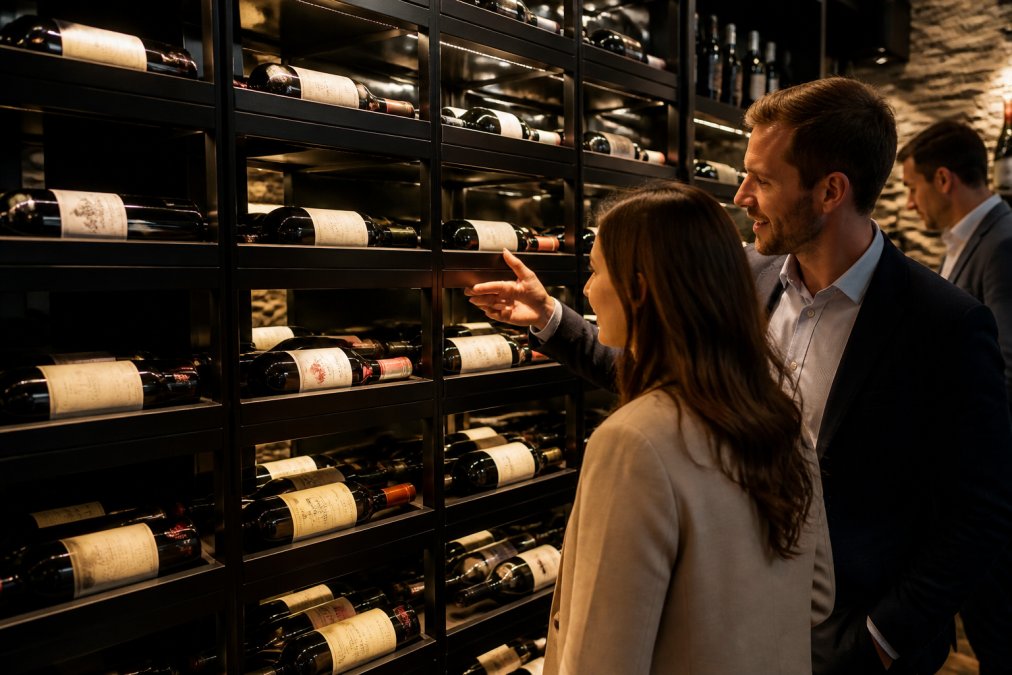 Modern wine cellar featuring label-forward matte black racks illuminated by warm integrated LED spotlights.
UV Protection and Wine Preservation
Ultraviolet light degrades wine through photochemical reactions that break down color compounds and accelerate oxidation. Professional installations prioritize UV-filtered lighting systems to prevent premature aging.
Color Temperature and Visual Hierarchy
Color temperature (measured in Kelvin) shapes bottle appearance and influences ambiance, affecting customer perception and staff retrieval efficiency.
Lumen Output and Glare Control
For accent lighting on wine racks, target 50-150 lux at the bottle surface, depending on ambient room lighting. Professional lighting designers calculate this based on room dimensions and existing ambient light.
Material Finish and Lighting Interaction
Matte black finishes absorb light, creating depth and visual separation. They require slightly higher lumen output than reflective finishes but hide dust and fingerprints far better, and create dramatic shadows that emphasize bottle shape and label detail.
Installation Considerations for Lighting Integration
Lighting integration begins during design. VintageView's modular racks accommodate LED strip integration at the top of each section. For commercial installations, coordinate lighting with electrical infrastructure and use dimmer controls. Test a sample section in the actual space before final installation to verify light interaction, shadow placement, and label legibility.
Commercial Wine Cellar Design Standards and Structural Integrity
Professional wine storage demands structural rigor that casual displays can skip. When bottles worth thousands of dollars hang on your wall, the engineering must be bulletproof.
Load-Bearing Requirements and Wall Assessment
A fully loaded wine wall weighs significantly. A wall holding 300 standard bottles (1.5 kg each) carries 450 kg of weight. Add the rack system itself, and you need proper wall assessment before installation.
Matte Black Modular Wine Wall - WS8 →
Climate Control Integration and Cork Hydration
Wine preservation depends on stable temperature (12-15°C) and humidity (50-80%). Position displays away from direct sunlight, heating vents, and air conditioning returns. For dedicated wine rooms, invest in proper climate control to protect both wine and system integrity. Maintain humidity above 50% to prevent cork drying and oxygen ingress.
Material Selection and Finishes for Premium Wine Displays
Material choice determines longevity and aesthetic impact. Professional displays demand materials that withstand significant weight, resist corrosion in humid environments, and maintain appearance through years of handling.
Steel Frame Construction and Load-Bearing Capacity
Steel frames support significant weight while remaining rigid under stress, maintaining alignment over time. Professional wine racks use mild or cold-rolled steel finished with protective coatings to resist corrosion in humid environments.
Powder-Coat Finishes: Durability and Maintenance Reality
Powder-coat finishes provide superior durability through a thick, cross-linked polymer layer that resists scratching, chipping, and corrosion. They require regular dusting and occasional wiping in humid environments. Small damage is cosmetic; significant damage requires professional refinishing. Proper installation prevents unnecessary damage.
Matte vs. Polished Finishes: Aesthetic and Functional Trade-Offs
Matte black finishes dominate professional installations because they hide dust and fingerprints, create visual depth, and require less frequent cleaning than polished surfaces. The trade-off: matte finishes absorb light, requiring slightly brighter accent lighting. Polished finishes show every fingerprint and require constant maintenance, making them rarely chosen for professional displays.
Corrosion Resistance in Humid Environments
Wine cellars and basements maintain humidity levels of 60-80% or higher. This moisture accelerates corrosion on unprotected metal. This is why material selection and finish quality directly impact system longevity.
Material Specifications for Professional Evaluation
When evaluating modular wine rack systems, request material specifications that include:
- Steel grade and thickness: Verify that frame material is rated for your intended load
- Surface preparation: Confirm that steel is cleaned and treated before finishing
- Powder-coat specification: Ask for the coating thickness (typically 60-100 microns for professional applications) and the curing process
- Finish type: Specify matte, polished, or specialty finishes, and understand the maintenance requirements for each
- Warranty: Professional systems typically offer 5-10 year warranties against finish failure and structural defects
Design Consultation and Custom Implementation for Professionals
Most successful professional wine installations begin with design consultation, not DIY planning or generic templates. This step separates installations that enhance spaces from those that feel retrofitted or awkward.
A proper consultation addresses:
- Space analysis: Measuring dimensions, identifying structural constraints, assessing wall condition
- Collection assessment: Understanding your bottle profile, growth trajectory, and display priorities
- Aesthetic integration: Ensuring the wine wall complements existing design rather than competing with it
- Functional workflow: In commercial settings, optimizing retrieval efficiency and sightline visibility
- Climate and preservation: Integrating temperature and humidity considerations into the design
| Design Element | Residential Priority | Commercial Priority |
|---|---|---|
| Load-bearing assessment | Recommended | Mandatory |
| Climate control | Important | Critical |
| Scalability | Moderate | High |
| Aesthetic finish | Personal preference | Brand-aligned |
| Security features | Optional | Essential |
Frequently Asked Questions
What are the key structural requirements for custom wine rack design in commercial spaces?
Professional wine rack installations must account for load-bearing capacity, wall stud placement, and anchor strength. Each bottle weighs approximately 1.5 kg, so a 360-bottle system like the Matte Black Modular Wine Wall WS8 requires walls capable of supporting 540+ kg. Assess wall composition, use appropriate fasteners, and verify structural integrity before installation. Climate-controlled environments also need airflow circulation to maintain cork hydration and prevent temperature fluctuations that damage bottles.
How do modular wine storage systems for restaurants improve efficiency compared to fixed installations?
Modular systems allow restaurants to expand capacity as their wine program grows without replacing the entire installation. They adapt to irregular spaces, accommodate different bottle sizes (standard, magnum, case storage), and enable reconfiguration as menu offerings change. Modular designs also simplify maintenance and cleaning in high-traffic hospitality environments, reducing downtime and extending system durability in busy commercial venues.
What's the ideal depth and spacing for wine display in professional settings?
Standard bottle depth is 75-80 mm for horizontal storage, though magnum bottles require additional space. High-reveal display configurations position bottles label-forward, maximizing visual impact while allowing easy identification. Professional installations typically use metal wine pins or steel frame construction to support cork-forward or label-forward orientation. Spacing between bottles should allow for airflow circulation and prevent cork compression over time.
Can custom wine rack systems handle oddly-shaped spaces like areas under stairs?
Yes, modular wine storage systems are engineered for flexible racking configurations and space optimization. Individual components can be arranged vertically, horizontally, or in staggered patterns to fit triangular, sloped, or narrow areas. The Matte Black Modular Wine Display Showcase offers 16 individual single-bottle racks that allow complete layout freedom, enabling you to design around architectural constraints while maintaining structural integrity and aesthetic appeal.
How do interior professionals work with custom wine rack designers to create bespoke installations?
Design consultation begins with space assessment, bottle capacity planning, and aesthetic integration into the overall interior. Professionals provide site measurements, wall composition details, lighting preferences, and design objectives. Premium providers offer material selection (matte black finishes) and layout optimization. This collaborative approach ensures installations meet both functional requirements and design vision while maintaining long-term durability and cork preservation.
What materials ensure premium durability and aesthetic quality in professional wine displays?
Steel frame construction with powder-coated finishes (matte black) provides superior durability in commercial environments. Modular rack systems resist corrosion and maintain structural integrity under constant temperature and humidity changes. Finishes should be professionally applied to ensure consistency and premium appearance. High-quality materials support long-term cork hydration, prevent airflow obstruction, and maintain label visibility without fading or degradation over years of use.
How does wine room layout planning differ between residential and commercial applications?
Residential wine cellars prioritize aesthetic integration, cork hydration, and personal collection display. Commercial venues require durability, security, rapid bottle access, and compliance with health/safety standards. Restaurant installations must accommodate staff workflow, high-traffic handling, and frequent inventory rotation. Professional design accounts for ambient lighting, case storage for bulk inventory, and climate control integration. Both require structural assessment, but commercial spaces demand reinforced systems rated for 540+ kg and anti-theft considerations.