
Table of Contents
- Why Commercial Grade Wine Racking Systems Matter for Your Business
- Quick Comparison: Commercial Grade Wine Racking Options
- Retail Wine Display Ideas That Drive Sales and Engagement
- Commercial Wine Cellar Design: Layout, Capacity, and Climate Integration
- Material Options: Powder-Coated Steel vs. Wire vs. Solid Wood Alternatives
- Compliance, Seismic Safety, and Anti-Tip Requirements
- Maintenance and Sanitation Protocols for High-Traffic Venues
- Frequently Asked Questions
Last Updated: September 14, 2026
Why Commercial Grade Wine Racking Systems Matter for Your Business
Commercial grade wine racking systems are engineered storage structures built to hold full bottle loads safely in retail, restaurant, and hospitality environments where appearance and durability both matter. This guide from Winerack Solutions breaks down the options, the safety rules, and the layout decisions that separate a display that sells from one that sags.
A residential rack is designed for a spare room. A commercial one has to survive daily handling, constant cleaning, and bottles moving in and out every week. That difference shows up in the joints, the finish, and the hardware.
Safety is the part most buyers underestimate. HSE guidance on safe storage and racking in the workplace treats loaded racking as a structure, not furniture, and expects it to be rated, anchored, and inspected. Get that wrong and the failure is expensive.
Below, we cover how to compare systems, plan capacity, choose materials, and keep the racking compliant and clean.
Quick Comparison: Commercial Grade Wine Racking Options
The right system depends on your wall structure, your bottle count, and how often staff restock. Here is how the main formats compare.
| System Type | Best For | Capacity Range | Key Strength |
|---|---|---|---|
| Wall-mounted modular | Bars, tasting rooms, tight walls | 3-60 bottles | Saves floor space |
| Freestanding display | Retail floors, flexible layouts | 60-500+ bottles | Reconfigurable |
| Floor-to-ceiling | Cellar rooms, feature walls | 200-1,000+ bottles | Maximum density |
| Retail display islands | High-traffic shop floors | 100-400 bottles | Merchandising focus |
Wall-mounted units suit venues with limited floor area. Freestanding displays win when you expect to move things around. Floor-to-ceiling builds maximize vertical storage but demand proper load-bearing assessment.
For a compact starting point, the Winerack Wall Serie W11 holds three bottles label-forward in matte black, which works well for a small bar or a retail feature wall.
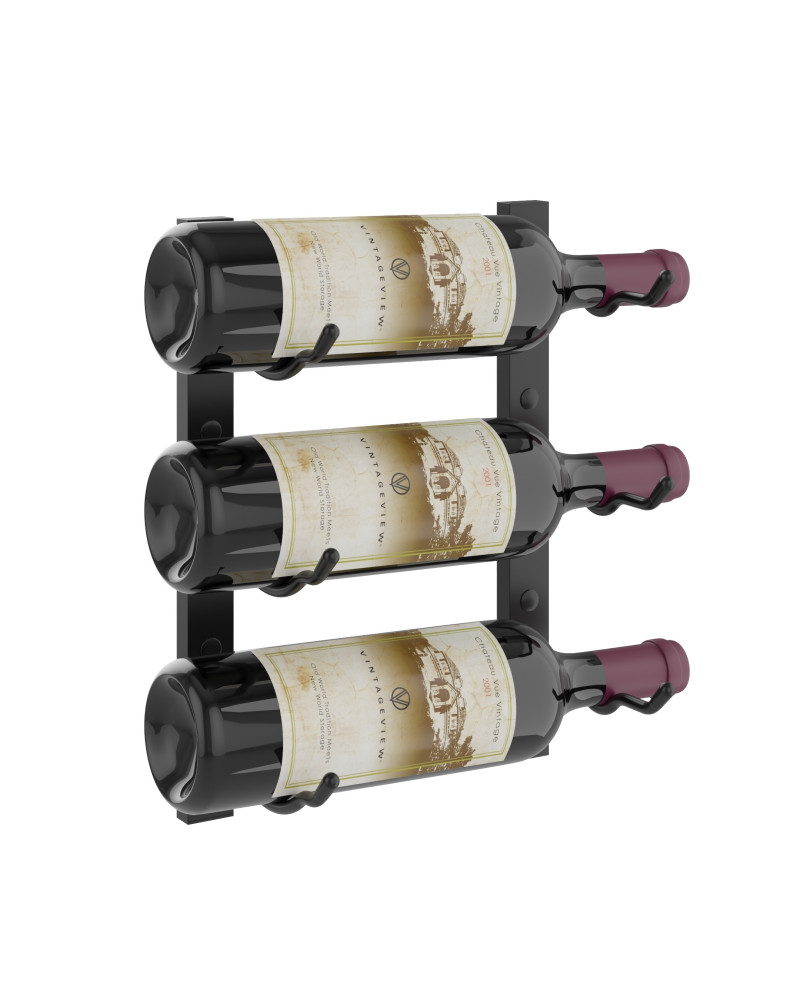 Winerack Wall Serie W11 - Depth 1 bottle
Retail Wine Display Ideas That Drive Sales and Engagement
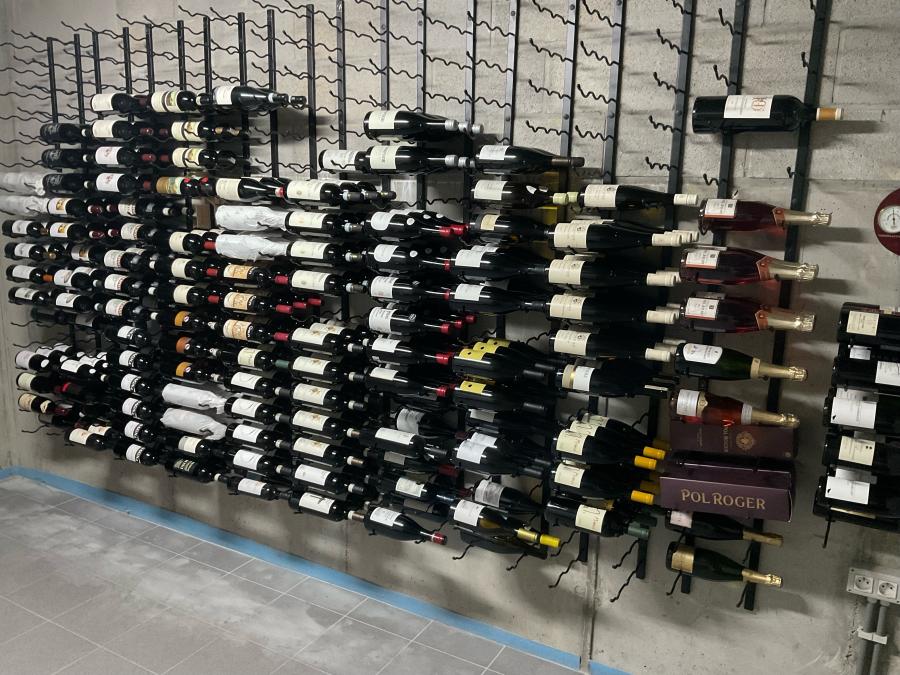
Label-forward display is the single biggest merchandising lever in a retail setting. Shoppers buy what they can read, so racks that show the label rather than the capsule consistently outperform neck-out storage. But the layout around that principle is where most stores leave money on the floor.
 2024 08 19 16.29.10
The mechanics that matter:
- Sight-line zoning. The first 1.5 metres inside the entrance is the highest-conversion zone. Put your highest-margin or most giftable bottles there, at eye level (roughly 1.4-1.6 m from the floor).
- Vertical runs at eye level for your highest-margin bottles, with backstock above and below.
- Island displays that create a walk-around browsing loop, shoppers who circle an island spend longer in the aisle than those who walk past a wall.
- Backlit feature walls that draw the eye to a single region or producer. Use warm-white LEDs (2700-3000K) so labels read true; cool-white washes out reds and makes premium bottles look cheap.
- Price-band grouping. Group by price band or occasion, not alphabetically. Buyers shop by occasion, and a display that mirrors that decision sells faster.
What most guides miss is the relationship between rack depth and browsing behaviour. A single-depth label-forward rack encourages a quick scan. A double-depth rack with a stepped profile encourages pick-up and handling, which correlates with higher conversion. If floor space allows, mix both: single-depth on the perimeter for scanning, double-depth on islands for handling.
Finally, keep the display restocked to a consistent fill level. A half-empty rack reads as "picked over" and suppresses browsing. Set a reorder trigger at roughly 70% fill so staff top up before the display looks depleted.
Commercial Wine Cellar Design: Layout, Capacity, and Climate Integration
Great commercial wine cellar design starts with capacity planning, not aesthetics. Measure the wall, count the bottles, then choose the format.
Planning Bottle Capacity and Scalability
Plan for growth, not your current inventory. A common mistake is buying to fit today's stock and hitting a wall within two years.
- Measure usable wall height and width before ordering
- Add 30-40% headroom over current bottle count
- Choose modular racking kits so you can extend runs later
- Confirm the wall can take the load, or specify freestanding units
Modular systems let you add sections without replacing the whole installation. That is the difference between a rack you outgrow and one you extend.
Integrating Racking with Cooling Systems
Racking and cooling have to be designed together. Blocked airflow is the most common cause of hot spots in climate-controlled rooms.
- Leave clearance behind racks for air circulation
- Avoid placing dense storage directly in front of evaporator units
- Keep sensors clear of bottle stacks so readings stay accurate
- Match rack depth to the room's cooling capacity
Get this wrong and your climate control works harder for worse results.
Material Options: Powder-Coated Steel vs. Wire vs. Solid Wood Alternatives
Material choice drives load rating, cleaning time, and how the rack looks after five years of daily service. The three formats behave very differently under commercial loads.
Powder-coated steel is the default for front-of-house and back-of-house alike. A properly cured powder coat resists moisture, wipes clean with a damp cloth, and holds color under UV and cleaning chemicals. Look for a coating thickness in the 60-80 micron range and a pre-treatment stage (phosphate or similar) before the powder is applied, that combination is what prevents chipping and corrosion at the joints. Steel frames also accept the highest load ratings per linear foot, which matters once you exceed a few hundred bottles.
Wire systems are lighter and cheaper per bottle, but the trade-off is deflection. A wire shelf rated for 40 kg may sag visibly under a full row of bottles, and the open structure collects dust on every horizontal run. Wire works for back-of-house overflow, case storage, or short-term display, not for a permanent front-of-house feature wall. If you specify wire, check the deflection rating at full load, not the static capacity.
Solid wood alternatives look warm and photograph well, but in a humid cellar or a venue with daily cleaning, they need more upkeep. Wood can bow under sustained weight, and unfinished surfaces absorb spills and cleaning residue. Where wood is used commercially, it is usually as an accent panel or a facing element over a steel frame, not as the load-bearing structure.
| Material | Load Rating (typical) | Cleaning Effort | Best Use |
|---|---|---|---|
| Powder-coated steel | Highest per linear foot | Low, wipe-clean | Front-of-house, high-traffic |
| Wire | Moderate, prone to deflection | High, dust collects | Back-of-house overflow |
| Solid wood alternatives | Varies; can bow under load | Moderate to high | Accent or low-traffic areas |
One more specification worth confirming: the hardware. Bolted connections with zinc-plated or stainless fasteners hold up far better in a damp cellar than untreated steel. If the rack will sit near a kitchen or a wash-down area, specify stainless hardware even if the frame itself is powder-coated steel.
Compliance, Seismic Safety, and Anti-Tip Requirements
Anti-tip anchoring is not optional in commercial premises. Loaded racking that is not secured to a load-bearing wall or floor is a serious liability in any venue open to staff and the public.
Key requirements to plan for:
- Anchor wall-mounted units into studs or masonry, never drywall alone
- Use anti-tip brackets on freestanding and floor-to-ceiling systems
- Specify reinforced joints for runs over a certain height
- Confirm industrial-grade hardware rated for the full loaded weight
Seismic zones add further requirements, so check local building rules before installation. HSE guidance on racking inspection and load safety recommends regular checks of anchors and joints, since vibration and repeated loading loosen fittings over time.
Maintenance and Sanitation Protocols for High-Traffic Venues
A monthly inspection cycle catches most racking problems before they become failures. High-traffic venues should check anchors, joints, and finishes more often than a private cellar would.
The routine that works:
- Wipe rails and shelves weekly with a damp cloth
- Check anchor bolts and anti-tip brackets monthly
- Inspect welded and bolted joints for movement quarterly
- Touch up any chipped powder coating promptly
- Re-torque fasteners on floor-to-ceiling runs twice a year
Cleaning matters for more than appearance. Dust and residue build up on horizontal surfaces, and in food-service settings that becomes a hygiene issue. A wipe-clean powder-coated finish makes this faster than wire or unfinished wood.
Food Standards Agency guidance on cleaning and hygiene in food businesses applies to any venue serving wine alongside food, so build racking cleaning into your existing schedule rather than treating it separately.
That is the operational side. The commercial side is simpler: racking that stays clean, stable, and well-lit sells more wine and lasts longer.
Frequently Asked Questions
What makes a wine racking system 'commercial grade'?
Commercial grade wine racking systems are built to handle continuous use in retail, restaurant, and hospitality settings. They use heavier steel gauges, reinforced joints, and load-bearing hardware rated for full bottle capacity. Unlike residential racks, they meet anti-tip and seismic safety standards, support modular expansion, and are finished with industrial-grade powder coating to resist chipping and moisture. The Wall Serie W11 from Winerack Solutions is an example of a compact steel rack designed for label-forward display in commercial environments.
How do you maximize bottle capacity in a retail wine display?
Start with vertical storage and floor-to-ceiling configurations to use every centimetre of wall height. Label-forward racks let you display more bottles in less depth while keeping labels readable for shoppers. Modular racking kits can be combined into custom configurations that fit odd spaces, such as under stairs or along narrow walls. Plan for at least 20% extra capacity beyond your current inventory so you can scale without replacing the entire system.
What safety considerations are required for commercial wine displays?
Commercial wine displays must address anti-tip anchoring, seismic safety, and load-bearing limits. Every wall-mounted or freestanding unit should be fixed to structural supports with installation hardware rated for the total weight of a full bottle load. In earthquake-prone regions, reinforced joints and lateral bracing are essential. Check local building codes for seismic restraint requirements. Heavy-duty systems designed for commercial use include these features as standard rather than as add-ons.
How do modular wine racks benefit hospitality businesses?
Modular wine racks let restaurants, bars, and hotels reconfigure storage as their wine list changes. You can add sections, switch between vertical storage and horizontal display, or relocate racks during renovations without buying a whole new system. Modular racking kits also simplify installation because each section is smaller and lighter. For busy venues, powder-coated steel modules resist wear and are easy to wipe down during daily sanitation routines.
Choosing commercial grade wine racking systems comes down to matching format, material, and safety rating to how your venue actually operates. Winerack Solutions builds modular, powder-coated steel systems with reinforced joints, anti-tip hardware, and label-forward display options that scale as your collection or stock grows. Explore the Wall Serie and modular ranges to configure a layout around your space. Shop Now and turn your wine storage into a display that works as hard as you do.