
Table of Contents
- Planning Your Custom Wine Cellar: Space, Budget, and Layout
- Wine Cellar Insulation Requirements: Vapor Barriers and Thermal Control
- Choosing Wine Cellar Cooling Systems for Your Space
- Modern Wine Cellar Design Ideas: Lighting, Flooring, and Finishes
- Best Wine Storage Systems for Home: Modular Racking Solutions
- Smart Home Integration and Energy Efficiency for Your Custom Wine Cellar
- Permitting, Building Codes, and Long-Term Maintenance
- Frequently Asked Questions
Last Updated: September 13, 2026
Planning Your Custom Wine Cellar: Space, Budget, and Layout
Building a custom wine cellar starts with three numbers: square footage, bottle count, and budget. Get those wrong and every later decision compounds the error.
This guide walks through the full sequence, from vapor barriers to smart controls, so you can plan a cellar that holds temperature and protects your collection.
Assessing Your Space and Storage Needs
Measure usable wall area first, not the floor. A narrow under-stair alcove with triangular walls can still work if you plan racking around the geometry.
Count your bottles now, then add room to grow. Most collectors underestimate within two years.
- Standard 750ml bottles need roughly 8-9cm of rack width each
- Label-forward display uses more wall space than neck-forward storage
- Leave at least 90cm of clearance in walkways for a functioning aisle
Setting a Realistic Budget for Your Project
Split your budget into four buckets: climate control, insulation and vapor barrier, racking, and finishes. Racking is the most visible line item, but cooling and insulation determine whether the room works at all.
A common mistake is spending the racking budget first and discovering the remaining funds won't cover a properly sized cooling unit. Sequence the budget in build order.
| Budget Bucket | Why It Matters | Plan It |
|---|---|---|
| Insulation and vapor barrier | Prevents moisture migration and mold | First |
| Cooling system | Holds temperature and humidity | Second |
| Racking system | Determines capacity and display | Third |
| Lighting and finishes | Affects UV exposure and aesthetics | Last |
Wine Cellar Insulation Requirements: Vapor Barriers and Thermal Control
Wine cellar insulation requirements come down to two jobs: stopping heat transfer and stopping moisture. A cellar that holds temperature but lets vapor through will grow mold behind the racks within a season.
The Dew Point Is the Number That Matters
Warm air holds more moisture than cold air. When warm, humid air meets a cold surface, it hits its dew point and condenses inside the wall cavity, saturating the insulation and feeding mold. The fix is a continuous vapor barrier on the warm side of the wall: the exterior face in a hot-humid climate, the interior face in a cold climate. In a mixed climate, the assembly needs to dry in at least one direction, which usually means vapor-retarding paint on the interior rather than a full poly sheet.
Guidance from Building Science Corporation on vapor barrier placement explains why climate zone determines which side the barrier belongs on. Getting this wrong is the single most common insulation failure in home wine cellars.
R-Value Targets and Assembly Options
A wine cellar is a conditioned box inside an unconditioned or semi-conditioned house. The temperature differential between the cellar (typically 55°F / 13°C) and the surrounding space drives heat gain. The larger that differential, the more R-value you need.
| Assembly | Typical R-Value | Best For | Watch Out For |
|---|---|---|---|
| Closed-cell spray foam | R-6 to R-7 per inch | Irregular cavities, rim joists, penetrations | Higher upfront cost; needs a licensed applicator |
| Rigid foam board (XPS or polyiso) | R-5 to R-6.5 per inch | Flat walls, ceilings, behind racking | Seams must be taped and foamed; gaps kill performance |
| Batt insulation + separate vapor barrier | R-3 to R-4 per inch | Budget builds in mild climates | Easily compromised by moisture; not recommended in humid zones |
Most practitioners find closed-cell spray foam plus a taped rigid foam layer on the warm side gives a good combination of air sealing and thermal performance, especially in basements.
Thermal Bridging: The Silent R-Value Killer
Every stud, outlet box, and pipe penetration is a path for heat to bypass your insulation. A 2x4 stud has an R-value of about 4.4, far less than the foam around it, so when studs run from the cold side to the warm side, they short-circuit the assembly. The fix is a continuous layer of rigid foam on the warm side of the studs, or spray foam that fills and seals every penetration.
Air Sealing Comes Before Insulation
Insulation slows heat transfer; air sealing stops it. A cellar with perfect R-value but leaky seams will still struggle to hold temperature because air carries heat and moisture with it. Seal the top plate, bottom plate, rim joist, and every penetration before installing insulation.
Climate Zone Cheat Sheet
- Hot-humid (e.g., Gulf Coast, Southeast): Vapor barrier on the exterior face; closed-cell foam preferred; dehumidification may be needed even with a cooling unit.
- Mixed-humid (e.g., Mid-Atlantic): Vapor-retarding paint on interior; rigid foam on exterior; assembly must be able to dry inward.
- Cold (e.g., Northeast, Midwest): Vapor barrier on the interior face; rigid foam on exterior to keep the dew point outside the cavity.
- Dry (e.g., Southwest): Vapor barrier less critical; focus on air sealing and thermal mass.
If you are unsure which zone you are in, the U.S. Department of Energy publishes a climate zone map most builders use as a starting point.
Choosing Wine Cellar Cooling Systems for Your Space
Wine cellar cooling systems fall into two categories: self-contained units that vent into an adjacent room, and split systems with a remote condenser. The right choice depends on heat load, noise tolerance, and where you can dump exhaust air, but sizing determines whether your cellar works, and most homeowners get it wrong by sizing to bottle count instead of heat load.
How to Calculate Heat Load
Heat load is the total heat your cooling unit must remove to hold the cellar at temperature. It comes from four sources:
- Conduction through walls, ceiling, and floor, driven by the R-value of your assembly and the temperature difference between the cellar and the surrounding space.
- Air infiltration, every time the door opens, warm air enters. A poorly sealed door can lose more cooling to infiltration than to conduction.
- Internal gains, lights, people, and the bottles themselves.
- Equipment gains, the cooling unit's own motor and fan.
A rough rule of thumb: for a well-insulated cellar (R-19 walls, R-30 ceiling) in a conditioned house, you need about 1 ton of cooling capacity per 1,000 cubic feet of volume, adjusted upward for hot climates and downward for cool basements. That is a starting point, not a substitute for a proper load calculation.
Self-Contained vs. Split Systems: The Real Trade-Offs
| Factor | Self-Contained | Split System |
|---|---|---|
| Installation complexity | Low, vents into adjacent room | High, requires licensed technician, refrigerant lines |
| Noise | Higher, compressor is in the cellar | Lower, condenser is remote |
| Efficiency in large rooms | Lower, struggles above ~1,000 cu ft | Higher, handles larger volumes |
| Exhaust air destination | Needs a vented adjacent space | Dumps heat outdoors or to a utility area |
| Condensate management | Drain line or manual tray | Drain line |
| Upfront cost | Lower | Higher |
| Lifespan | Shorter, runs harder in hot climates | Longer, less cycling |
Self-contained units are simpler to install but noisier and less efficient in larger rooms. Split systems cost more upfront and need a licensed technician, yet they run quieter and handle bigger volumes. The deciding factor is usually where you can dump the exhaust air, a self-contained unit venting into a closet will overheat the closet and underperform.
The Condensate Drain Is Not Optional
Cooling units pull moisture from the air as they cool it, and that moisture has to go somewhere. Without a drain line, you will be emptying a tray by hand, and if you forget, it overflows onto your floor. Plan the drain line before you buy the unit; a condensate pump can lift water to a drain if gravity will not.
Maintenance: The Day-2 Reality
A cooling unit is a mechanical system, and mechanical systems fail.
- Filters: Clean or replace every 2-3 months. A clogged filter forces the unit to run longer and harder.
- Condensate drain: Check for clogs before summer, when humidity is highest.
- Coils: Have the evaporator and condenser coils cleaned annually by a technician.
- Refrigerant charge: Check annually. A slow leak degrades performance gradually, which is why a smart sensor is worth installing.
- Fan motor: Listen for bearing noise. A failing fan motor is usually replaceable without replacing the whole unit.
Energy Efficiency: What It Actually Costs to Run
A cooling unit running 24/7 is the largest ongoing energy cost of a wine cellar. A tight vapor barrier, correct R-value, and a right-sized unit use less power than a brute-force approach. A well-insulated cellar in a conditioned house may run its unit only a few hours a day; a poorly insulated one may run continuously.
- Add a Wi-Fi temperature and humidity sensor inside the cellar to catch drift early.
- Set alerts for drift beyond your target range so you can service the unit before it fails.
- Use a smart plug to log cooling unit runtime and spot inefficiency, a sudden increase in runtime usually means a filter, a coil, or a refrigerant issue.
- Choose LED lighting on occupancy sensors to cut heat and power draw.
U.S. Department of Energy guidance on insulation and energy efficiency covers how R-value and air sealing interact, which applies directly to cellar walls and directly affects how hard your cooling unit has to work.
Modern Wine Cellar Design Ideas: Lighting, Flooring, and Finishes
Modern wine cellar design ideas have moved toward glass, steel, and matte finishes. The goal is a room that reads as architecture, not a furniture showroom.
LED lighting with UV protection is non-negotiable. Ultraviolet light degrades wine faster than temperature swings, so specify low-UV fixtures and keep them on dimmers.
For flooring, porcelain tile and sealed concrete handle humidity better than hardwood. Wall finishes should be breathable on the interior face and moisture-resistant; marine grade plywood resists warping when relative humidity climbs.
Best Wine Storage Systems for Home: Modular Racking Solutions
The best wine storage systems for home balance capacity, adjustability, and structural load. Modular steel racking wins on all three because you can add sections as your collection grows instead of replacing the whole wall.
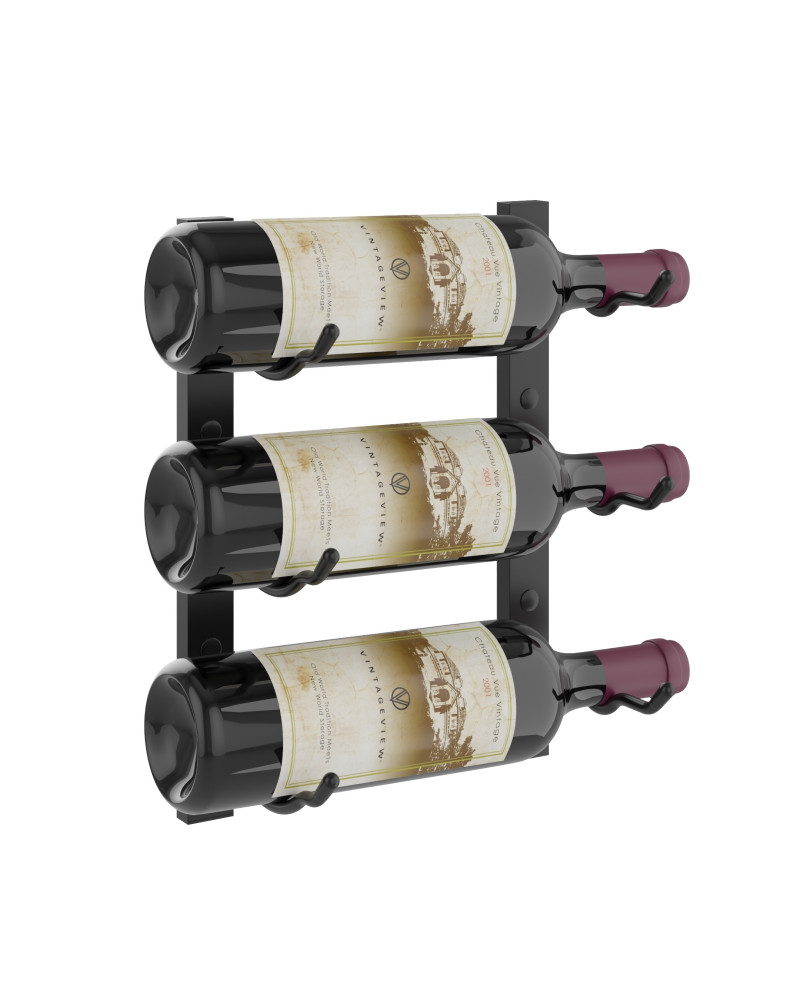 Winerack Wall Serie W11 - Depth 1 bottle
 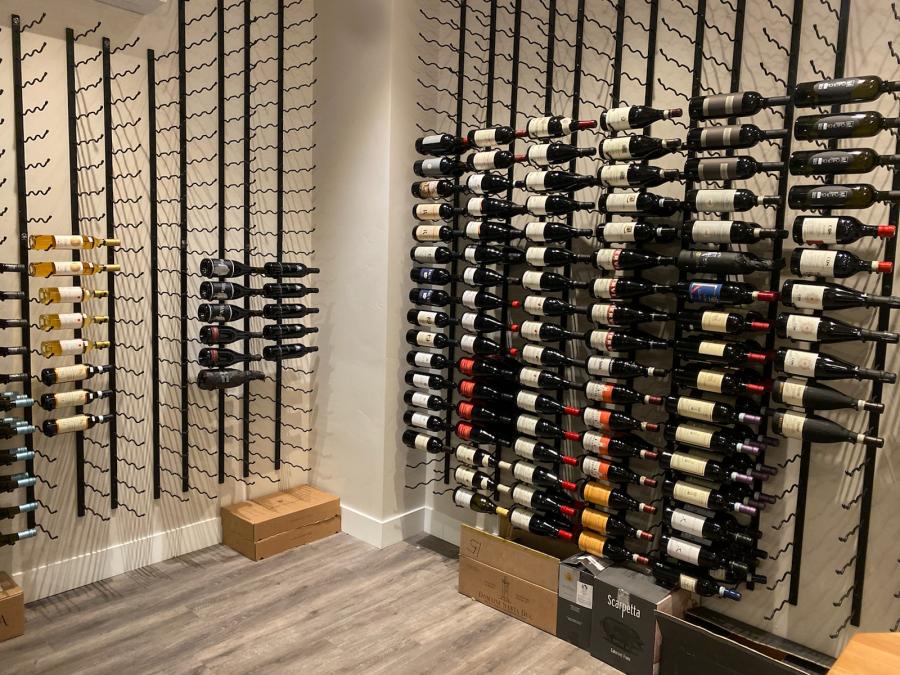 7 Img 20240214 141523
Wall-mounted systems like the Winerack Wall Serie W11 hold three bottles label-forward in a compact 1-bottle-deep profile, which suits narrow alcoves and oddly shaped walls where a full-depth cabinet won't fit. The matte black steel finish is powder-coated, so it holds up in humid cellars.
Before you fix anything to a wall, confirm what's behind the plaster, a rack rated for the weight is only as strong as the anchors holding it.
- Check for studs or masonry, and use anchors rated for the loaded weight
- Plan rack depth around bottle orientation: label-forward needs more projection
- Buy modular so you can extend capacity without a full rebuild
For interior designers and hospitality spaces, modular systems also mean a layout can be reconfigured later without new fabrication.
Smart Home Integration and Energy Efficiency for Your Custom Wine Cellar
Smart integration turns a cellar from a room you check into a system you monitor. Temperature and humidity sensors paired with a smart hub let you catch a failing cooling unit before it damages bottles.
- Add a Wi-Fi temperature and humidity sensor inside the cellar
- Set alerts for drift beyond your target range
- Use a smart plug to log cooling unit runtime and spot inefficiency
- Choose LED lighting on occupancy sensors to cut heat and power draw
U.S. Department of Energy guidance on insulation and energy efficiency covers how R-value and air sealing interact, which applies directly to cellar walls.
Permitting, Building Codes, and Long-Term Maintenance
Permitting and building codes decide whether your cellar is legal and insurable. Converting a basement or adding a cooling system often triggers electrical and mechanical permits, and skipping them creates problems at resale.
Check local requirements before you start. Rules vary by jurisdiction for basement conversions, egress, and HVAC work.
Maintenance keeps the system honest:
- Inspect the vapor barrier and seals annually for gaps
- Clean or replace cooling unit filters every few months
- Check the condensate drain for clogs before summer
- Re-torque rack anchors once a year
- Test humidity sensors against a calibrated reference
International Code Council on residential building codes publishes the model codes many jurisdictions adopt, which is a useful starting point before you call your local building department.
Building a custom wine cellar is a sequencing problem: insulation and vapor control first, cooling second, racking and finishes last. Get that order right and the room performs for decades; get it wrong and you'll rebuild walls you just finished.
Winerack Solutions offers premium, modular wine storage systems designed to transform any space into a stunning, high-performance wine display. Our scalable solutions blend functionality with modern design to perfectly fit your unique collection and interior style. By utilizing high-quality materials and providing straightforward installation, we help wine enthusiasts, interior professionals, and hospitality businesses elevate their wine storage into a true interior design feature. If you're planning a layout for a home, a client, or a hospitality venue, explore the modular systems and design your cellar around storage that grows with you.
Frequently Asked Questions
Is it cheaper to build or buy a wine cellar?
Building a custom wine cellar typically costs more upfront than buying a prefabricated unit, but it adds lasting property value and fits your exact space. A modular system like the Winerack Wall Serie W11 starts at €54.45 per section, letting you scale over time. For long-term collectors, building usually pays off through better climate control and customization.
How much would it cost to build a wine cellar?
Costs vary widely based on size, cooling system, insulation, and racking. A basic basement conversion might start around a few thousand euros, while a fully custom room with premium finishes can exceed €20,000. Modular racking like the Winerack Wall Serie W11 at €54.45 per unit helps control expenses by letting you expand gradually.
How do you properly insulate a custom wine cellar?
Proper insulation involves installing a vapor barrier on the warm side of the walls, using closed-cell spray foam or rigid foam boards with a high R-value, and sealing all gaps to prevent thermal bridging. This maintains temperature stability and prevents mold. Aim for R-19 or higher in walls and R-30 in ceilings for effective wine cellar insulation requirements.
What is the best way to manage temperature and humidity in a wine cellar?
Use a dedicated wine cellar cooling system to maintain 12-14°C and 55-75% relative humidity. Pair it with a reliable vapor barrier and airtight door seal. Avoid passive cooling unless your space is naturally stable. Active systems with digital controls and smart home integration offer the most consistent results for long-term wine preservation.
How do you choose the right wine storage system for a custom space?
Measure your space, count your bottles, and decide between wall-mounted, floor-standing, or modular options. For oddly shaped areas, modular systems like the Winerack Wall Serie W11 adapt easily. Consider bottle orientation, label-forward display, and future expansion. The best wine storage systems for home balance capacity, aesthetics, and installation simplicity.
What are the most common mistakes when building a wine cellar?
Common mistakes include skipping the vapor barrier, undersizing the cooling unit, using inadequate insulation, and ignoring door sealing. Many also forget to plan for structural load or permit requirements. Avoid these by mapping your space, consulting a professional for HVAC integration, and choosing modular racking that can grow with your collection.