
Table of Contents
- Is a Closet Wine Cellar Actually Feasible?
- How to Convert a Closet into a Wine Cellar
- Insulation, Vapor Barriers and Moisture Management
- Choosing a Wine Cellar Cooling Unit
- Building a Wine Closet: Racking and Layout
- Wine Cellar Closet Ideas for Tight and Odd Spaces
- Permits, Electrical Safety and Building Codes
- Planning Your Closet Conversion with VintageView
- Frequently Asked Questions
Last Updated: November 12, 2026
Is a Closet Wine Cellar Actually Feasible?
So can you build a wine cellar in a closet? Yes, and the result can protect a serious collection when the space is sealed, insulated and cooled correctly. A closet conversion works best when the closet has an exterior wall, a door that seals, and enough depth for racks plus airflow. The catch is that a closet is a small box inside a heated home, so every weakness in its envelope shows up fast.
Feasibility comes down to four things:
- Size: depth and wall space for the racks you need
- Location: an exterior wall helps, an interior wall makes cooling harder
- Seal: air leaks undo good insulation
- Power: a dedicated circuit for the cooling unit
Get those right and a closet becomes a genuine cellar. Get them wrong and you get a cool cupboard that swings in temperature.
A Suitability Checklist for Different Closet Types
Not every closet deserves the investment. Use this checklist before you buy anything.
| Closet Type | Suitability | Main Challenge |
|---|---|---|
| Under-stair closet | Good | Triangular walls and low headroom |
| Coat closet | Good | Shallow depth limits bottle orientation |
| Walk-in bedroom closet | Excellent | Needs a sealed door and dedicated power |
| Kitchen pantry closet | Fair | Heat from appliances nearby |
| Hallway linen closet | Fair | Often an interior wall with no venting route |
Run through these questions:
- Does the closet have at least one exterior wall?
- Can the door be fitted with a seal?
- Is there space for a cooling unit, either through-wall or ducted?
- Can a licensed electrician reach the closet with a dedicated circuit?
- Is the floor level and dry?
- Can you spare the closet's current storage?
Three or more "no" answers means you should look at a different space.
How to Convert a Closet into a Wine Cellar
If you are asking can you build a wine cellar in a closet, the conversion follows a fixed order: assess the space, insulate and seal it, install cooling, then fit racks and load bottles. Skipping ahead, especially fitting racks before the cooling is running, is the most common mistake we hear about. Racks are the last step, not the first.
The sequence matters because each stage depends on the one before it. Insulation has to go in before the walls close up. The vapor barrier has to sit on the warm side of the insulation. The cooling unit has to be sized for the finished, sealed room, not the open closet you started with.
Assessing Size, Location and Bottle Capacity
Measure the closet's usable interior space first, ignoring shelves and hanging rails. Then subtract space for the cooling unit, airflow gaps and door swing.
Capacity planning is where most people guess badly. Bottles stored horizontally take up a predictable footprint, and rack depth decides how many rows you get. A shallow coat closet may only take single-depth racks. A deeper walk-in can take double-depth.
Plan for growth, too. A collection that fits exactly today will overflow within a season or two. Modular racking can allow you to add capacity later.
Insulation, Vapor Barriers and Moisture Management
Insulation, a vapor barrier and moisture control decide whether the cellar holds steady or sweats. A closet cellar runs colder than the room around it, and that temperature difference drives moisture toward the warm side of the walls. Without a barrier, that moisture ends up inside the insulation, where it can condense and cause damp.
Work through it in this order:
- Insulate every surface: walls, ceiling and floor. The door needs insulation too.
- Fit a vapor barrier on the warm side of the insulation, sealed at every joint and edge.
- Seal air leaks around pipes, sockets and the door frame before you close anything up.
- Use a sealed, insulated door with a gasket, not a hollow interior door.
Watch out: a vapor barrier fitted on the wrong side traps moisture inside the wall cavity, which is worse than having no barrier at all. Get the placement right, or bring in someone who does this for a living.
Condensation on the cooling unit, the door glass or the ceiling usually points to one of three things: an air leak, an undersized unit running constantly, or a barrier that was never sealed properly.
Choosing a Wine Cellar Cooling Unit
A wine cellar cooling unit is the piece of equipment that holds the closet at a stable cellar temperature, and it must be sized for the sealed, finished room rather than guessed from the closet's original dimensions. Undersizing is a common and damaging error: an undersized unit runs continuously, never quite reaches setpoint during warm spells, and pulls humidity down as it struggles.
Match the unit type to the closet's venting route
- Through-wall units discharge heat into an adjacent room through the wall. They suit closets with a spare wall facing a garage, utility room, or hallway where exhaust heat is acceptable.
- Ducted units move heat and air through ductwork, which suits interior closets with no adjacent venting wall but requires a route for the duct run and a place for the exhaust to go.
- Self-contained units sit inside the room and need clearance around the cabinet for intake and exhaust. They are the simplest to install but consume interior floor or wall space.
Estimate the cooling load before you order
Sizing depends on four inputs: the room's interior volume (height x width x depth), the insulation quality of walls, ceiling, floor, and door, the temperature of the spaces surrounding the closet, and the heat the unit must remove to hold cellar temperature. A closet sharing a wall with a warm kitchen or sitting against a sun-baked exterior wall carries a heavier load than one on a cool north wall with an unconditioned buffer space behind it.
A practical approach is to calculate the volume, then apply a load factor based on how well the envelope is sealed and how warm the surrounding rooms run. Manufacturers commonly publish sizing charts keyed to volume and insulation level; use such a chart as the starting point, then add margin for the door, any glass, and the heat gain from lighting.
Plan ventilation and electrical supply
Every cooling unit needs a way to reject heat. Through-wall and ducted units exhaust into another space, so confirm that space can absorb the heat without becoming uncomfortable or triggering its own cooling load. Self-contained units need clearance around the cabinet and a return path for air.
Electrical requirements matter here. Most units need their own dedicated circuit, and some need a specific voltage.
Watch out: a unit sized for the open closet rather than the sealed, insulated room will short-cycle once the envelope is finished, which swings humidity and shortens compressor life.
Building a Wine Closet: Racking and Layout
Racking and layout turn a sealed, cooled box into a working cellar. Start with the bottle count you planned, then choose rack depth and orientation to fit the walls you have. Label-forward display racks show bottles at a glance, while traditional horizontal storage packs more bottles into the same footprint.
 Compact walk-in closet converted into a wine cellar with matte black label-forward racks and warm downlighting.
Layout rules that hold up in practice:
- Keep at least one clear walkway if the closet is walk-in
- Leave a gap between the top rack and the ceiling for airflow
- Keep racks off the floor on a raised base
- Group by region or by drinking window, not by whatever fits
For a closet conversion, our Matte Black Modular Wine Rack Display Kit (7-Piece Set) holds 144 bottles across seven modular elements, and the Matte Black Modular Wine Rack Display kit Deluxe (15-Piece Set) holds 288 standard bottles and 32 magnum bottles. Both are available in a matte black finish. If you are planning the racking for a new closet cellar, our guide to expandable wine racking for growing collections covers how to pick a system that scales.
Wine Cellar Closet Ideas for Tight and Odd Spaces
Tight and odd-shaped closets reward clever layouts more than raw capacity. An under-stair closet with a sloped ceiling can take staggered racks that follow the angle. A narrow closet can use double-depth wall racks to double capacity without eating floor space.
Ideas that work in awkward footprints:
- Wall-mounted pins along a narrow side wall for a floating display
- Vertical columns in the tall corner of an under-stair space
- A single display row at eye level, with bulk storage below
- Corner racks that follow the return walls
For a cramped or unusual closet, our guide to modern metal wine display ideas for every space shows layouts built around odd dimensions. Vino Pins, like the VP2 double-depth set, are designed to mount direct to the wall, which suits a shallow closet where a full rack frame would crowd the space.
Permits, Electrical Safety and Building Codes
Permits and code requirements vary by location, so check with your local building authority before work starts. Structural changes, new electrical circuits and any alteration to a load-bearing wall typically need approval. Adding a dedicated circuit for a cooling unit is electrical work, and in most places it must be done by a licensed electrician.
Ask your authority about:
- Whether the conversion counts as a habitable space change
- Electrical circuit and outlet requirements
- Insulation and vapor barrier standards for the climate
- Any ventilation requirements for the cooling unit
Keep records of the work. If you ever sell the home, documented, permitted work is far easier to explain than a closet someone rewired themselves.
Planning Your Closet Conversion with VintageView
The closet conversions that hold up share one trait: the plan came before the purchase. Measure the space, run the suitability checklist, settle the cooling and sealing details, and only then choose racks sized to the collection you actually have.
That is where we can help. VintageView offers modular wine storage that can be scaled as a collection grows, from a compact wall display to a larger setup.
For a reader planning the full build, our step-by-step guide on how to build a custom wine cellar walks through the whole conversion. For a cramped closet, see how to maximize wine display space in tight areas. And when you are ready to equip the space, the Matte Black Modular Wine Rack Display Kit gives you a complete, install-ready set.
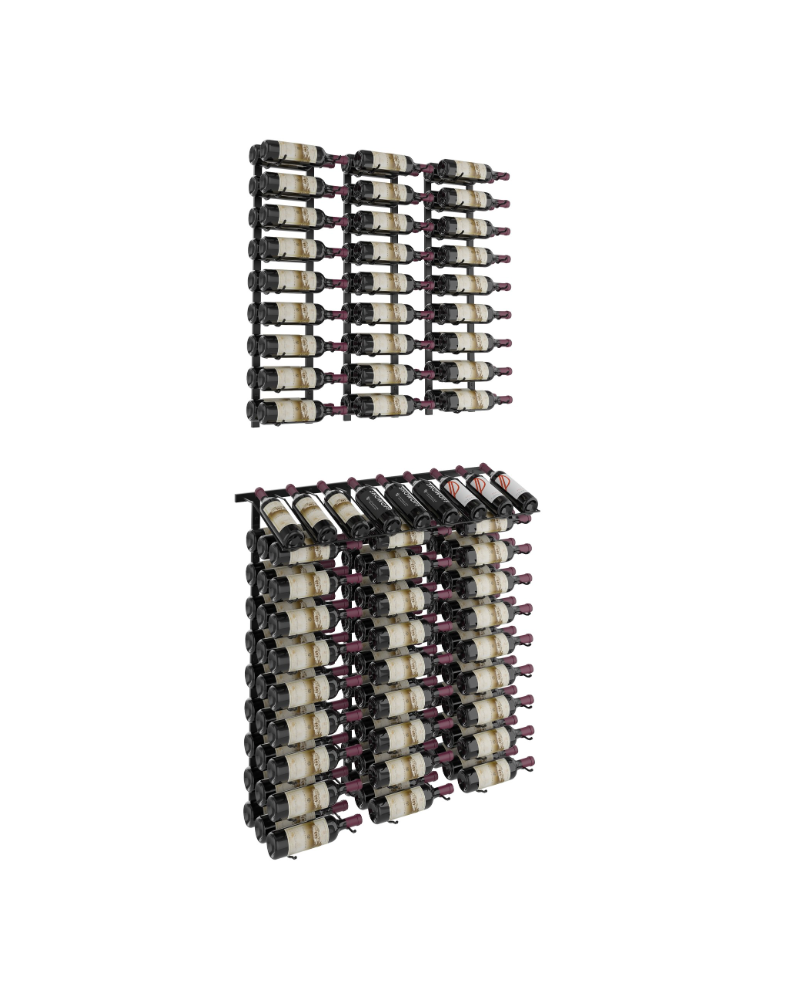 Matte Black Modular Wine Rack Display Kit (7-Piece Set)
Start with the checklist, not the catalog. Measure twice, seal once, and the closet will do the rest.
A closet cellar only performs as well as its weakest detail, whether that is an unsealed door, an undersized cooling unit or racking that runs out of room.
Frequently Asked Questions
Can I build a wine cellar in my closet?
Yes, if the closet is well insulated, sealed against moisture and fitted with a cooling unit. A closet wine cellar works best when the space is at least a few square metres and has access to power. Small coat closets or under-stair spaces can work too, but you will need to plan rack depth and cooling capacity carefully. The main limits are heat gain from surrounding rooms and whether you can vent the cooling unit.
Does a closet wine cellar need a cooling unit?
A dedicated wine cellar cooling unit is strongly recommended. Without one, a closet will drift with the room around it, and daily temperature swings spoil wine faster than a steady slightly warm temperature. A through-wall or ducted unit holds both temperature and humidity steady. Size it to the closet's volume and heat load, not just the bottle count, and check the electrical requirements before you buy.
What temperature and humidity should a closet wine cellar maintain?
Aim for a stable temperature in the mid-50s Fahrenheit (around 12 to 14 Celsius) and humidity between 50 and 70 percent. Stability matters more than the exact number. High humidity causes condensation and mould, while low humidity dries out corks. A vapor barrier, a sealed door and a correctly sized cooling unit are what keep those levels steady in a converted closet.
How many wine bottles can a closet cellar hold?
Capacity depends on the closet's usable wall area and rack depth. A double-depth wall rack holds two bottles per column, so a narrow closet can still store a useful collection. Measure the wall space, subtract door swing and cooling unit clearance, then plan rack spacing. Modular systems can let you add sections later.
