
Last Updated: November 7, 2026
Quick Summary
A commercial wine storage cost analysis for 2026 should cover four layers: capital costs like racking and cooling equipment, capacity costs measured per bottle and per case, operating costs for energy, humidity, maintenance and security, and return metrics including total cost of ownership and payback period.
- Hardware cost per bottle falls as capacity rises, from about $5.36 on a 360-bottle wall to $13.11 on a 48-bottle unit.
- A 360-bottle wall holds thirty cases, giving a per-case figure you can compare across quotes.
- Plan capacity around bottles held in three years, not today's collection, to avoid buying framework twice.
- Specify the cooling load before the racking, since glazing and insulation change the demand.
- Build total cost of ownership by adding annual operating costs multiplied by expected service life to capital spend.
Table of Contents
- What a Commercial Wine Storage Cost Analysis Should Include in 2026
- Commercial Wine Storage Systems: Where the Capital Budget Goes
- Wine Storage Capacity Planning and Cost per Case
- Restaurant Wine Display and Storage: Cost Model by Business Type
- Operating Costs: Energy, Humidity Control and Maintenance Fees
- Wine Cellar Design Trends 2026 and How They Move the Budget
- Total Cost of Ownership, Payback Period and Revenue per Square Foot
- Build Your 2026 Wine Storage Budget With Winerack Solutions
- Frequently Asked Questions
What a Commercial Wine Storage Cost Analysis Should Include in 2026
A commercial wine storage cost analysis is a structured breakdown of every capital and operating expense a venue will carry to store and display wine over time. Operators often underestimate the operating side more than the hardware side, which is why a useful cost analysis looks beyond a single price tag.
The first thing to get right is scope. A cost analysis that stops at the racking quote tells you what you will spend in month one. It says nothing about what the room costs you in month thirty.
Below, we break down the cost lines that belong in a serious 2026 budget, from racking and cooling through to energy, maintenance and payback.
Here is the framework we use:
- Capital costs: racking and display hardware, climate control equipment, room construction and finishes
- Capacity costs: cost per bottle and cost per case, which let you compare quotes fairly
- Operating costs: energy, humidity management, maintenance and security
- Return metrics: total cost of ownership, payback period and revenue per square foot
Get those four layers right and the budget holds together. Skip one and the numbers look fine on paper but never quite match reality.
U.S. Small Business Administration guidance on capital budgeting
Commercial Wine Storage Systems: Where the Capital Budget Goes
Capital spend on commercial wine storage systems splits into two roughly independent buckets: the racking and display hardware, and the climate control plant that keeps the room stable. Operators who budget for one and improvise the other usually end up paying twice.
Racking and Display Hardware by Bottle Count
Hardware cost scales with bottle count, but not linearly. Larger modular kits spread the cost of rails and framework across more bottles, so cost per bottle falls as capacity rises. That is the single most useful thing to understand when comparing quotes.
Here is how the modular kits in our catalogue break down by capacity, which gives you a concrete anchor for the hardware line in your budget:
|
System |
Bottle Capacity |
Price |
Cost per Bottle |
|---|---|---|---|
|
Matte Black Modular Wine Wall - WS6 |
270 bottles |
$1,585 |
~$5.87 |
|
Matte Black Modular Wine Wall - WS7 |
315 bottles |
$1,760 |
~$5.59 |
|
Matte Black Modular Wine Wall - WS8 |
360 bottles |
$1,930 |
~$5.36 |
|
Matte Black Modular Wine Rack Display Kit Deluxe |
288 standard + 32 magnum |
$2,420 |
~$7.56 |
|
Freestanding Bin 3 |
48 bottles |
$629.33 |
~$13.11 |
Price
The pattern is clear: the jump from a 270-bottle wall to a 360-bottle wall adds 90 bottles for $345, which works out cheaper per bottle than the smaller kit. Small freestanding units cost the most per bottle, which is fine for a compact under-counter fill but expensive as a primary strategy.
Watch out: buying a kit sized to today's collection rather than to your three-year plan can mean buying framework twice.
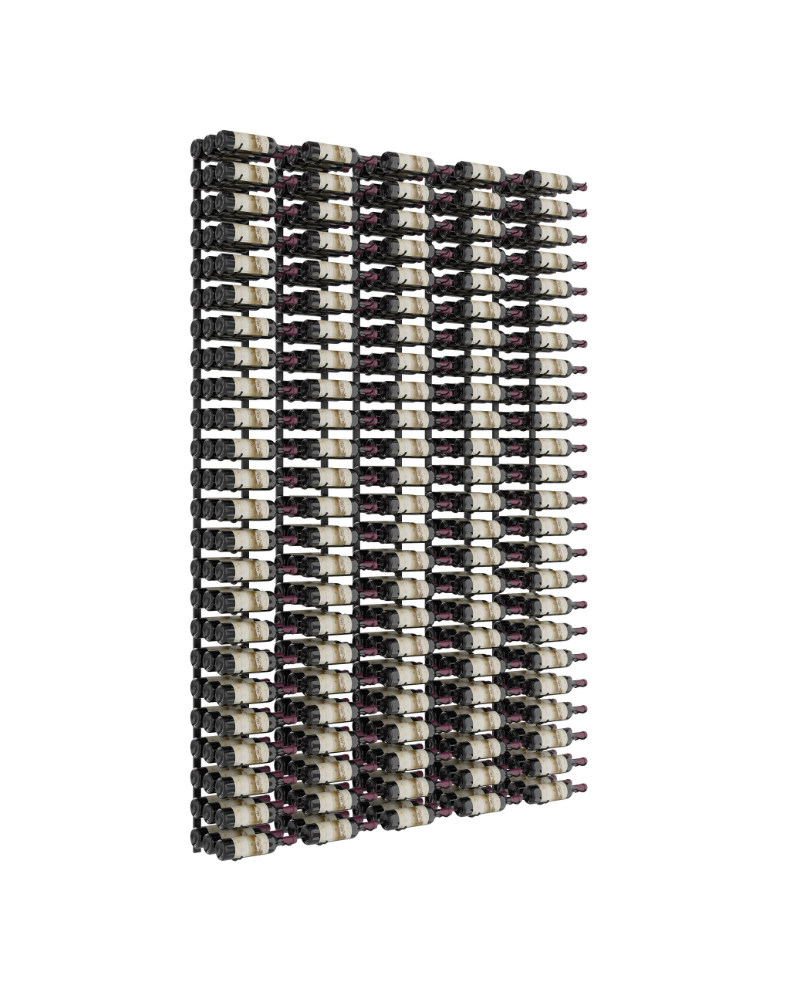 Matte Black Modular Wine Wall - WS8
Climate Control: Through-the-Wall, Ducted and Ceiling-Mount Cooling
Cooling is the second capital line and the one that varies most between buildings.
Specify the cooling load before you specify the racking, since rooms with different glazing and insulation have very different demands.
Wine Storage Capacity Planning and Cost per Case
Wine storage capacity planning is the discipline of matching bottle count, bottle format and growth rate to the physical space and the budget line that pays for it. Get it right and every later cost falls into place.
Start with three numbers: bottles you hold today, bottles you expect to hold in three years, and the share of your collection in magnum or larger formats. That third number matters because magnum racks hold fewer bottles per unit of wall, so a collection heavy in large formats needs more space than the raw bottle count suggests.
Then convert to cost per case. A case is twelve bottles, so a 360-bottle wall holds thirty cases. Divide the hardware price by thirty and you have a per-case figure you can compare against any other quote, whatever the unit count on the spec sheet.
Three general planning considerations for any commercial room:
- Plan for growth above current holdings
- Reserve wall space for display rows, not just dense storage
- Keep magnum capacity in the plan from day one rather than retrofitting it
If you are weighing how construction and finishing costs scale with room size, our walkthrough of how to estimate custom wine cellar cost per square foot covers the assumptions behind that calculation.
Restaurant Wine Display and Storage: Cost Model by Business Type
Restaurant wine display and storage costs follow a different shape depending on the business. A fine dining room needs a visible, label-forward wall near the host stand. A wine bar needs dense back-of-house capacity plus a small curated display. A hotel needs both, plus the durability to survive constant staff turnover.
The cost model splits into four lines for each business type:
|
Business Type |
Display Priority |
Capacity Priority |
Operating Load |
|---|---|---|---|
|
Fine dining |
High, front of house |
Medium, curated list |
Medium |
|
Wine bar |
Medium, feature wall |
High, deep inventory |
High |
|
Hotel |
High, lobby and restaurant |
High, multi-outlet |
High |
|
Private club |
Medium, member areas |
Medium |
Medium |
|
Retail store |
High, shop floor |
High, stock room |
Medium |
The practical difference between these types is not the hardware. It is how hard the room works. A hotel running three outlets will open and close its cooling more often, restock more frequently and put more hands on the racks than a private club with a stable membership.
For operators designing a luxury front-of-house installation, our guide to luxury wine display for restaurant design goes deeper into layout and finish decisions.
Operating Costs: Energy, Humidity Control and Maintenance Fees
Operating costs are where commercial wine storage budgets can drift. Energy, humidity control and maintenance are recurring costs.
Energy consumption depends on the cooling configuration, the insulation of the room and the difference between cellar temperature and ambient temperature. A through-the-wall unit in a warm climate works harder than a ducted system in a temperate one. Ask the equipment supplier for an estimated running load, not just a purchase price.
Humidity control is a cost to account for separately from cooling.
Maintenance covers filter changes, condenser cleaning, gasket replacement and the occasional service call. Budget for it as an annual figure rather than reacting to failures.
Security features may also carry a cost to budget for.
U.S. Department of Energy guidance on commercial refrigeration efficiency
Wine Cellar Design Trends 2026 and How They Move the Budget
Wine cellar design trends can favour visible, architectural storage over hidden rooms, with label-forward display and matte black finishes among the styles now in demand.
Each trend carries a budget consequence:
- Label-forward display uses more wall per bottle than dense cork-forward storage, so capacity per square metre falls while visual impact rises.
- Floor-to-ceiling walls need the structure above to carry the load and the cooling to handle a taller air column.
- Matte black and bronze finishes are a style choice for the room.
- Mixed-format display, with magnum racks beside standard rows, adds flexibility at a modest hardware premium.
The honest trade-off is capacity against presence. A room designed to be seen stores fewer bottles per square metre than a room designed purely to store. Decide which one you are building before the hardware quote goes out.
Total Cost of Ownership, Payback Period and Revenue per Square Foot
Total cost of ownership is the sum of capital spend plus every operating cost across the life of the installation. It is the only number that lets you compare two options fairly, because a cheaper racking quote paired with a harder-working cooling system can cost more over five years than the reverse.
Build the model in four steps:
- Total the capital lines: hardware, cooling, construction and finishes
- Add annual operating costs: energy, humidity, maintenance and security
- Multiply operating costs by the expected service life
- Subtract any residual value or salvage
Payback period follows from revenue. If a display wall lifts average bottle spend per table, or lets you list wines you previously could not stock, that incremental margin pays back the capital over time. Revenue per square foot is the metric that makes the case to a finance director: a wall that earns more per square metre than the space it occupies is an asset, not a cost.
For hotel operators weighing this calculation, our analysis of how to use modular wine storage for hotel profit sets out the revenue side in detail.
IRS guidance on depreciation of business property
Build Your 2026 Wine Storage Budget With Winerack Solutions
A commercial wine storage budget built on seven cost lines holds up under scrutiny. One built on a single hardware quote does not. The difference is not the size of the spend, it is whether the operating side was ever in the room when the decision was made.
At Winerack Solutions, we supply premium modular wine storage from VintageView, engineered for commercial venues as well as private cellars. Our kits range from a compact 48-bottle freestanding unit to a 360-bottle architectural wall. The matte black finish suits a sleek, minimalist look, and the modular design allows the installation to be extended as your collection grows.
If you are costing the hardware line, our matte black modular wine wall shows the accessories and display add-ons that sit inside the capital budget.
The challenge is not finding a racking quote. It is building a budget that survives contact with a working restaurant, hotel or club. Start with capacity planning, specify cooling against a real heat load, and put operating costs in the model from day one. Get started with Winerack Solutions and build a wine storage plan that pays for itself.
Frequently Asked Questions
What factors affect the cost of commercial wine storage?
Five factors drive most of the budget: bottle capacity, racking material and finish, cooling type (through-the-wall, ducted or ceiling-mount), room construction and insulation, and ongoing energy and maintenance. Capacity planning matters most, because undersizing a system forces a second purchase within a couple of years.
How should a restaurant plan a restaurant wine display and storage area?
Start with the list, not the wall. Count bottles by category, add 20 to 30 percent for growth, then split the total between back-of-house storage and front-of-house display. Display racks should sit away from heat sources, direct sun and kitchen exhaust, and the cooling system needs to handle the whole room, not just the rack. A label-forward wall of 270 to 360 bottles suits most fine dining rooms, while a compact 48-bottle freestanding bin works for by-the-glass programs.
How can a business estimate the capacity needed for commercial wine storage?
Use case capacity as your base unit. A standard case holds 12 bottles of 750ml, so 1,000 bottles is roughly 84 cases. Multiply your monthly through-put by the ageing period you plan for, then add a growth buffer. Our range includes 270-, 315- and 360-bottle wall kits and a 48-bottle freestanding bin.
What should a commercial wine storage cost analysis include?
A complete analysis separates capital expenditure from operating costs. Capital covers racking, cooling equipment, insulation, lighting and installation. Operating covers energy consumption, humidity control, maintenance fees, insurance and security features. Add a payback estimate and a revenue-per-square-foot figure so the storage investment is judged against the space it occupies, not just its purchase price. Review the model annually, because energy and maintenance costs shift.
