
Last Updated: October 24, 2026
Quick Summary
Custom wine cellar cost per square foot is the total build spend divided by the room's floor area, covering the shell, climate control, racking and finishes. Treat it as a starting frame, not a final answer, because two cellars of identical size can differ widely once cooling, insulation and racking are priced properly.
- Split any quote into four cost groups: room shell, climate control, racking and display, and finishes with electrical.
- Size cooling equipment by cubic volume, insulation quality and the temperature gap, not floor area alone.
- Racking is the one line item you can pin down exactly, since each kit carries a stated bottle count.
- Fixed costs spread across more bottles lower your cost per bottle, so plan for three years of buying.
- A common working contingency is ten to fifteen percent of build cost, sized to your specific risks.
Table of Contents
- Breaking Down Custom Wine Cellar Cost Per Square Foot
- Wine Cellar Construction Cost: Room Shell, Insulation and Finishes
- Wine Cellar Cooling System Cost and Climate Control Sizing
- Racking and Display: The Component You Can Price Exactly
- How Wine Cellar Storage Capacity Drives Your Cost Per Bottle
- Wine Cellar Budget Planning: Contingency, Labor Markets and Quote Checks
- Plan Your Layout and Order Your Racking System
- Frequently Asked Questions
Breaking Down Custom Wine Cellar Cost Per Square Foot
Custom wine cellar cost per square foot is the total build spend divided by the floor area of the room, and it is the fastest way to sanity-check a quote before you commit.
Here is what most guides get wrong: they quote one blended number for every project. In practice, two cellars of identical size can differ by a wide margin once cooling, insulation and racking are priced properly.
What the Square-Foot Figure Actually Includes
The square-foot number should cover four cost groups: the room shell, climate control, racking and display, and finishes with electrical work. Design fees and contingency sit on top. If a quote gives you one number without splitting these out, ask for the breakdown before you compare it to anything.
A useful way to read any benchmark is to test it against your own scope. A converted closet with a modest bottle count will land low. A purpose-built room with a glass enclosure and full climate control will land high. Same square footage, different build.
Wine Cellar Construction Cost: Room Shell, Insulation and Finishes
Wine cellar construction cost is driven by how much building work the room needs before a single bottle goes in. A finished spare room needs far less than a bare basement corner.
The most useful way to read construction cost is to split it into the line items a contractor will actually quote, then price each one against your room.
The Shell, Itemized
- Demolition and prep, removing old finishes, capping utilities, and correcting uneven substrates. Often overlooked in early budgets.
- Framing and structural work, new partition walls, soffits to conceal ducting, and any beam or header work. Structural changes are the single largest swing factor in a conversion.
- Insulation, closed-cell spray foam is the common choice for wine rooms because it acts as both insulation and vapor barrier in one pass; rigid board plus a separate vapor barrier is an alternative. Thickness and R-value should be specified by material, not left as an allowance.
Existing Room Versus New Build
Converting an existing room is usually the cheaper path. The walls, floor and ceiling already exist, so you are adding insulation, sealing, cooling and finishes rather than building from scratch.
A new build or a basement dig-out adds excavation, framing and structural work. That pushes the per-square-foot figure up. If you are weighing the two, price the shell separately from everything else, then compare like for like, a conversion quote that excludes electrical upgrades is not comparable to a new-build quote that includes them.
Where the Shell Budget Drifts
The three most common overruns in wine-room construction are structural surprises (a wall that is not load-bearing as assumed, or one that is), electrical upgrades (an older panel that cannot carry a dedicated cooling circuit), and moisture remediation (a damp basement that needs drainage or treatment before insulation goes in). Each of these is site-specific and cannot be priced from a national benchmark, which is why a contingency line belongs in the budget from day one, not added after the first surprise.
U.S. Department of Energy guidance on basement insulation and moisture control
Wine Cellar Cooling System Cost and Climate Control Sizing
Wine cellar cooling system cost depends on room volume, insulation quality and the temperature gap the unit must hold.
Cooling equipment is priced by capacity, not by floor area alone. A tall room with a small footprint holds more air than a wide, low one.
- Ducted systems suit larger rooms and remote equipment placement
- Through-wall units fit compact cellars with an exterior wall
- Self-contained units are the simplest to specify
- Glass enclosures need more capacity because glass gains heat
Running costs follow the same logic. Better insulation and a correctly sized unit mean shorter run times.
Racking and Display: The Component You Can Price Exactly
Racking is the one line item you can pin down to the dollar before construction starts.
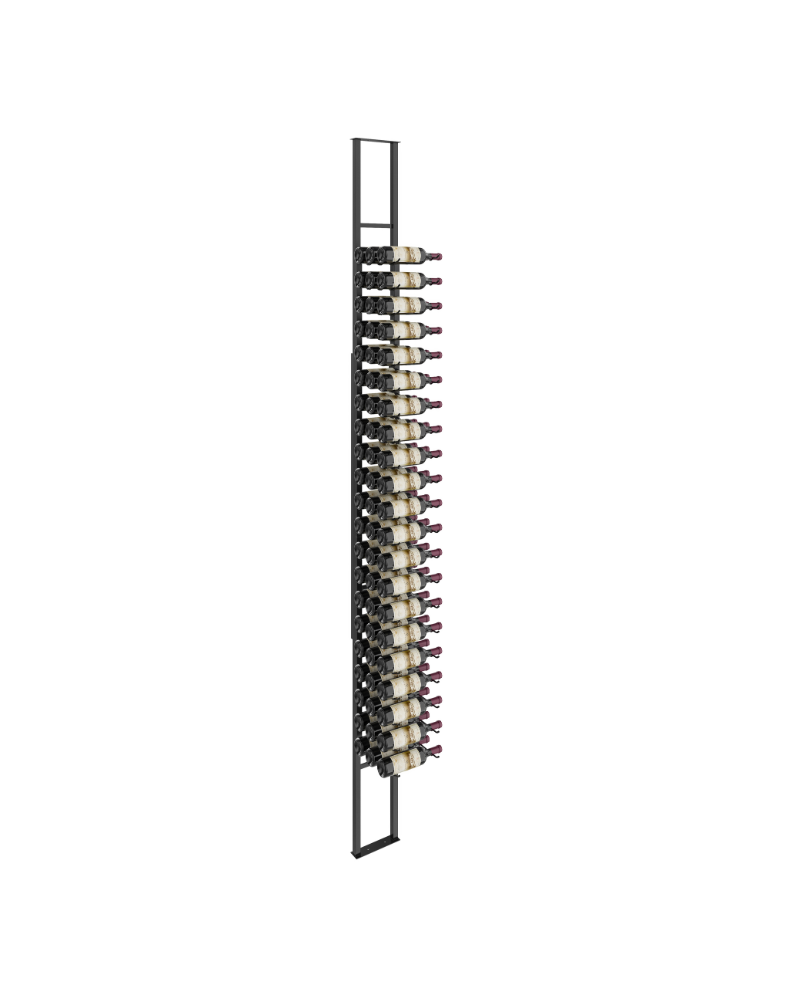 Matte Black Modular Floor-to-Ceiling Wine Rack Kit
This is also where design and function meet. For a project like that, our Matte Black Modular Floor-to-Ceiling Wine Rack Kit holds 63 bottles in a single dramatic column. Larger rooms scale up with the 360-bottle Matte Black Modular Wine Wall, while mixed collections suit the Deluxe 15-piece display kit for 288 standard and 32 magnum bottles.
Matte Black Modular Floor-to-Ceiling Wine Rack Kit →
If you are still comparing systems, our modular wine rack buyer's guide sets out the options side by side. Price racking first, then let the remaining budget flow to construction and cooling.
Racking is the one line item you can pin down before construction starts, because each kit carries a stated bottle count.
| Racking kit | Bottle capacity | Note |
|---|---|---|
| Matte Black Modular Floor-to-Ceiling Wine Rack Kit | 63 bottles | Single column, no wall fixing needed |
| Matte Black Modular Wine Wall | 360 bottles | Scales up for larger rooms |
| Deluxe 15-piece display kit | 288 standard and 32 magnum bottles | Suits mixed collections |
How Wine Cellar Storage Capacity Drives Your Cost Per Bottle
Wine cellar storage capacity changes the economics of the whole project. Fixed costs such as cooling, insulation and electrical work stay roughly the same whether you store 300 bottles or 900. Spread those costs across more bottles and the cost per bottle falls.
So plan for the collection you expect, not just the one you own today. Collectors who size for the current count often rebuild within a couple of years.
- Count current bottles, then add your annual buying rate for three years
- Allow for magnums and oversize bottles, which take more room
- Leave space for display rows, not just dense storage
- Check that the racking system can be extended later
Wine Cellar Budget Planning: Contingency, Labor Markets and Quote Checks
Wine cellar budget planning comes down to three habits: adjust the benchmark to your local market, hold a contingency sized to your actual risks, and check every quote against a written scope. Most guides stop at a national per-square-foot range; the framework below is how you turn that range into a number you can defend.
Adjusting a Benchmark to Your Location
A national square-foot figure is an average across very different labor markets. The same shell scope can quote materially differently in a high-cost metro than in a lower-cost region, and permitting timelines and fees vary by jurisdiction as well. Rather than trust a single number, build a local adjustment:
- Get two or three local shell quotes for comparable scope, not one. The spread between them tells you how much local-market noise exists.
- Separate labor from materials on each quote. Materials travel better across markets than labor does; if the labor line is the outlier, that is a local-market signal.
- Ask about permit fees and inspection timelines in your jurisdiction. These are fixed costs that a national benchmark never captures.
- Note trade availability. In tight markets, specialty trades (HVAC for cooling, glazing for glass enclosures) carry a premium and longer lead times.
A practical pattern: use the national benchmark as a starting frame, then let your local quotes pull it up or down. If your local quotes cluster well above the benchmark, the benchmark is not wrong, it is just not yours.
Sizing Contingency to Your Risks
A flat percentage is a blunt tool. A more honest approach is to size contingency against the specific risks your room carries:
- Structural unknowns, older homes, basements, and rooms with prior renovations carry the highest risk. Budget more here.
- Electrical capacity, if the panel is near capacity or the room is far from the panel, expect an upgrade line.
- Moisture and drainage, a damp basement or a room below grade needs investigation before insulation, not after.
- Glass and enclosure complexity, frameless glass and custom doors carry longer lead times and less price certainty than standard doors.
A common working figure is ten to fifteen percent of build cost, but the right number is the one that matches your risk list. A clean, dry, above-grade room with a modern panel needs less; a damp basement conversion with an old panel needs more.
Quote Evaluation Checklist
Use this when a quote lands. A quote that fails three or more items should be revised before you compare totals.
- Shell work itemized separately from cooling and racking
- Insulation and vapor barrier specified by material and thickness
- Cooling unit sized to room volume, with model number stated
- Racking priced by kit and bottle count
Reconciling the Benchmark With the Quote
Once you have local quotes and a risk-sized contingency, reconcile them against the square-foot benchmark. If your quote is far above the benchmark, check whether the difference is scope (glass, structural work, electrical upgrades) or market (labor, permits). If it is scope, the benchmark was never the right comparison. If it is market, your local quotes are the better number.
Plan Your Layout and Order Your Racking System
The square-foot figure only becomes useful once you know your room, your capacity and your cooling load. Start with the shell and climate costs, lock in racking at a fixed price, then hold a contingency for the rest.
VintageView builds modular, label-forward wine storage that lets you price capacity exactly and expand it later. Our matte black steel systems suit wine rooms, restaurants and open-plan living spaces, and they install as complete kits.
Frequently Asked Questions
How do you estimate custom wine cellar cost per square foot?
Start with the room shell: insulation, vapor barrier, electrical work and finishes, then add cooling equipment, a cellar door or glass enclosure, lighting and racking. Divide the total by the room's floor area to get a per-square-foot figure. Because racking and cooling scale with bottle count rather than floor area, two cellars of the same size can land far apart. Price each component separately first, then convert to a per-square-foot number for comparison.
What factors affect the cost of a custom wine cellar most?
Four factors move the total more than anything else: bottle capacity, cooling load, whether you convert an existing room or build new, and the finish level of the racking and millwork. A high-density metal racking system stores more bottles per square metre than a display-heavy layout, which lowers cost per bottle even when the floor area stays the same. Local labor rates for electrical, insulation and finishing work are the fourth variable.
What should wine cellar budget planning include beyond construction?
Set aside a contingency of roughly 10 to 15 percent for hidden work: moisture remediation, upgrading electrical service, or reinforcing a floor. Include the cost of commissioning the cooling unit, ongoing energy use, and a small allowance for future bottle growth. Many collectors outgrow a fixed layout within two years, so choose modular racking that can extend along the same wall rather than a sealed built-in.
How much does a wine cellar cooling system cost to run?
Running cost depends on the unit's capacity, the insulation and vapor barrier quality, and how often the door opens. A well-sealed room with a correctly sized split system holds temperature with shorter compressor cycles than an oversized unit in a poorly sealed space. Ask your installer for the unit's rated power draw and estimate hours of operation per day to get a realistic annual energy figure before you commit.
