
Table of Contents
- What Separates Commercial Wine Storage From Residential Racks
- Commercial Wine Rack Kits: Complete Systems Compared
- Modular Wine Storage Racks That Expand With Your Collection
- Restaurant Wine Racks: Matching Capacity to Service Flow
- Retail Wine Display Racks: Label-Forward Layouts That Sell
- Planning Bottle Capacity, Dimensions, and Room Layout
- Which Durable Commercial Wine Storage System Fits Your Venue?
- Frequently Asked Questions
Last Updated: October 18, 2026
What Separates Commercial Wine Storage From Residential Racks
Durable commercial wine storage systems are built to survive daily handling, constant restocking, and years of service in busy venues. That is the core difference from a residential rack, which only has to hold a private collection that rarely moves.
We have supplied storage for restaurants, retail shops, and private cellars long enough to know where the split happens. It comes down to three things: how much weight the frame carries, how often bottles are touched, and whether the system can grow without a rebuild.
Durability, Capacity, and Daily Wear
A busy restaurant might pull and replace dozens of bottles in a single evening.
Commercial-grade construction usually means welded steel frames and a powder-coated finish. Steel holds its shape under load and resists the scuffs that come with constant use.
Capacity is the other divider. A home rack holds a few dozen bottles. A venue needs a system planned around its peak stock, not its average.
Commercial Wine Rack Kits: Complete Systems Compared
The fastest route to a finished installation is a commercial wine rack kit: a complete set of modular elements that arrive ready to assemble into a defined capacity.
But "kit" is not a durability specification. Two kits with the same bottle count can differ enormously in how they carry load, how the joints are made, and how the finish survives a decade of cleaning.
What to check on any commercial kit
- Frame and weld quality. Look for continuous welded steel joints rather than spot welds or mechanical fasteners at load-bearing intersections. A kit that relies on brackets and screws at every shelf-to-post connection will loosen under repeated restocking; a welded frame holds its geometry.
- Load rating per shelf and per column. Ask for the rated load per bottle position and per vertical column, not just total bottle count. A 360-bottle wall distributes weight across many fixing points; a 48-bottle freestanding bin concentrates it. The two need different anchoring.
- Finish durability. Powder coat over pre-treated steel resists chipping and cleaning chemicals far better than paint or bare metal. Matte black powder coat also hides fingerprints and scuffs in high-traffic venues.
- Corrosion resistance. In coastal venues, near kitchens, or anywhere humidity swings, confirm the steel and coating are specified for damp conditions. Standard indoor powder coat is fine for a dining room; a back-of-house wall near a dish pit needs more.
How the kits compare on capacity and format
Our own range shows how capacity and height trade off against each other.
| Kit | Bottle Capacity | Height | Format |
|---|---|---|---|
| WS6 Modular Wine Wall | 270 bottles | 184 cm | Wall-fixed modular wall |
| WS8 Modular Wine Wall | 360 bottles | 244 cm | Wall-fixed modular wall |
| WS7 Modular Wine Wall | 315 bottles | 214 cm | Wall-fixed modular wall |
| Display Kit Deluxe (15-piece) | 288 standard + 32 magnum | Varies | Modular display + storage |
| Display Kit (7-piece) | 144 bottles | Varies | Modular display + storage |
| Floor-to-Ceiling Post Kit | 63 bottles | Full room height | Freestanding column |
| Waterfall Display Rack | 81 bottles | Varies | Wall-fixed label-forward display |
| Freestanding Bin 3 | 48 bottles (750ml) | 3.5 ft | Freestanding bin |
The WS6, WS7, and WS8 are the workhorses for venues that need high-density storage on a single wall. The Deluxe kit adds magnum capacity, which matters for restaurants pouring large-format bottles. The Floor-to-Ceiling Post Kit and Waterfall rack suit spaces where the display itself is part of the design.
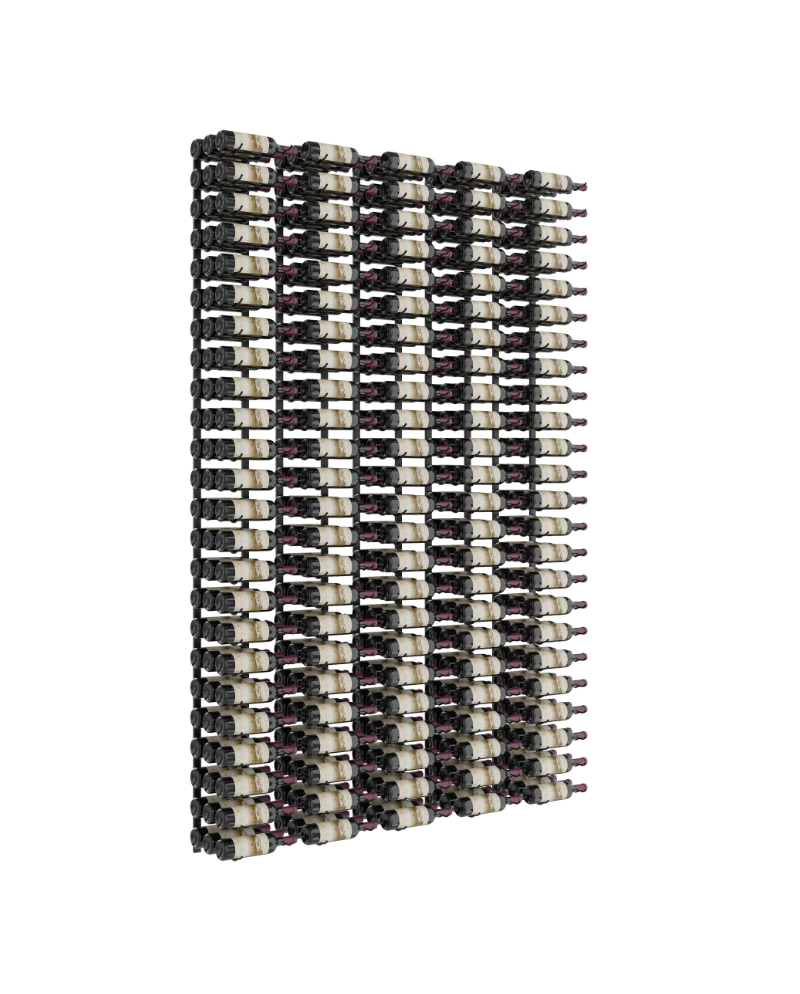 Matte Black Modular Wine Wall - WS7
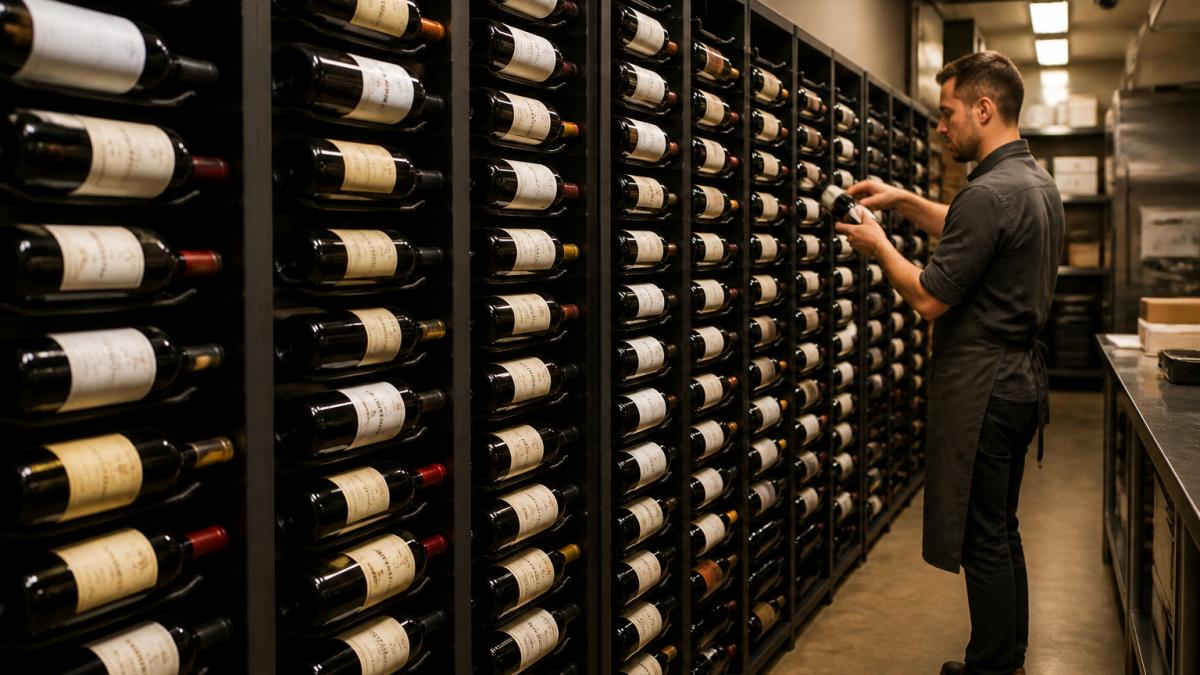 A restaurant back-of-house wall lined with tall matte black steel wine racks holding hundreds of bottles, staff member in apron restocking a row, warm overhead lighting
Modular Wine Storage Racks That Expand With Your Collection
Modular wine storage racks solve the problem that kills most storage plans: growth. A fixed rack is a commitment to one capacity forever.
 Matte Black Modular Wine Wall - WS8
This is where a lot of buyers get burned. They buy a system sized for today, then discover the manufacturer has discontinued the line or changed the finish two years later.
The fix is to buy into a system built on standard, repeatable elements.
Restaurant Wine Racks: Matching Capacity to Service Flow
Restaurant wine racks have to do two jobs at once: store the cellar and support service.
A working restaurant layout usually splits into three zones. The main display holds the wines guests see and order from, positioned where diners or staff pass it.
Capacity planning follows the menu. A wine list of 80 labels with two bottles of each needs 160 slots before you count backups.
The Floor-to-Ceiling Post Kit earns its place here.
Retail Wine Display Racks: Label-Forward Layouts That Sell
Retail wine display racks are merchandising tools first and storage second.
Label-forward display is the format that works. Bottles sit with their labels facing out, so shoppers scan vintages the way they scan a bookshelf.
Matte Black Modular Wine Wall - WS8 →
Our Waterfall Display Rack was built for exactly this.
A practical rule for retail: keep the best-margin and highest-turnover wines at eye level, and reserve the top and bottom rows for slower stock.
Planning Bottle Capacity, Dimensions, and Room Layout
Capacity planning is where most storage projects go wrong, and it is the cheapest problem to fix on paper. Measure the wall, count the bottles, check the load, and plan the workflow before you order anything.
Step 1: Count the real number, then add headroom
Count every bottle you own or stock, not the tidy version. Then add the growth you expect over the next two years. For a collector moving from 500 to 1,000 bottles, plan for 1,200. For a restaurant, plan around the fullest week of the year, not an average Tuesday. A storage system that fills up in month one is already failing.
Step 2: Match capacity to dimensions and sightlines
A high-density wall kit packs more bottles into the same height, while a floor-to-ceiling column trades width for vertical reach. Note the height of each kit: the WS6 stands 184 cm, the WS7 214 cm, and the WS8 244 cm. Check those against your ceiling, your sightlines, and anything mounted above. In retail, the top and bottom rows are the hardest to browse; in restaurants, the top rows may need a step or ladder, which affects service flow.
Step 3: Plan the operational workflow
Storage layout should follow the path a bottle takes from delivery to table or till. A working commercial layout usually splits into three zones:
- Display zone, the wines guests see and order from, positioned where diners or staff pass it.
- Depth stock, back storage for slower movers and backups.
- Active rotation, a small service-adjacent section holding the bottles in play for the evening.
Leave aisle clearance for staff carrying cases and for customers browsing. A display that forces staff to sidestep or reach across a walkway will get damaged, and a retail floor that crowds shoppers will lose sales.
Step 4: Confirm the load and the anchoring
This is the step most plans skip. A full 360-bottle wall carries a serious load, and that load has to reach structure, not plasterboard. Confirm the wall construction and fixing points before installation day. For freestanding columns and bins, confirm tip-over resistance: a tall column should be anchored to the floor or structure. When in doubt, have a qualified installer or structural professional confirm the fixing method.
Step 5: Control the environment
Wine ages best in stable, cool, dark conditions. A storage wall placed against a sunny window or a heat source works against that. Cork moisture and seal integrity depend on steady conditions, so keep the display away from direct sun and temperature swings. Racks alone are sufficient for short-term display and service stock; long-term aging of valuable bottles needs temperature, humidity, light, and vibration control, which means a cellar or cabinet system, not just a rack.
Which Durable Commercial Wine Storage System Fits Your Venue?
The right system depends on what the space has to do. Use this as a starting point, then size the capacity against your own count.
- Fine dining restaurant: WS7 or WS8 wall for density, plus a Floor-to-Ceiling Post Kit as a room divider.
- Boutique retail or tasting room: Waterfall Display Rack for label-forward merchandising, backed by a 7-piece kit for volume.
- Serious private cellar: WS8 for maximum capacity on one wall, or the Deluxe 15-piece kit if you collect magnums.
- Small bar or compact space: Freestanding Bin 3 for 48 bottles, sized to sit below a wall rack or counter.
A common mistake is choosing on looks alone and discovering the capacity is wrong three months in. Start with the bottle count, then pick the format that fits the room, then choose the finish. Matte black is the finish across our range because it reads as premium in photographs and in person, and it holds up to daily cleaning.
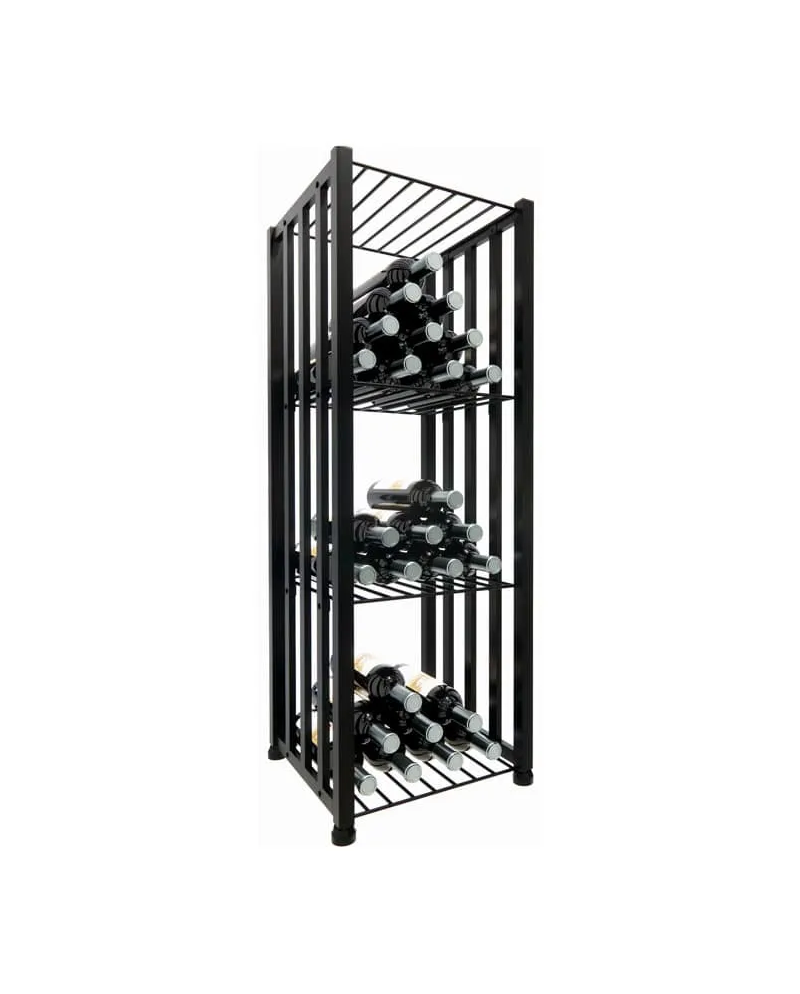 Freestanding wine bottle storage for 48 bottles
Frequently Asked Questions
What makes a wine storage system suitable for commercial use?
Commercial settings demand more than home racks can offer. Look for heavy-duty steel construction, high bottle capacity per square metre, and systems rated for constant daily access by staff and customers. Modular commercial wine storage also matters: a system built from repeatable rack elements can be expanded or reconfigured as your list grows. Finishes should hold up to cleaning and handling, and layouts should keep labels visible so staff can find bottles quickly during service. Durability under repeated use is the deciding factor.
Are modular wine storage racks suitable for retail displays?
Yes. Modular wine storage racks suit retail well because they let you build label-forward displays that customers can browse without staff help. You can start with a compact kit and add rack elements as inventory grows, rather than replacing the whole system. Kits like the 7-piece set holding 144 bottles work for boutique spaces, while larger walls scale to 360 bottles. The key is choosing a system where individual components can be added or rearranged without rebuilding the entire wall.
How should a commercial wine display be organized?
Organize by how customers and staff actually shop or serve. For retail, group by varietal, region, or price band so browsing feels logical. For restaurants, place by-the-glass bottles closest to service stations and reserve high shelves for aging stock. Label-forward display racks make every bottle readable at a glance, which speeds up service and helps retail customers find what they want. Keep magnum or oversized bottles on dedicated racks so standard slots stay uniform.
What should you consider when planning a wine room for a restaurant?
Start with bottle count and growth: a 270 to 360-bottle wall covers most mid-size lists, but plan for expansion. Consider access routes, since staff need to reach bottles during busy service without disrupting diners. Floor-to-ceiling post kits work as room dividers in open-plan spaces, while wall-mounted systems suit tighter back-of-house areas. Also plan for how the room will be organized, lit, and maintained, and confirm the wall or floor can carry the loaded weight before installation.
What features make wine racking systems easy to expand?
Expansion comes down to modularity. Systems built from standard rack elements, like the W33 and W43 racks used across these kits, let you add capacity in defined increments instead of starting over. Choose a kit with a consistent finish and mounting standard so new sections match the original installation. Kits ranging from 63 to 360 bottles share the same design language, which means a small starter wall can grow into a full wine room over time without visual mismatch.
Choosing storage for a working venue means balancing capacity, durability, and design against a space that has to perform every day. At VintageView, we build modular steel systems that grow with your collection, from the 360-bottle WS8 wall to the freestanding Bin 3, all in a matte black powder-coated finish designed to look as good in year ten as it did on day one. Get started with VintageView and turn your storage into a display worth showing off.