
Table of Contents
- Understanding Scalable Wine Storage Solutions
- Wine Rack Capacity Planning: Forecasting Your Collection Growth
- Wine Storage for Small Spaces: Maximizing What You Have
- Wine Collection Organization: Building a System That Scales
- Wine Room Design: Creating Your Ideal Display
- Selecting Modular Racks That Expand With Your Collection
- Installation, Durability, and Long-Term Value
- Frequently Asked Questions
Last Updated: October 5, 2026
Understanding Scalable Wine Storage Solutions
Scalable wine storage solutions grow alongside your collection without a complete overhaul. At Winerack Solutions, we focus on modular designs that add capacity incrementally, transforming any space into a sophisticated display while staying flexible for future expansion.
The best scalable wine storage combines three elements: modular architecture that connects seamlessly, enough initial capacity to absorb growth, and reconfigurable layouts.
Most collectors choose storage based on today's collection size, not tomorrow's, leading to constant upgrades, wasted money, and scrambling for space. A truly scalable system anticipates growth.
Wine Rack Capacity Planning: Forecasting Your Collection Growth
The foundation of any scalable wine storage strategy is honest capacity planning. Before buying, know three numbers: how many bottles you have now, how many you'll realistically have in three to five years, and the buffer between them.
Calculating Current and Projected Bottle Capacity
Start with an accurate count of your current collection, many collectors underestimate by 20 percent or more.
Next, estimate your annual acquisition rate.
Multiply your annual rate by your planning horizon: 30 bottles per year over five years is 150 additional bottles. Add this to your current count for your projected collection size.
Your actual collection will likely grow faster than you predict, new regions, auction opportunities, unexpected gifts. Build in a buffer for these surprises.
The 30-50% Capacity Buffer Rule
Never fill your storage system to maximum capacity. The industry standard is 30 to 50 percent empty space at all times, preventing constant reorganization and leaving room to add bottles without disruption.
Here's the math:
- Current collection: 200 bottles
- Projected growth (5 years at 30 bottles/year): 150 bottles
- Total needed: 350 bottles
- Add 40% buffer: 490 bottles total capacity
This means you should choose a system that holds around 500 bottles, not one that holds exactly 350. That buffer space is your insurance against constant reconfiguration.
Many collectors resist this rule, seeing empty space as wasted investment. The opposite is true: empty space is flexibility, the difference between a system you'll outgrow and one you'll keep for a decade.
Wine Storage for Small Spaces: Maximizing What You Have
Not every collector has a dedicated wine room. Many work with constraints: apartments with limited wall space, multi-purpose kitchens, or oddly-shaped rooms that don't fit standard furniture.
Scalable storage in small spaces requires creative thinking about vertical space and unconventional placements, maximizing bottle capacity without making the space feel cramped.
Under-Stairs Storage and Unconventional Layouts
Unused space under a staircase is one of the most underutilized storage opportunities in residential design. The triangular shape and sloped ceiling seem awkward but are ideal for wine storage.
VintageView's modular under-stairs systems are engineered specifically for this space. The Matte Black Modular Wine Display Under The Stairs 1-deep holds 30 bottles in a single-bottle-deep configuration, while the 2-deep version holds 60 bottles.
 Matte Black Modular Wine Wall - WS6
The key advantage: under-stairs storage doesn't compete with other furniture. It transforms dead space into functional display, which alone can solve storage problems for years in small apartments or homes without cellars.
Other unconventional spaces worth considering:
- Hallway walls with adequate climate control
- Corners of dining rooms or kitchens
- Alcoves or recessed areas in living spaces
- The space above kitchen cabinetry (if climate-controlled)
The rule is simple: if the space stays between 45 and 65 degrees Fahrenheit and away from direct sunlight, it can work for wine storage.
Freestanding and Countertop Options
When wall mounting isn't possible, freestanding storage offers flexibility without permanent installation, ideal for kitchens, dining rooms, or temporary setups.
VintageView's Freestanding wine bottle storage for 48 bottles is compact at just 3.5 feet in height, making it ideal for placement below wall-mounted racks or in kitchen configurations where vertical space is limited.
Freestanding systems offer distinct advantages for small spaces:
- No drilling or wall damage
- Easy to move or reconfigure
- Can combine with wall-mounted systems for hybrid storage
- Works in rentals where permanent installation isn't allowed
The trade-off is capacity per square foot: freestanding units use more floor space than wall-mounted alternatives. For collectors in tight quarters, flexibility often outweighs the space cost.
Wine Collection Organization: Building a System That Scales
Storage capacity means nothing if you can't find the bottle you want. Scalable wine storage requires an organization system that grows with your collection and adapts as your tastes evolve.
Organizing by Type, Region, and Drinking Window
There's no universally correct method. Your organization should match how you actually think about and access your wine.
Type-based organization works well if you drink across regions, grab a red or white without scanning your entire collection.
Region-based organization appeals to enthusiasts who study specific areas deeply, you know exactly where your Bordeaux sits, separate from your Burgundy.
Many serious collectors use hybrid systems: organize by region, then separate bottles within each region by drinking window.
Tracking and Inventory Management
As your collection grows beyond 200 bottles, memory alone fails: you forget what you have, duplicates happen, and bottles age past their prime unopened.
Simple tracking doesn't require expensive software. A spreadsheet works fine: bottle name, vintage, quantity, location, purchase date, and drinking window.
Tracking forces you to know your collection: you see buying patterns, notice gaps, and catch bottles approaching their optimal drinking window before they fade.
For collectors with 500+ bottles, dedicated wine inventory apps add tasting notes, price tracking, and photo documentation. The investment pays off in a more intentional, better-organized collection.
Wine Room Design: Creating Your Ideal Display
A true wine room transforms storage into architecture, the difference between bottles hidden away and a collection displayed as an interior design feature.
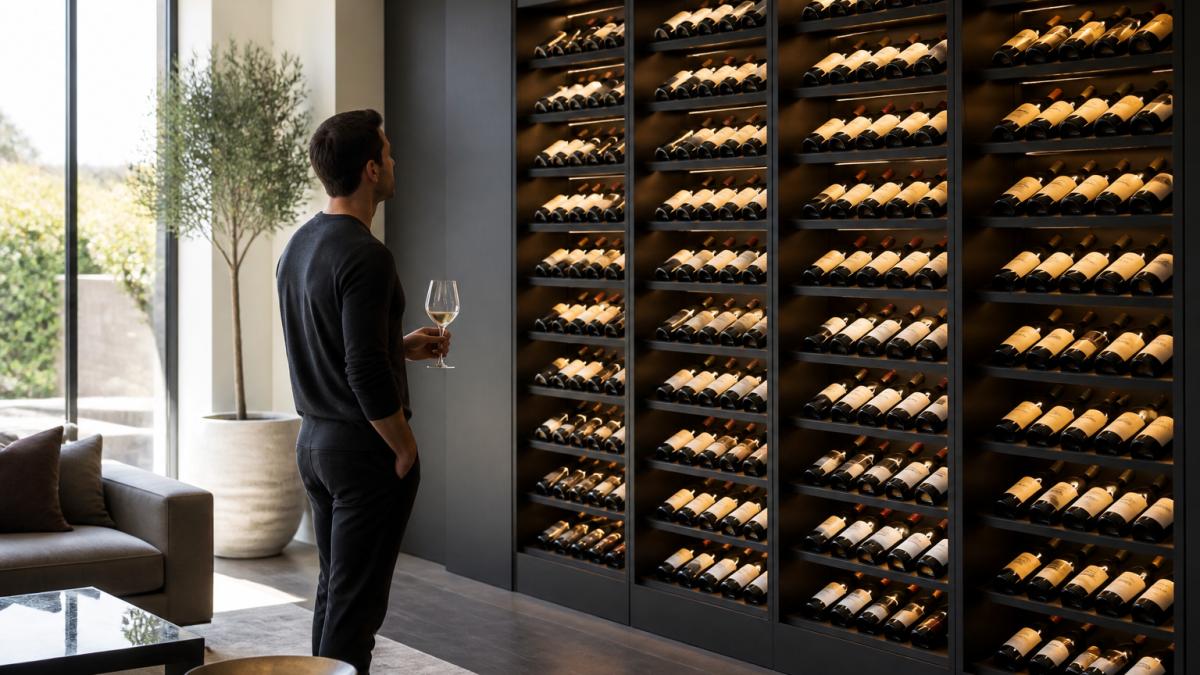 Modern living room with sleek matte black modular wine wall displaying bottles with warm accent lighting, integrated into sophisticated interior design with comfortable seating nearby
Choosing Between Modular Wall Systems and Freestanding Storage
Modular wall systems offer the highest capacity per square foot and the most dramatic visual impact, transforming blank walls into stunning focal points.
VintageView's modular wall systems range from the Matte Black Modular Wine Wall WS6 (270 bottles across 184 cm height) to the WS8 (360 bottles across 244 cm height).
Matte Black Modular Wine Wall - WS6 →
The Matte Black Modular Wine Display Rack Waterfall offers a different aesthetic. With nine specialized display racks, it holds 81 bottles in a cascading, artistic arrangement.
For spaces with height limitations or smaller collections, the Matte Black Modular Wine Rack Display Kit (7-Piece Set) holds 144 bottles and adapts to various wall configurations. The Deluxe version (15-Piece Set) accommodates 288 standard bottles plus 32 magnum bottles, offering capacity for serious collectors in compact footprints.
 Matte Black Modular Wine Rack Display kit Deluxe (15-Piece Set)
The choice depends on your space, collection size, and aesthetic.
Environmental Conditions: Temperature, Humidity, Light, and Vibration
Storage capacity and display aesthetics matter only if the bottles inside are preserved.
Temperature is most critical.
Humidity should stay between 50 and 80 percent. Too dry and corks dry out, allowing oxidation; too humid and labels deteriorate.
Light degrades wine rapidly, ultraviolet light breaks down the compounds that give wine flavor and color.
Vibration from appliances, traffic, or music systems disrupts sediment and accelerates aging. Position storage away from washing machines, speakers, or high-traffic areas.
Most homes can provide adequate conditions: basements stay cool and dark, and interior walls away from windows work well.
Selecting Modular Racks That Expand With Your Collection
True scalability means your system grows without forcing replacement. Modular racks connect together, letting you add capacity as your collection expands.
Stackable and Reconfigurable Systems
VintageView's modular systems use connecting pins and architectural engineering to create expandable configurations, start with a base system and add racks as needed.
The W33 and W43 rack profiles anchor most expandable configurations. They stack vertically and connect horizontally, creating walls of any height or width your space allows, you're not locked into a final size.
Reconfiguration is equally important: as your organization or space changes, modular racks adapt. Rearrange sections, change heights, or redistribute bottles without replacing the entire system.
For serious collectors planning major expansion, the floor-to-ceiling approach works beautifully. VintageView's Matte Black Modular Floor-to-Ceiling Wine Rack Kit uses a heavy-duty Carrier post and Backer support system, holding 63 bottles in a dramatic floating column.
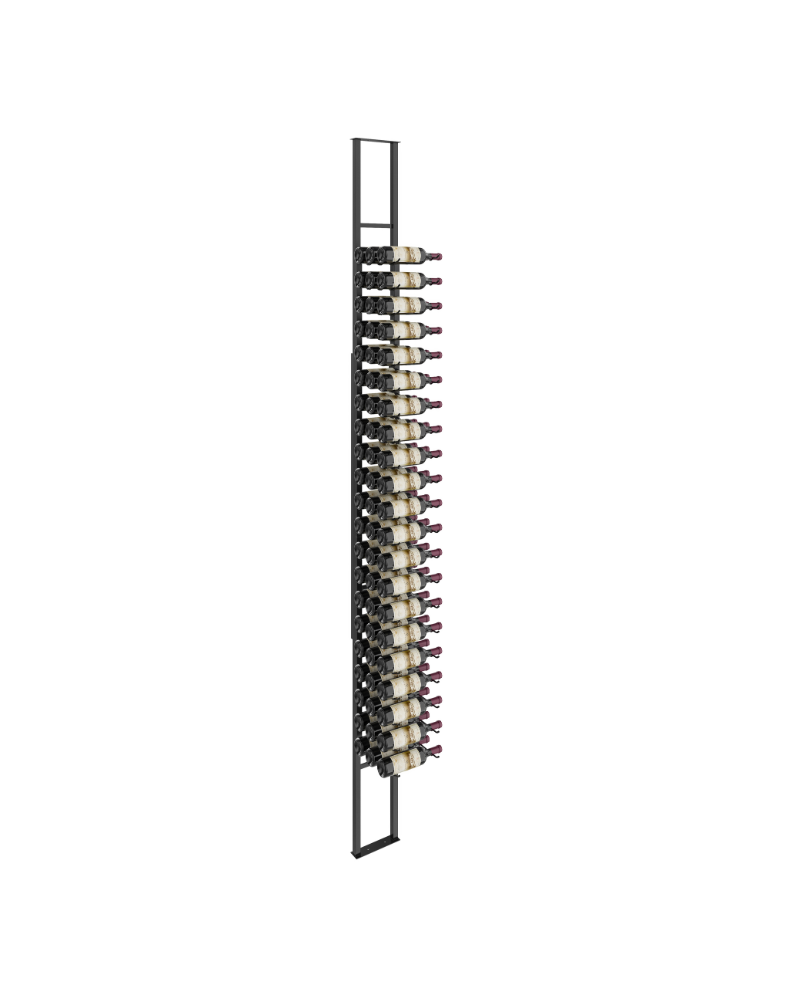 Matte Black Modular Floor-to-Ceiling Wine Rack Kit
Real-World Capacity Limits and Bottle Formats
Not all bottles are the same size. Standard 750ml bottles fit most racks, but magnums (1.5L), half-bottles (375ml), and large formats require specialized accommodation.
VintageView's Matte Black Modular Wine Rack Display Kit Deluxe specifically addresses this with dedicated magnum storage.
When planning capacity, account for your actual bottle mix. Standard racks suit primarily 750ml collections; significant magnum or large-format holdings need systems with dedicated spaces.
Capacity also depends on bottle shape: Burgundy bottles are wider at the shoulders than Bordeaux, and Champagne bottles are heavier and need stronger support.
Installation, Durability, and Long-Term Value
A scalable storage system is only valuable if it survives years of use and adapts to your needs. Installation quality and material durability determine whether it becomes a permanent fixture or a frustrating limitation.
Structural and Weight Considerations
Wine is heavy. A single bottle weighs approximately 1.5 pounds. A fully loaded 360-bottle wall system weighs over 500 pounds. Your walls must support this weight securely.
Before installation, verify wall construction. Drywall alone cannot support a loaded wine wall, anchor into studs or use heavy-duty wall anchors rated for the system's weight.
The systems themselves must be engineered for this weight.
Installation also affects future reconfiguration. A system bolted permanently into studs is hard to move or expand. The best modular systems are secure and permanent but not so rigid that future adjustments are impossible.
Flexibility and Reconfiguration
The mark of true scalability is reconfiguring without starting over. As your collection grows, your organization preferences, space, and display aesthetic may all shift.
VintageView's modular systems excel here: the connecting pin architecture lets you add racks, rearrange sections, or modify heights without replacing the installation.
The best systems balance permanence with flexibility, secure enough to hold 500 pounds of wine safely, modular enough to adapt as your needs evolve.
Building scalable wine storage for a growing collection requires planning, realistic capacity forecasting, and systems engineered for expansion. VintageView's modular wine racks, from compact under-stairs solutions to dramatic floor-to-ceiling displays, combine functional storage with design sophistication.
Wine storage best practices from the International Sommelier Association
Home climate control guidelines for wine preservation
Interior design principles for wine room layouts
Frequently Asked Questions
How do I calculate the right scalable wine storage capacity for my collection?
Start by counting your current bottles, then estimate annual additions based on your purchasing habits. Multiply your current collection by 1.3 to 1.5 to account for a 30-50% growth buffer, this prevents outgrowing your storage within 2-3 years. For example, a 100-bottle collection should accommodate 130-150 bottles. Modular wine storage systems let you add capacity incrementally as your collection expands, so you're not locked into a fixed size from day one.
What's the best wine rack capacity planning approach for a growing collection?
Use a phased expansion strategy: start with a system that holds 30-50% more than your current collection, then add modular units as you reach 80-85% capacity. This approach avoids both wasted space and the frustration of running out of room. Track your collection in a simple spreadsheet or app so you know exactly when to expand. Modular systems with connecting pins and stackable racks make this scaling seamless without redesigning your entire setup.
Can modular wine storage work in oddly-shaped spaces like under stairs or narrow alcoves?
Yes. Modular systems are designed for flexible layouts, including triangular and narrow spaces. Under-stairs storage is particularly popular because it transforms wasted architectural space into a functional display. Options like 1-deep and 2-deep under-stairs configurations fit different stair slopes and depths. For truly unusual shapes, modular racks can be adapted to follow the contours of your space, just measure carefully and plan your layout before ordering.
What environmental conditions matter most for scalable wine storage?
Temperature stability (45-65°F), humidity (50-80%), darkness, and minimal vibration are critical. Consistent temperature prevents cork expansion and contraction, while humidity protects labels and cork integrity. UV light degrades wine, so avoid direct sunlight. Vibration from foot traffic or appliances can disturb sediment. When planning your wine room design, choose a location away from kitchens, HVAC vents, and high-traffic areas. Insulation and blackout coverings help maintain ideal conditions as your collection grows.