
Table of Contents
- Why Modern Wine Display Matters in Retail
- Label-Forward Wall Displays: The 81-Bottle Centerpiece
- High-Capacity Wine Display Layout for Large Retail Spaces
- Modular Wine Racks for Retail: Flexible and Scalable Storage
- Wine Shop Display Ideas: Small-Space Solutions
- Commercial Wine Storage: Durability and Performance Standards
- Floor-to-Ceiling and Freestanding Options for Retail Environments
- Selecting the Right Modern Wine Display for Your Retail Space
- Frequently Asked Questions
Last Updated: October 9, 2026
Why Modern Wine Display Matters in Retail
A modern wine display for retail stores does more than organize inventory.
 Matte Black Modular Wine Display Rack Waterfall
Retail wine environments that prioritize visual merchandising see customers engage more deliberately.
At VintageView, we've worked with wine retailers, restaurants, and hospitality businesses to understand what drives purchasing behavior: customers buy what they can see, understand, and trust.
This guide covers seven proven display strategies for spaces from small wine shops to grocery wine departments and fine dining establishments, each addressing real retail constraints: floor space, wall capacity, customer flow, and inventory turnover.
Label-Forward Wall Displays: The 81-Bottle Centerpiece
The Matte Black Modular Wine Display Rack Waterfall holds up to 81 bottles in a cascading arrangement that draws attention from across the store.
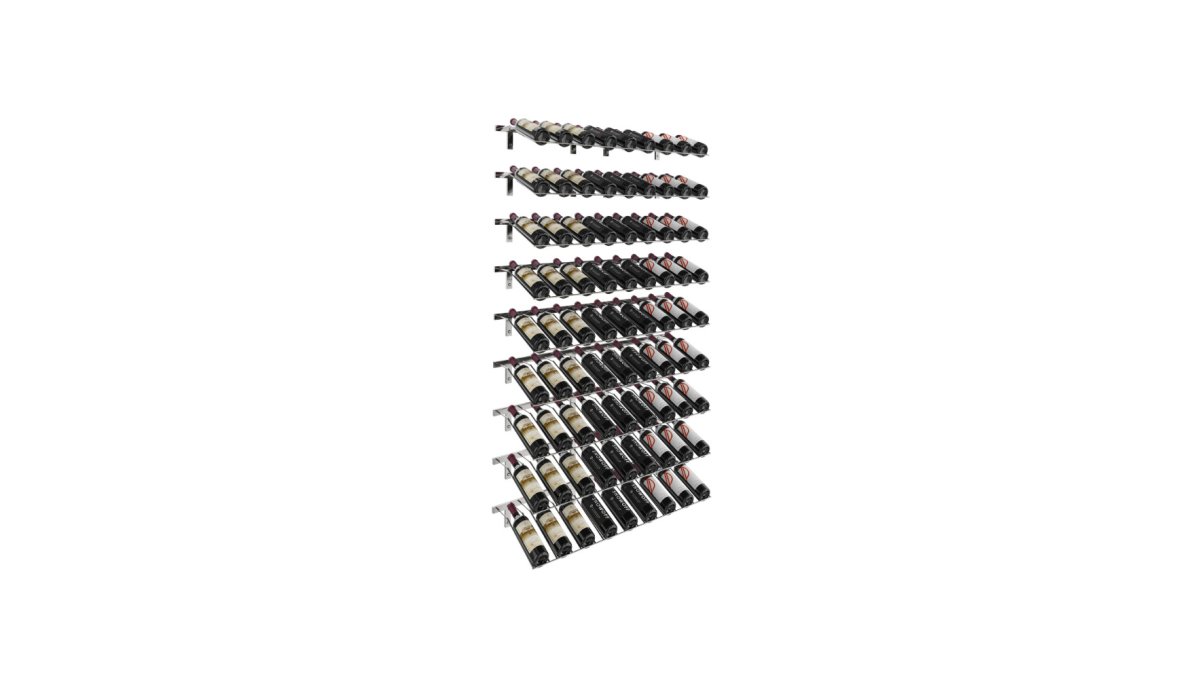 Matte Black Modular Wine Display Rack Waterfall
This configuration works best as a focal point near the store entrance or at the end of an aisle, letting customers browse without reaching or searching.
For retail spaces with limited floor footprint, wall-mounted displays maximize vertical space, a single wall can hold dozens of bottles without consuming open floor area.
Retailers using label-forward displays report that customers spend more time examining options and asking staff questions.
High-Capacity Wine Display Layout for Large Retail Spaces
Large retail environments, wine shops with dedicated sections, grocery wine departments, restaurant wine rooms, need systems that hold serious volume without looking cluttered.
The Matte Black Modular Wine Wall - WS8 holds 360 bottles across a single architectural wall. The WS7 holds 315 bottles, and the WS6 holds 270 bottles.
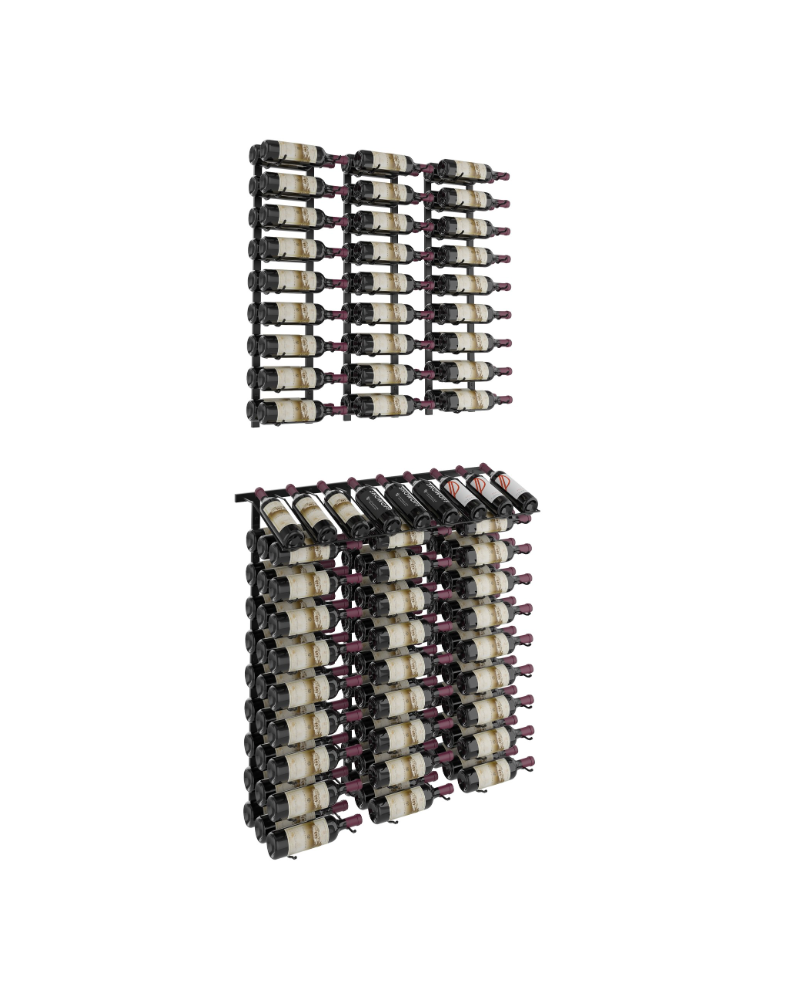 Matte Black Modular Wine Rack Display Kit (7-Piece Set)
These high-capacity systems work because they organize volume into readable sections. A wall of 360 bottles looks intentional and curated when arranged by region, price tier, or varietal.
For restaurants with extensive wine programs, these systems support both the wine list and customer browsing.
Large retail spaces benefit from modular architecture that adapts as inventory changes.
Modular Wine Racks for Retail: Flexible and Scalable Storage
Retail spaces change. Inventory rotates. Seasonal selections come and go. A rigid display system becomes a liability when you need to pivot quickly.
Modular wine racks solve this problem. The Matte Black Modular Wine Rack Display Kit (7-Piece Set) holds 144 bottles and can be arranged in multiple configurations.
 Matte Black Modular Wine Display Showcase
Modularity means you're not locked into a single layout.
For interior professionals working with retail clients, modularity is essential.
The steel construction ensures durability through repeated reconfiguration. Retailers report that the ability to refresh displays without replacing infrastructure saves time and money over years of operation.
Wine Shop Display Ideas: Small-Space Solutions
Not every wine retailer has room for a 360-bottle wall. Small wine shops and boutique operations need displays that create impact in compact footprints.
The Matte Black Modular Wine Display Showcase holds 16 bottles with complete layout freedom.
Small spaces benefit from displays that do double duty: they store inventory and serve as design statements.
The Freestanding wine bottle storage for 48 bottles (the Bin 3) offers another approach for retailers with limited wall space.
Small retailers often compete on curation and expertise rather than selection breadth. A focused, beautifully displayed collection of 48 carefully chosen bottles outperforms a chaotic 200-bottle wall.
Commercial Wine Storage: Durability and Performance Standards
Retail and hospitality environments demand durability that residential displays don't require: bottles move frequently, staff restock multiple times daily, and systems experience constant handling. But durability alone doesn't make a display successful. The strongest retail wine displays also support measurable merchandising performance, safe operation, and efficient maintenance.
Performance metrics that matter
A modern wine display should be evaluated against the same retail metrics as any other merchandising fixture, sales per square foot, inventory turnover, conversion rate, and average transaction value. A display occupying premium wall or floor space should earn its footprint.
Label-forward, eye-level displays typically produce higher engagement than spine-out or floor-level storage, showing up as longer dwell time, more staff questions, and more deliberate bottle selection.
Inventory turnover is another useful check. If a high-capacity wall holds slow-moving inventory for months, it may be functioning as storage rather than display. Reserve the most visible positions for fast-turning or high-margin bottles and rotate slower inventory through secondary positions.
Safety, load, and accessibility
Commercial displays carry significant load. A 360-bottle wall supports hundreds of pounds distributed across mounting points and must remain stable as inventory sells down and restocks unevenly. Anchoring, load limits, and even weight distribution are not optional in public retail spaces.
Accessibility affects both safety and sales. Bottles above comfortable reach or below knee level are harder for customers to inspect and staff to restock safely. Keep best-selling and premium bottles in the primary reach zone, use upper positions for backstock or slower movers, and keep aisle clearance wide enough for two customers to pass and browse.
Matte Black Modular Wine Display Rack Waterfall →
Always confirm that wall-mounted or floor-to-ceiling systems are anchored according to the manufacturer's load specifications and that local accessibility and safety requirements for public retail spaces are met. A display that looks impressive but fails a load or clearance check is a liability.
Lighting, signage, and wayfinding
Lighting and signage work with the rack system to improve visibility and shopping ease. Warm, focused lighting highlights label color and bottle shape, but prolonged direct light and heat can damage wine over time, light the display for presentation while keeping bottles out of harsh direct sun and away from heat sources.
Signage and wayfinding turn a wall of bottles into a navigable category. Price tags, varietal markers, region cards, and shelf-edge labels help customers understand the selection without staff assistance. A display organized by region, price tier, or style is easier to browse and restock than one arranged by bottle size or color.
Maintenance and total cost of ownership
The initial fixture is only part of the cost of a commercial display. Powder-coated matte black finishes resist fingerprints and dust better than glossy finishes, and modular steel systems let staff clean around bottles without disassembling entire sections.
A display that is difficult to clean or reconfigure becomes a hidden cost.
For restaurants, the display itself is part of the customer experience. A well-maintained wine wall signals quality and professionalism; a dusty, poorly organized display undermines the dining experience regardless of the wine quality inside.
Floor-to-Ceiling and Freestanding Options for Retail Environments
Some retail spaces can't accommodate wall mounting. Others benefit from displays that create architectural features independent of existing walls.
The Matte Black Modular Floor-to-Ceiling Wine Rack Kit holds 63 bottles and uses a heavy-duty Carrier post system that requires no wall mounting.
Floor-to-ceiling displays work well in open-concept retail environments where walls are limited or where you want visual separation between departments.
The Bin 3 freestanding unit offers flexibility for retailers who reconfigure layouts seasonally or rent rather than own their space.
Freestanding options also work well for pop-up retail, temporary installations, or retailers testing new store layouts, a modular, movable system pays dividends when flexibility matters more than permanent infrastructure.
Selecting the Right Modern Wine Display for Your Retail Space
Choosing the right display system requires honest assessment of your space, inventory, and customer behavior. A useful approach is a short decision framework connecting fixture type to store size, bottle mix, merchandising goals, and operational constraints.
Step 1: Define the merchandising goal
Start with what the display is supposed to do. Is it a focal point drawing customers in, a high-capacity wall organizing a broad selection, a compact curated feature for premium bottles, or a flexible system that changes with seasonal inventory? Different goals point to different fixture types.
- Focal point: label-forward wall display or floor-to-ceiling column
- Broad selection: high-capacity modular wall system
- Curated premium: small-space showcase or freestanding unit
- Flexible or temporary: modular kits and freestanding options
Step 2: Match fixture type to store size and layout
Store size and layout narrow the options quickly. Small shops and boutique retailers often get more impact from a compact, well-lit feature than a large wall that looks empty. Large retail environments and grocery wine departments usually need high-capacity walls organized by region, price, or varietal, while open-concept spaces with limited walls may benefit from floor-to-ceiling columns that double as room dividers.
Measure available wall area, ceiling height, and floor footprint before committing. Note architectural constraints such as windows, doors, uneven walls, and traffic paths. A display that blocks customer flow or staff restocking routes creates friction no matter how good it looks.
Step 3: Account for bottle mix and capacity
Capacity should reflect the bottle mix you actually stock, not just the maximum a system can hold. Standard 750ml bottles, magnums, and specialty formats may need different rack configurations, if you carry large-format bottles, confirm the system supports them without compromising stability or presentation.
Plan for your typical inventory plus a modest growth margin. A system that is too small creates frustration; one that is oversized looks empty and unprofessional. Modular systems let you start smaller and expand as inventory grows.
Step 4: Evaluate installation, safety, and compliance
Installation requirements vary by fixture type. Wall-mounted systems need suitable wall structure and anchoring; floor-to-ceiling systems need stable floor contact and proper tensioning; freestanding units need a level surface and clearance for safe movement.
Check safety and compliance early. Reach ranges, aisle clearance, load limits, and anchoring requirements all affect where a display can go and how it can be used, and local accessibility and safety requirements may apply in public retail spaces. Confirming these details before purchase avoids costly changes later.
Step 5: Plan lighting, signage, and wayfinding
Lighting and signage are part of the display decision, not an afterthought. Focused lighting improves label visibility and bottle presentation, while signage and category markers help customers navigate the selection. A display organized by region, price tier, or style is easier to browse and restock.
Keep in mind that light and heat exposure can affect wine over time, present bottles attractively while avoiding harsh direct sun and proximity to heat sources.
Step 6: Compare total cost of ownership
Beyond the initial fixture, consider cleaning, reconfiguration, replacement parts, and staff time. Powder-coated steel systems resist fingerprints and dust, and modular designs allow sections to be refreshed or expanded without replacing the entire infrastructure. Over years of operation, durability and flexibility often matter more than the initial purchase.
| Display Type | Bottle Capacity | Best For | Space Requirements |
|---|---|---|---|
| Label-Forward Wall (81-Bottle) | 81 | Boutique shops, focal points | Single wall section |
| High-Capacity Wall (270-360 bottles) | 270-360 | Large retail, restaurants | Full wall or multiple sections |
| Modular Kits (144-288 bottles) | 144-288 | Flexible retail layouts | Adaptable wall space |
| Small-Space Display (16 bottles) | 16 | Curated selections, design features | Compact wall or shelf |
| Freestanding Unit (48 bottles) | 48 | No-mount installations, movable displays | Floor footprint only |
| Floor-to-Ceiling Column (63 bottles) | 63 | Open layouts, room dividers | Floor-to-ceiling space |
The best display for your retail space is the one that matches your merchandising goal, fits your layout and bottle mix, meets safety and accessibility requirements, and can be maintained and reconfigured over time. Capacity and appearance matter, but they are only part of the decision.
Frequently Asked Questions
What makes a modern wine display effective in a retail store?
An effective modern wine display prioritizes label visibility, allowing customers to browse bottles easily. Steel construction ensures durability under retail conditions, while modular systems adapt to changing inventory and space constraints. Eye-level presentation increases sales per square foot, and organized layout reduces customer confusion. Quality finishes like matte black create a premium aesthetic that justifies higher price points and builds brand trust.
How should retailers organize a wine display layout to maximize sales?
Organize by price point or region at eye level where customers spend most time looking. Use vertical space efficiently with floor-to-ceiling systems or stacked configurations to display more bottles in smaller footprints. Group complementary wines together and ensure aisles are wide enough for comfortable browsing. Label-forward presentation lets customers identify bottles instantly, reducing decision time and increasing conversion rates in busy retail environments.
Can modular wine racks for retail adapt to odd-shaped spaces?
Yes, modular systems are designed for flexibility. Individual components can be arranged in grids, cascades, or custom patterns to fit triangular alcoves, narrow corridors, or spaces under stairs. Single-bottle racks offer complete layout freedom, allowing you to work around structural obstacles. This adaptability means retailers don't need to compromise on storage capacity or aesthetic quality, even in unconventional retail layouts.
What should restaurants and wine bars consider for commercial wine storage?
Commercial spaces need heavy-duty steel construction that withstands high-traffic environments and frequent restocking. Capacity matters: floor-to-ceiling systems and high-density walls maximize inventory in limited square footage. Durability and security are essential in hospitality settings where bottles are handled constantly. Label-forward display helps staff locate wines quickly during service, improving customer experience and reducing order fulfillment time.
Ready to transform your retail wine display? VintageView's modular systems fit any space and scale with your business. Shop Now!